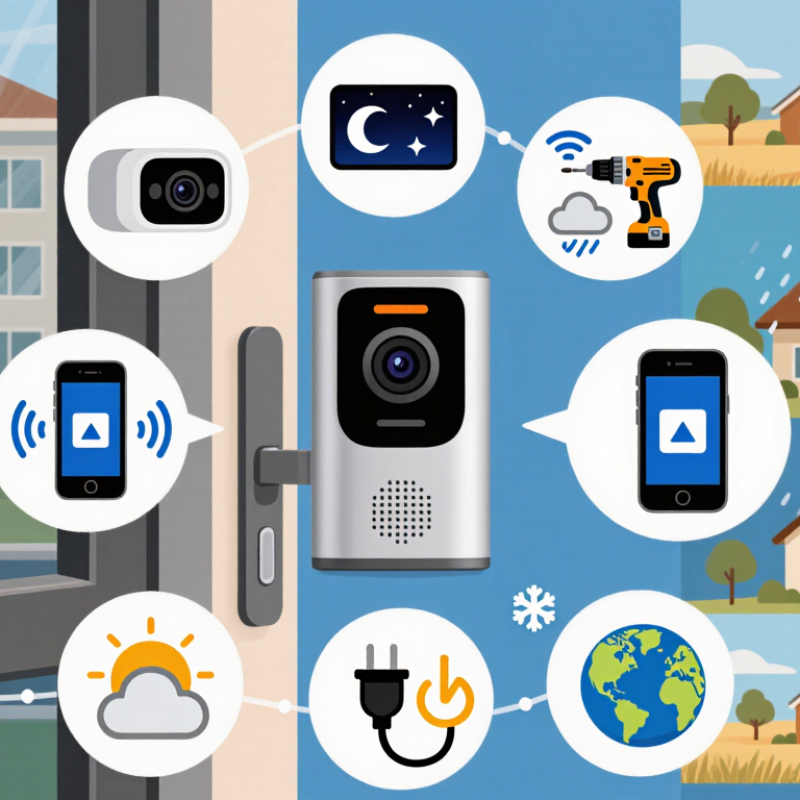
| 1 | Existing Doorbell Voltage | Many wired residential doorbell systems use low-voltage alternating current, commonly 16–24 VAC at 50 or 60 Hz. | Select a doorbell that explicitly supports the measured voltage range, such as 16–24 VAC. | Measure the two doorbell wires with a multimeter before installation. Do not connect a low-voltage device directly to mains electricity. |
| 2 | Transformer Capacity | Transformer capacity is expressed in volt-amperes (VA). A 16 VAC, 10 VA transformer can provide approximately 0.625 A under its rated conditions because VA ÷ V = A. | Check both voltage and VA rating; a voltage match alone does not confirm adequate power. | Compare the doorbell's specified operating current or VA requirement with the transformer's available capacity, including any existing chime. |
| 3 | AC or DC Compatibility | VAC and VDC are different electrical supplies. A device designed for 16–24 VAC should not automatically be treated as compatible with a 12 VDC or 24 VDC adapter. | Require the input type, voltage range, frequency, polarity, and connector details to be clearly stated. | Match the complete electrical specification, not only the number printed on the adapter. |
| 4 | Battery Energy in Wh | Battery energy is estimated by voltage × ampere-hours: Wh = V × Ah. For example, a 3.7 V, 5 Ah battery stores approximately 18.5 Wh before conversion losses. | Compare rated Wh, usable Wh, charging time, standby consumption, and temperature limits rather than comparing mAh alone. | Ask whether the stated capacity is nominal or usable and whether the figure includes battery-management-system losses. |
| 5 | Battery Runtime | Approximate runtime can be calculated as usable battery Wh ÷ average system power W. Video recording, night illumination, Wi-Fi activity, and cold weather can increase consumption. | Use a conservative estimate based on motion events and live-view frequency instead of relying only on a manufacturer's maximum runtime claim. | Request test conditions, average daily events, standby power, and the expected recharge interval. |
| 6 | Solar Input | Solar charging depends on panel power, voltage, current, orientation, shading, daylight hours, and charge-controller efficiency. A nominal 5 W panel will not deliver 5 W continuously. | Confirm supported solar voltage and current, connector polarity, minimum charging conditions, and whether direct sunlight is required. | Calculate seasonal energy yield for the installation location and keep a wired or manual-recharge backup plan where sunlight is limited. |
| 7 | Charging and Battery Safety | Rechargeable lithium batteries require protection against overcharge, over-discharge, short circuit, and excessive temperature. Charging performance is affected by ambient conditions. | Look for a documented battery-management system, safe charging limits, replaceability information, and an operating-temperature range. | Do not use an unapproved adapter or bypass the supplied charging and protection circuitry. |
| 8 | Product Safety Standard | IEC 62368-1 is an audio/video, information, and communication technology equipment safety standard based on hazard-based safety engineering principles. | Request a current test report, certificate, or declaration applicable to the exact model and intended market. | Treat a standard reference as model-specific evidence to verify, not as a substitute for installation instructions or local approval requirements. |
| 9 | Weather and Outdoor Protection | Ingress protection ratings are defined under IEC 60529. The first digit addresses solid-particle protection and the second digit addresses water protection; the actual installation still affects durability. | Choose a documented outdoor rating suitable for rain, dust, temperature, and the mounting position. | Check whether the rating applies to the complete assembled product, including cable entry, battery cover, and mounting accessories. |
| 10 | Regional Installation and Compliance | Electrical systems, radio equipment, privacy rules, and emergency-response requirements vary by country or region. Wireless operation may also depend on supported frequency bands and local approvals. | Confirm the intended market, input plug or adapter configuration, wireless regulations, language support, warranty coverage, and replacement-parts availability. | Use a qualified installer for fixed wiring and retain the product's electrical, safety, and conformity documentation. |