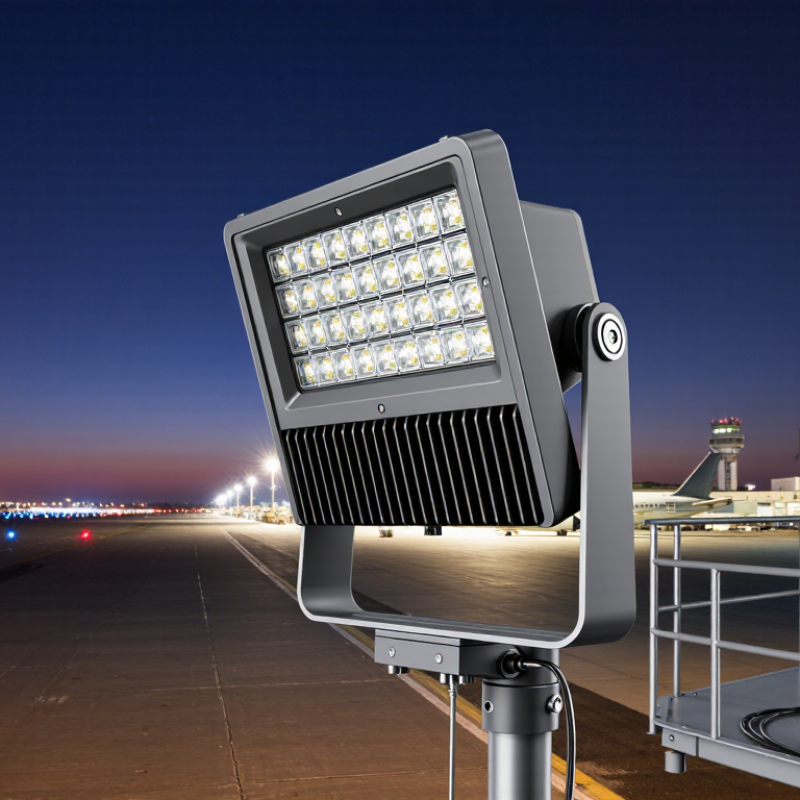
| Aircraft Apron and Stand Area | Support aircraft turnaround, ground handling, passenger boarding, fueling, baggage loading, and service operations. | 240–1,000 W per luminaire | Average 20–50 lx, with higher levels near active service points. | 25°–60° asymmetric or medium-wide beam | 4,000–5,000 K | CRI ≥ 70; CRI ≥ 80 where detailed inspection is required | IP66 minimum; IK08 or higher | Use low-glare optics, strong pole-mounting hardware, dimming, and accurate photometric files. Minimize light spill toward aircraft cockpits and nearby navigation areas. |
| Aircraft Maintenance and Hangar Forecourt | Provide uniform illumination for aircraft inspection, maintenance access, equipment movement, and night-time servicing. | 200–800 W per luminaire | Average 300–750 lx for detailed maintenance tasks; lower levels may be suitable for circulation zones. | 30°–90° depending on mounting height and façade geometry | 4,000–5,000 K | CRI ≥ 80 | IP66; IK08–IK10 in exposed areas | Select flicker-controlled LED drivers, high color consistency, low-glare shields, and corrosion-resistant housings. Confirm that the lighting does not interfere with aircraft inspection cameras. |
| Cargo Apron and Logistics Yard | Illuminate cargo loading, pallet handling, vehicle circulation, and container transfer operations. | 240–1,000 W per luminaire | Average 20–50 lx; 50 lx or more at loading and inspection points. | 30°–60° asymmetric beam | 4,000–5,000 K | CRI ≥ 70 | IP66 minimum; IK08 or higher | Prioritize uniformity, impact resistance, thermal management, and compatibility with high-mast installations. Use occupancy or scheduling controls to reduce energy consumption during low activity periods. |
| Taxiway Service Road and Airside Vehicle Route | Improve visibility for authorized service vehicles without creating glare or confusion for aircraft operators. | 80–300 W per luminaire | Average 5–15 lx, depending on traffic volume and road classification. | Asymmetric 40°–80° beam | 3,000–4,000 K | CRI ≥ 70 | IP66; IK08 | Use controlled cutoff optics, low-glare visors, and carefully aimed poles. Ordinary floodlights must not replace certified taxiway centerline, edge, stop-bar, or guidance lighting. |
| Passenger Terminal Exterior and Drop-Off Zone | Provide safe pedestrian and vehicle movement around entrances, canopies, ramps, and curbside areas. | 80–400 W per luminaire | Average 10–30 lx, with brighter zones at entrances, crossings, and ticketing access points. | 15°–45° narrow or 30°–90° wide beam | 3,000–4,000 K | CRI ≥ 80 | IP65–IP66; IK08 | Select visually comfortable optics, low flicker, anti-glare accessories, and dimming capability. Match the luminaire finish and color to the terminal architecture where required. |
| Airport Parking Structures and Open Parking Areas | Support vehicle circulation, pedestrian safety, security monitoring, and license-plate visibility. | 60–300 W per luminaire | Average 5–20 lx, based on parking layout, security needs, and local regulations. | 30°–120° depending on pole spacing | 3,000–4,000 K | CRI ≥ 70; CRI ≥ 80 near payment and pedestrian areas | IP65–IP66; IK08 | Use broad uniform distribution, photocell or time-clock control, motion dimming where practical, and optics that limit spill to adjacent roads or properties. |
| Perimeter Road and Security Fence | Support security patrols, surveillance cameras, intrusion detection, and maintenance access. | 60–240 W per luminaire | Average 5–15 lx; higher levels may be required at gates and sensitive access points. | 10°–30° long-throw or 30°–60° asymmetric beam | 3,000–4,000 K | CRI ≥ 70; CRI ≥ 80 for camera-critical locations | IP66; IK08; corrosion-resistant finish | Coordinate beam direction with CCTV fields of view. Avoid excessive backlight, use surge protection, and select stable mounting brackets for exposed locations. |
| Airport Access Road and Intersection | Improve driver visibility, pedestrian awareness, directional signage visibility, and traffic safety. | 80–300 W per luminaire | Average 10–30 lx, subject to road category and traffic volume. | 30°–90° roadway distribution | 3,000–4,000 K | CRI ≥ 70 | IP66; IK08 | Use cutoff or semi-cutoff optics, consistent pole spacing, surge protection, and dimming schedules. Verify lighting levels against the applicable road-lighting requirements in the project country. |
| Emergency Assembly and Fire Access Area | Provide dependable visibility for emergency response, evacuation, fire-service access, and assembly operations. | 100–400 W per luminaire | Average 10–30 lx, with higher levels at gates, equipment points, and emergency access routes. | 30°–90° wide beam | 4,000–5,000 K | CRI ≥ 70 | IP66; IK08 or higher | Use reliable drivers, surge protection, clear access to service components, and backup or emergency-lighting provisions where required by the local life-safety design. |
| Helicopter Parking and Maintenance Area | Support helicopter parking, ground handling, maintenance, and controlled personnel movement. | 120–500 W per luminaire | Average 20–50 lx; higher levels may be needed for maintenance work. | 25°–60° controlled beam | 4,000–5,000 K | CRI ≥ 80 for maintenance tasks | IP66; IK08 | Control glare and upward light near flight paths. Confirm pole locations, obstacle-clearance requirements, and lighting restrictions with the airport operator and applicable aviation authority. |
| Airport Construction and Temporary Work Zone | Provide temporary illumination for construction access, material handling, earthworks, and night-time works. | 100–500 W per portable or temporary luminaire | Average 20–50 lx; 50–200 lx for detailed construction tasks. | 30°–120° adjustable beam | 4,000–5,000 K | CRI ≥ 70 | IP65–IP66; IK08 | Choose portable or modular units with adjustable brackets, protected cables, stable bases, and glare control. Temporary lighting plans must be coordinated with active airside operations. |
| Airport Building Façade and Signage | Highlight architectural features, identify terminal entrances, and improve nighttime wayfinding. | 30–200 W per luminaire | Typically 5–30 lx on vertical surfaces, depending on façade material and signage requirements. | 10°–30° narrow beam or 30°–60° wall-wash beam | 3,000–4,000 K | CRI ≥ 80 | IP65–IP66; IK08 | Use precise optics, adjustable aiming, low-glare accessories, and programmable dimming. Avoid light trespass toward aircraft movement areas, control towers, and nearby residences. |