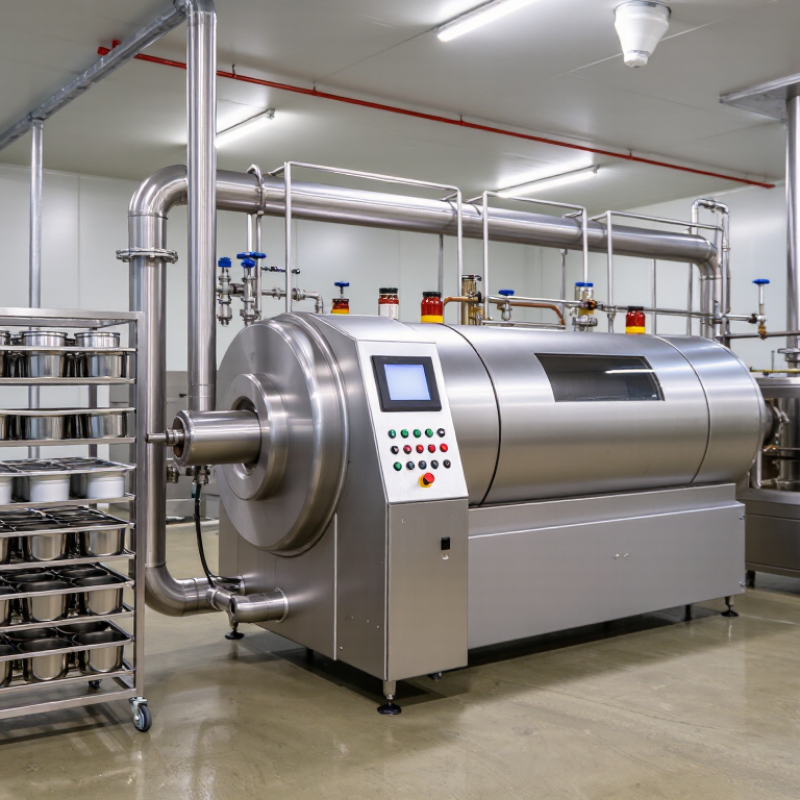
| What it is | A sealed pressure vessel that heats packaged products using recirculated hot water distributed through spray nozzles. | It combines water-spray heat transfer with controlled pressure and temperature during processing and cooling. |
| Typical applications | Thermally processed foods in cans, glass jars, retort pouches, and other heat-resistant sealed containers. | The container must be suitable for the specified temperature and pressure conditions. Product formulation and package geometry affect the process. |
| Common process temperature | Many commercial retort processes operate in the approximate range of 110–121 °C; actual schedules may differ. | The required temperature and holding time must be established for the specific product, container, and equipment. |
| Pressure control | The vessel uses controlled pressure during heating and cooling; the operating setpoint depends on the process and package. | Overpressure can help protect flexible or semi-rigid packages from swelling, distortion, or seal damage. It is not a universal fixed value. |
| Typical cycle stages | Loading, venting or air removal as required, heating, come-up, holding, cooling, and unloading. | The programmed sequence and transition conditions should follow the validated process schedule. |
| Water circulation | A pump circulates heated water through a distribution system and spray nozzles over the product load. | Consistent water distribution and appropriate loading patterns help support uniform heat transfer. |
| Heating and cooling | Heating may use steam or another configured heat source; cooling commonly uses water while pressure is controlled. | Cooling-water quality, cooling rate, and pressure control should be appropriate for the package and plant requirements. |
| Automatic controls | A control system can manage programmed temperatures, pressure, circulation, timing, alarms, and cycle records. | Automation supports repeatability but does not replace calibration, operator oversight, or process validation. |
| Process verification | Commercial thermal processes are set using product-specific heat-penetration and process data. | A qualified process authority should establish or review the scheduled process, especially for low-acid foods. |
| Selection considerations | Assess vessel capacity, package format, loading method, heating utility, cooling-water needs, controls, and applicable pressure-vessel requirements. | Compare equipment against the intended product mix and validated process requirements rather than relying on a single headline specification. |