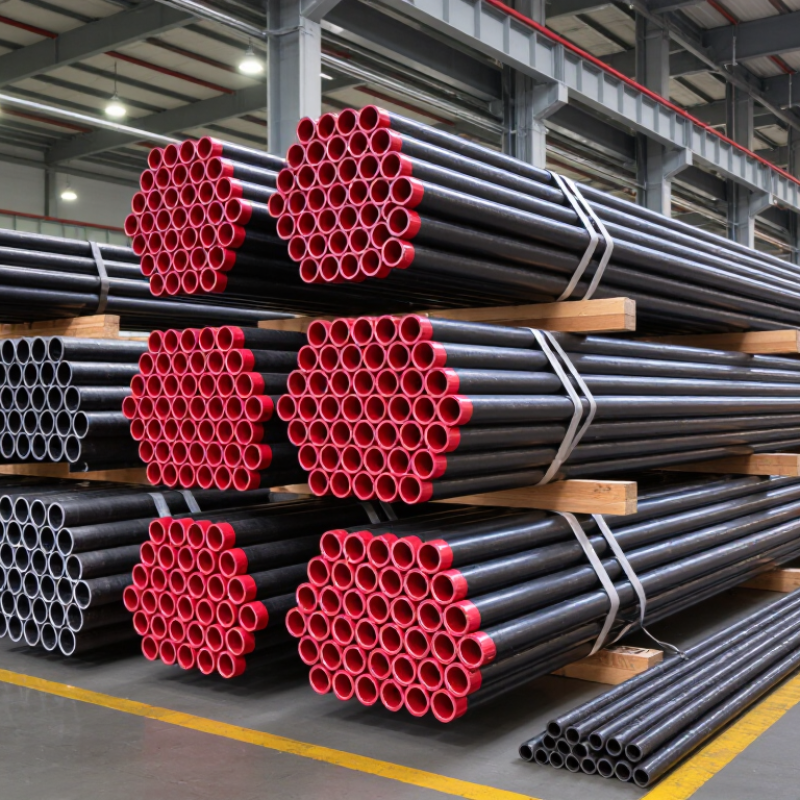
| Carbon Steel Pipe Fundamentals |
| Material Definition | Carbon steel pipe | Iron-based pipe in which carbon is the principal alloying element. Manganese, silicon, sulfur, phosphorus, and residual alloying elements are controlled by the applicable standard. | Small-bore to large-diameter pipe, depending on the manufacturing method and standard. | Fluid transport, pressure service, structural work, utilities, and industrial systems. | Carbon steel is generally economical and strong, but it normally requires corrosion protection when exposed to moisture, chemicals, or aggressive soil. |
| Pipe versus Tube | Pipe | Usually identified by nominal pipe size (NPS) and schedule, with dimensions commonly governed by ASME B36.10M for welded and seamless wrought steel pipe. | NPS sizes such as 1/2, 1, 2, 4, 6, 8, 12, 24, and larger. | Process piping, water lines, steam lines, and transmission systems. | Pipe dimensions are selected by nominal size and wall thickness; actual outside diameter remains fixed for a given NPS. |
| Common Carbon Steel Pipe Grades and Standards |
| ASTM A53 Grade B | Welded or seamless pipe | Minimum yield strength: approximately 240 MPa. Minimum tensile strength: approximately 415 MPa. | Commonly supplied from small diameters through large structural and utility sizes, subject to product form. | Water, air, steam, low-pressure process service, fire protection, and general mechanical applications. | A versatile general-purpose grade. Confirm whether Type E, Type S, or Type F construction is required. |
| ASTM A106 Grade B | Seamless high-temperature pipe | Minimum yield strength: approximately 240 MPa. Minimum tensile strength: approximately 415 MPa. | Commonly used in nominal sizes from 1/8 through 26, with availability depending on the supplier and specification. | High-temperature service, steam, refinery piping, boiler connections, and process lines. | Designed for elevated-temperature service. The complete design must consider temperature, pressure, corrosion allowance, and allowable stress. |
| API 5L Grade B | Line pipe, PSL 1 or PSL 2 as specified | Typical PSL 1 minimum yield strength: approximately 245 MPa. Minimum tensile strength: approximately 415 MPa. | Small, medium, and large diameters for pipeline construction. | Oil, gas, water, and other liquid or gaseous transmission pipelines. | Specify product specification level, delivery condition, testing, ends, and impact requirements according to the pipeline project. |
| API 5L X42 | High-strength line pipe | Minimum yield strength: approximately 290 MPa. Minimum tensile strength: approximately 415 MPa. | Available in welded and seamless forms depending on diameter, wall thickness, and purchase specification. | Pipeline transportation of oil, gas, and water. | Higher strength than Grade B can support reduced wall thickness or higher design efficiency, subject to engineering approval. |
| API 5L X52 | High-strength line pipe | Minimum yield strength: approximately 360 MPa. Minimum tensile strength: approximately 460 MPa. | Frequently selected for medium- and large-diameter transmission lines. | Long-distance oil and gas pipelines, water transmission, and industrial utility pipelines. | Weldability, toughness, sour-service requirements, and fracture-control requirements must be checked for the project. |
| API 5L X65 | Higher-strength line pipe | Minimum yield strength: approximately 450 MPa. Minimum tensile strength: approximately 535 MPa. | Typically used for engineered pipeline systems rather than general-purpose piping. | High-capacity transmission pipelines and demanding pipeline infrastructure. | Requires careful control of welding procedures, heat input, toughness, forming, and inspection requirements. |
| ASTM A333 Grade 6 | Low-temperature seamless or welded pipe | Minimum yield strength: approximately 240 MPa. Minimum tensile strength: approximately 415 MPa. Charpy impact testing is commonly specified at low temperature, including around -45°C for Grade 6. | Available in a range of nominal sizes subject to the manufacturing process. | Low-temperature process piping, refrigerated systems, and cold-service applications. | Confirm the required impact-test temperature, wall thickness, supplementary requirements, and design code. |
| Manufacturing Types |
| Seamless Pipe | Hot-finished or cold-drawn seamless | Manufactured without a longitudinal weld seam by piercing and forming a solid billet. | Common in small and medium diameters; larger sizes are available under selected standards and manufacturing routes. | High-temperature, high-pressure, boiler, refinery, and critical process service. | Often chosen where a welded seam is undesirable. It may have higher material cost and size limitations compared with welded pipe. |
| ERW Pipe | Electric resistance welded | Produced from formed strip or plate with a longitudinal seam created by electric resistance heating and pressure. | Commonly used from small diameters through medium and some large diameters, depending on equipment and standard. | Water, gas, structural columns, low- to medium-pressure service, and general utility piping. | Efficient and economical. Weld-zone quality, heat treatment, nondestructive testing, and dimensional tolerances should be confirmed. |
| LSAW Pipe | Longitudinal submerged arc welded | Formed from plate with a straight longitudinal weld, commonly produced by U-ing and O-ing or press-forming processes. | Often used for large diameters, approximately 16 to 60 inches, with the exact range depending on the mill and specification. | Large water mains, oil and gas pipelines, piling, and high-capacity transmission lines. | Provides good dimensional control for large diameters. Plate grade, weld procedure, seam inspection, and end preparation are important. |
| SSAW Pipe | Spiral submerged arc welded | Manufactured by helically forming steel strip or plate and welding the spiral seam. | Frequently used for large diameters, often approximately 20 inches and above, subject to the applicable standard. | Water transmission, slurry lines, piling, low- to medium-pressure service, and large-diameter infrastructure. | Can provide efficient large-diameter production. Check ovality, spiral seam requirements, hydrostatic testing, and allowable operating pressure. |
| Nominal Sizes, Outside Diameters, and Wall Thickness Examples |
| Small-Bore Example | NPS 1/2, Schedule 40 | Outside diameter: 21.3 mm. Nominal wall thickness: approximately 2.77 mm. | Typical inside diameter: approximately 15.8 mm before dimensional tolerance. | Instrument air, small utility lines, drains, and general process connections. | Actual inside diameter varies with wall-thickness tolerance and corrosion allowance. |
| General Utility Example | NPS 2, Schedule 40 | Outside diameter: 60.3 mm. Nominal wall thickness: approximately 3.91 mm. Approximate mass: 5.79 kg/m. | Nominal inside diameter: approximately 52.5 mm. | Water, compressed air, fire protection, and general industrial piping. | A common reference size. Confirm the required schedule, end type, and pressure rating for the system. |
| Medium-Diameter Example | NPS 6, Schedule 40 | Outside diameter: 168.3 mm. Nominal wall thickness: approximately 7.11 mm. Approximate mass: 28.26 kg/m. | Nominal inside diameter: approximately 154.1 mm. | Plant utility headers, water lines, process piping, and fire-water systems. | Large flow capacity with widely available fittings and flanges in many piping systems. |
| Large-Diameter Example | NPS 12, Schedule 40 | Outside diameter: 323.9 mm. Nominal wall thickness: approximately 9.53 mm. Approximate mass: 73.8 kg/m. | Nominal inside diameter: approximately 304.8 mm. | Water transmission, cooling-water systems, process headers, and large utility networks. | Transportation and lifting requirements become significant as diameter and wall thickness increase. |
| Very Large-Diameter Example | NPS 24, Schedule 40 | Outside diameter: approximately 610.0 mm. Nominal wall thickness: approximately 12.70 mm. | Nominal inside diameter: approximately 584.6 mm. | Large water mains, transmission pipelines, intake systems, and infrastructure projects. | Large-diameter dimensions may be governed by line-pipe or project standards rather than standard schedules alone. |
| Wall Thickness System | Schedules 10, 40, 80, 160 | Schedule number indicates a standardized wall-thickness series; the actual thickness changes with nominal pipe size. | Available schedules depend on NPS and the governing dimensional standard. | Schedule 40 is common for general service; higher schedules are used when additional wall thickness is required. | Schedule alone does not determine allowable pressure. Design temperature, material grade, corrosion allowance, weld efficiency, and code rules are also required. |
| Common Uses and Required Considerations |
| Water and Utility Piping | Carbon steel water pipe | Often supplied as welded or seamless pipe with bare, painted, coated, or lined surfaces. | From small utility lines to large transmission diameters. | Raw water, potable-water infrastructure where approved, cooling water, fire water, and wastewater systems. | External coating, internal lining, cathodic protection, water chemistry, and joining method should be specified. |
| Oil and Gas Transmission | Line pipe | Usually selected to API 5L or an equivalent project specification with defined grade, PSL, toughness, and testing. | Medium to very large diameters, commonly welded for major transmission lines. | Crude oil, natural gas, refined products, and high-capacity water transmission. | Check sour-service resistance, hydrostatic testing, weld inspection, fracture toughness, girth-weld procedures, and regulatory requirements. |
| Steam and High-Temperature Service | High-temperature process pipe | Seamless carbon steel grades such as ASTM A106 Grade B are frequently considered for suitable temperature ranges. | Small- to medium-diameter process piping and headers. | Steam, boiler feed systems, refinery process lines, and hot oil systems. | Verify allowable stress, thermal expansion, insulation, fatigue, oxidation, and temperature limits before selection. |
| Structural Applications | Structural carbon steel pipe | Round hollow sections or structural pipe may be specified under structural steel standards rather than pressure-pipe standards. | Commonly supplied in medium and large diameters with various wall thicknesses. | Piles, columns, trusses, handrails, barriers, frames, and supports. | Structural design should consider buckling, axial load, bending, connections, local corrosion, and applicable building codes. |
| Corrosion Protection | Uncoated, painted, galvanized, lined, or externally coated pipe | Protection methods include paint systems, zinc galvanizing, fusion-bonded epoxy, three-layer polyethylene, cement mortar lining, and other project-approved systems. | Applicable to most standard pipe sizes, subject to coating equipment and dimensional limits. | Buried pipelines, outdoor piping, marine environments, water systems, and chemical utility services. | Select protection based on soil, humidity, temperature, fluid chemistry, UV exposure, abrasion, and expected service life. |
| Inspection and Testing | Quality verification | Common controls include chemical analysis, tensile testing, dimensional inspection, hydrostatic testing, visual inspection, and nondestructive examination such as ultrasonic or radiographic testing. | Requirements depend on grade, manufacturing method, diameter, wall thickness, and purchase specification. | Pressure piping, pipelines, critical process systems, and safety-related infrastructure. | Specify the inspection plan, test pressure, acceptance criteria, certificates, traceability, and applicable edition of the standard. |
| Length and Ends | Plain end, beveled end, threaded end, or grooved end | Common commercial lengths include approximately 6 m and 12 m, while exact random-length ranges depend on the standard and order. | Length and end preparation are selected according to joining method and site requirements. | Butt-welded pipelines, threaded utility lines, grooved fire systems, and flanged process piping. | Confirm end squareness, bevel angle, thread standard, groove dimensions, caps, bundling, and transport limitations. |