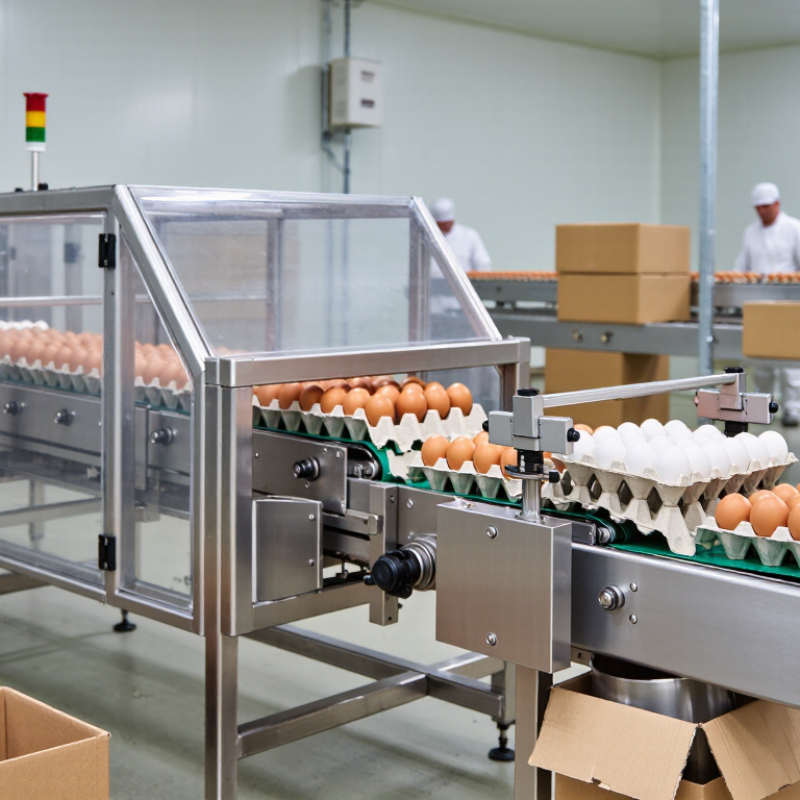
| Manual or Semi-Automatic Tray Packer | Up to 4,000 eggs/hour | Small farms, local distributors, seasonal operations | Approximately 1–3 kW, excluding optional compressor | Approximately 0.5–1.5 kWh per 1,000 eggs | Operator loads eggs and trays; machine performs alignment or transfer | EU Declaration of Conformity; risk assessment; machinery technical file; electrical schematic; user manual; applicable harmonised standards list | Confirm whether the control panel and components are certified for the destination market; verify 60 Hz compatibility where required; request wiring diagrams and component certificates | Approximately 12–30 months, depending on labour savings and utilisation | Remote commissioning, operating training, spare sensors and belts, troubleshooting guide, response-time commitment |
| Automatic Egg Grading and Tray Packing Line | 8,000–18,000 eggs/hour | Medium farms, packing centres, regional wholesalers | Approximately 5–15 kW, excluding refrigeration and building services | Approximately 0.6–1.8 kWh per 1,000 eggs | Automatic conveying, grading, counting, and tray loading with operator supervision | Declaration of Conformity; machinery risk assessment; electrical safety documentation; emergency-stop validation; guarding and interlock records; operating and maintenance manuals | Determine whether UL certification, field evaluation, or local approval is required; verify panel construction, short-circuit rating, grounding, motor protection, and 60 Hz operation | Approximately 18–36 months at stable daily throughput | Factory acceptance test; installation drawings; commissioning support; preventive-maintenance schedule; critical spare-parts list; software backup |
| High-Speed Automatic Packing Line | 24,000–60,000 eggs/hour | Large packing stations, export-oriented processors, supermarket suppliers | Approximately 15–40 kW, excluding compressors, refrigeration, and printers | Approximately 0.8–2.5 kWh per 1,000 eggs | Integrated grading, weighing, tray or carton packing, conveyor controls, and production data interface | Full machinery technical file; conformity assessment; electrical diagrams; safety-circuit validation; guarding documentation; EMC and low-voltage compliance evidence where applicable | Request North American control-panel documentation, approved component list, SCCR information, grounding method, voltage and frequency confirmation, and local inspection support | Approximately 24–48 months, mainly influenced by utilisation, labour cost, breakage reduction, and product mix | On-site installation option; operator and maintenance training; remote diagnostics; spare-parts availability; documented escalation process; annual service option |
| Integrated Egg Packing and Case-Packing System | 36,000–90,000 eggs/hour | Large-scale commercial plants and multi-shift operations | Approximately 25–70 kW, excluding building utilities | Approximately 1.0–3.0 kWh per 1,000 eggs | Integrated grading, packing, case handling, pallet interface, traceability, and line monitoring | Require a complete line-level conformity assessment, safety validation, machine boundary definition, interface responsibilities, and final Declaration of Conformity | Confirm whether each machine and the integrated line require separate approval; review control-panel certification, network safety, disconnects, grounding, and site acceptance requirements | Approximately 30–60 months unless the line operates at high utilisation with significant labour savings | Site survey; installation supervision; acceptance testing; production ramp-up support; preventive-maintenance contract; guaranteed spare-parts lead times |
| Carton Packing Module | 4,000–30,000 eggs/hour, depending on carton format | Retail cartons, premium packaging, mixed carton formats | Approximately 3–15 kW, excluding upstream grading equipment | Approximately 0.5–2.0 kWh per 1,000 eggs | Automatic carton forming, egg placement, closing, coding, and discharge | Check guarding, access doors, emergency stops, pinch-point protection, electrical documentation, and conformity of the complete machine assembly | Verify voltage, frequency, control-panel construction, safety relays, motor protection, and compatibility with local electrical codes | Approximately 18–42 months, depending on carton labour and changeover frequency | Format-change instructions; tooling support; replacement vacuum cups or grippers; training; remote assistance; changeover-time target |
| Used or Refurbished Automatic Line | Depends on original design and refurbishment quality | Cost-sensitive buyers with qualified maintenance teams | Must be measured during inspection; nameplate data may not reflect actual operating load | Measure with a power meter during normal production; do not rely only on original specifications | May include obsolete controls, discontinued sensors, or limited traceability functions | Request current conformity status; an old CE mark alone does not prove that the refurbished configuration complies with current requirements | Confirm local acceptance before shipment; check replacement parts, panel condition, grounding, short-circuit rating, and 60 Hz compatibility | Approximately 12–36 months if downtime and replacement-part costs are controlled | Written refurbishment scope; test report; remaining warranty; parts-availability statement; control-system backup; inspection photos and maintenance history |