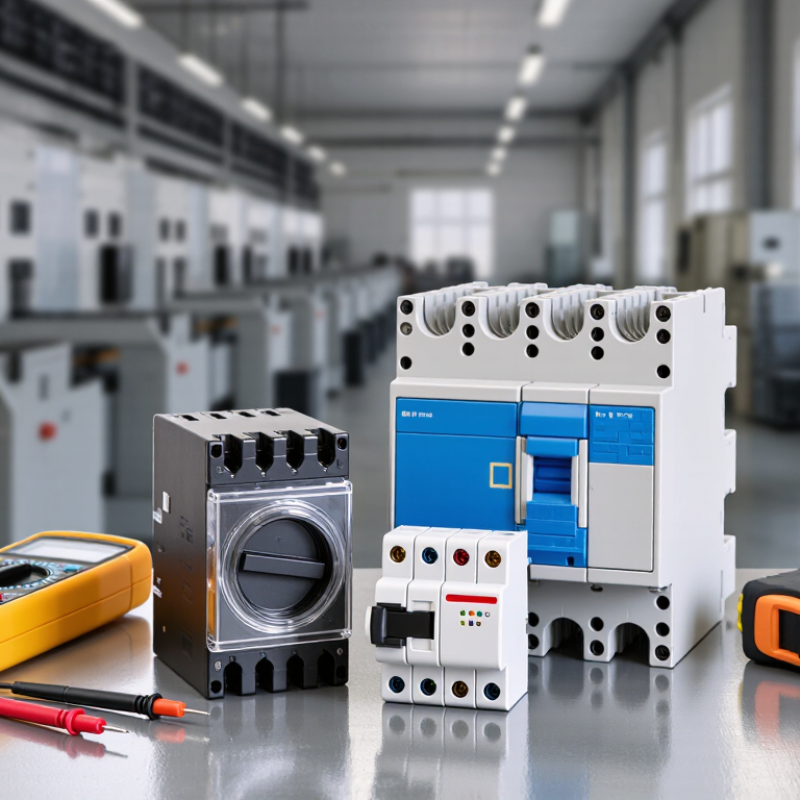
| Product scope | Availability of miniature circuit breakers (MCBs), molded-case circuit breakers (MCCBs), air circuit breakers (ACBs), residual-current devices, and accessories. | Product catalogs, technical datasheets, and model-specific installation instructions. | Confirm that the supplier offers the required device type, pole configuration, rated current, and accessories for each application. |
| Applicable product standards | Standards declared for the exact breaker model and its intended market. | IEC 60898-1 covers circuit-breakers for overcurrent protection in household and similar installations. IEC 60947-2 applies to low-voltage circuit-breakers. UL 489 is a North American standard for molded-case circuit breakers and related devices. | Match the standard to the installation and jurisdiction. Check the certificate or listing number in the issuing certification body’s database; do not rely on a general company statement. |
| Rated voltage and current | Declared operational voltage, rated current, frequency, and number of poles. | Model-specific nameplate and datasheet; applicable product standard and local electrical code. | Compare ratings at the actual system voltage and frequency. Verify derating requirements for ambient temperature, enclosure, and installation conditions. |
| Interrupting capacity | Breaking-capacity ratings and the conditions under which they apply. | Datasheet values such as Icn or Icu/Ics, as applicable to the product and standard; test reports or certification records. | Compare the rating with the prospective short-circuit current at the installation point. Check that the rating and test conditions correspond to the exact model and configuration. |
| Trip characteristics and protection functions | Available trip curves, thermal-magnetic or electronic trip options, adjustable settings, and protection functions. | Time-current curves, trip-unit documentation, and coordination or selectivity data where provided. | Request curves and settings for the specific device. Assess coordination with upstream and downstream protective devices rather than comparing curve labels alone. |
| Environmental and installation suitability | Operating temperature range, enclosure compatibility, mounting method, terminal options, and stated environmental limits. | Installation manual, datasheet, and applicable enclosure or environmental ratings. | Check the complete assembly and operating conditions. An individual breaker rating does not automatically establish the rating of the panel or enclosure. |
| Certification and traceability | Current certificates, product markings, manufacturing-site scope, and model-level traceability. | Certificates and listings from recognized certification bodies; production identification and quality-system documentation. | Verify scope, validity, factory location, and exact model designation directly with the certification body or its public directory when available. |
| Quality and change control | Documented production controls, inspection procedures, component traceability, and notification of design changes. | Quality-system certificates, inspection records, audit information, and written change-control procedures. | Ask which site and product families are covered, how nonconforming products are handled, and how buyers are notified of changes affecting certification or performance. |
| Technical documentation | Availability of datasheets, dimensional drawings, wiring diagrams, manuals, and selection or coordination guidance. | Current revision-controlled documents for the exact product range. | Compare completeness, language availability, revision dates, and consistency between documents, labels, and certificates. |
| Global delivery and logistics | Export experience, lead-time commitments, packaging, shipping terms, and availability of replacement units. | Written quotations, delivery schedules, packaging specifications, and shipment records where available. | Evaluate delivery performance using the buyer’s own order history or references. Confirm lead times and trade terms for the destination market. |
| After-sales and warranty support | Warranty terms, technical response channels, troubleshooting support, and availability of spare parts. | Published warranty documentation, service procedures, and written support commitments. | Compare response-time commitments, warranty exclusions, local service coverage, and the process for investigating product failures. |
| Project and customization support | Support for panel builders, OEMs, project documentation, and approved configuration options. | Technical application guides, configuration records, and written confirmation of any non-standard requirements. | Confirm that proposed configurations remain within the product’s certified scope and that engineering approvals are documented. |