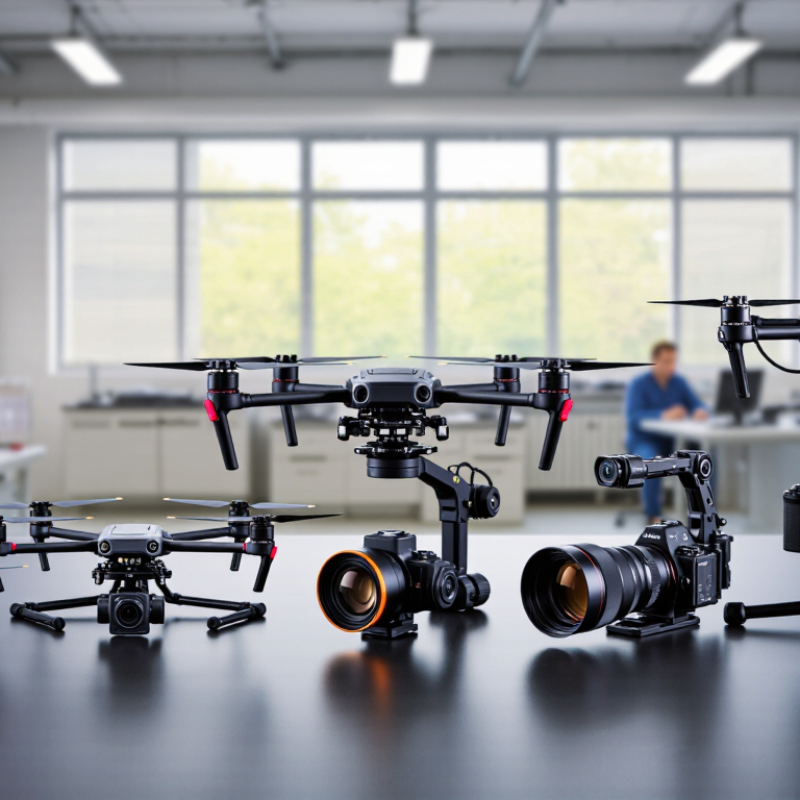
| Single-Axis Gimbal | 1 axis, usually pitch | Approximately 50–300 g | Compact RGB camera or fixed-focus imaging module | Basic electronic stabilization, lightweight frame, low power consumption, simple control interface | Entry-level aerial photography, mapping previews, flight monitoring and small multirotor platforms | Lowest weight, cost and integration complexity | Limited compensation for yaw and roll; image stability can decrease during turns, wind gusts and sideways movement |
| Two-Axis Gimbal | 2 axes, commonly pitch and roll | Approximately 150–700 g | Compact RGB, multispectral or inspection camera | Brushless motors, inertial measurement unit, active horizon correction and selectable camera angles | Surveying, agriculture, infrastructure inspection and general aerial imaging | Good balance between stabilization performance and aircraft endurance | Yaw movement is generally handled by the aircraft; heading changes may still introduce motion or framing shifts |
| Three-Axis Gimbal | 3 axes: pitch, roll and yaw | Approximately 300 g–2 kg | High-resolution RGB, mirrorless, zoom or stabilized video camera | Independent three-axis control, smooth heading changes, horizon leveling, target tracking and programmable pointing | Professional photography, cinematography, inspection, public safety and precision surveying | Best overall image stability and independent camera pointing | Higher mass, power demand, price and mechanical complexity than one- or two-axis designs |
| EO/IR Dual-Sensor Gimbal | Usually 3 axes | Approximately 500 g–2.5 kg | Visible-light electro-optical camera combined with thermal infrared camera | Day/night imaging, thermal palettes, digital zoom, sensor switching, metadata recording and target geolocation support | Search and rescue, firefighting, utility inspection, security and nighttime operations | Combines visual detail with heat-based detection in one stabilized payload | Thermal image resolution is commonly lower than visible-light resolution; payload cost and power use are relatively high |
| Long-Zoom EO Gimbal | Usually 3 axes | Approximately 700 g–3 kg | Visible-light camera with optical zoom lens, often with a wide camera for context | Optical magnification, autofocus, image stabilization, target tracking, low-light processing and geotagged imagery | Long-range inspection, traffic observation, border monitoring and infrastructure assessment | Detailed observation from a safer or more distant operating position | Long focal lengths narrow the field of view and amplify vibration, atmospheric haze and pointing errors |
| Multispectral Gimbal | Usually 2 or 3 axes | Approximately 200 g–1 kg | Multiple narrow spectral bands, commonly including visible and near-infrared channels | Radiometric or calibrated capture, band registration, exposure synchronization and vegetation-index data generation | Crop health analysis, environmental monitoring, forestry and land-use assessment | Captures information that standard RGB cameras cannot provide | Requires calibration, controlled data processing and suitable lighting; not primarily designed for cinematic video |
| LiDAR-Compatible Gimbal | Usually 2 or 3 axes | Approximately 1–5 kg, depending on the scanner and accessories | Laser-scanning payload with GNSS and inertial navigation components | Precise pointing, vibration isolation, synchronized positioning and support for point-cloud acquisition | Topographic surveying, forestry measurement, corridor mapping and 3D asset inspection | Produces accurate three-dimensional measurements in areas where imagery alone is insufficient | High payload mass, substantial processing requirements and strong dependence on navigation quality and calibration |
| Heavy-Lift Cinema Gimbal | 3 axes | Approximately 1–8 kg or more | Professional cinema, mirrorless or broadcast-style camera with interchangeable lens | High-torque motors, adjustable mounting, vibration isolation, remote focus and zoom control, lens support and precision balancing | Film production, commercial video, live events and high-end aerial cinematography | Supports larger cameras and lenses with smooth, highly controlled movement | Requires a suitable heavy-lift aircraft, careful balancing and greater operational planning; endurance is reduced |
| Quick-Release Modular Gimbal | Usually 2 or 3 axes | Approximately 300 g–3 kg | Interchangeable RGB, thermal, multispectral, zoom or mapping modules | Tool-free or low-tool payload exchange, standardized connectors, automatic recognition and mission-specific configuration | Multi-mission fleets, inspection contractors, emergency response and research operations | One aircraft can support several sensor roles with reduced equipment duplication | Connector durability, calibration repeatability, center-of-gravity changes and software compatibility must be managed carefully |