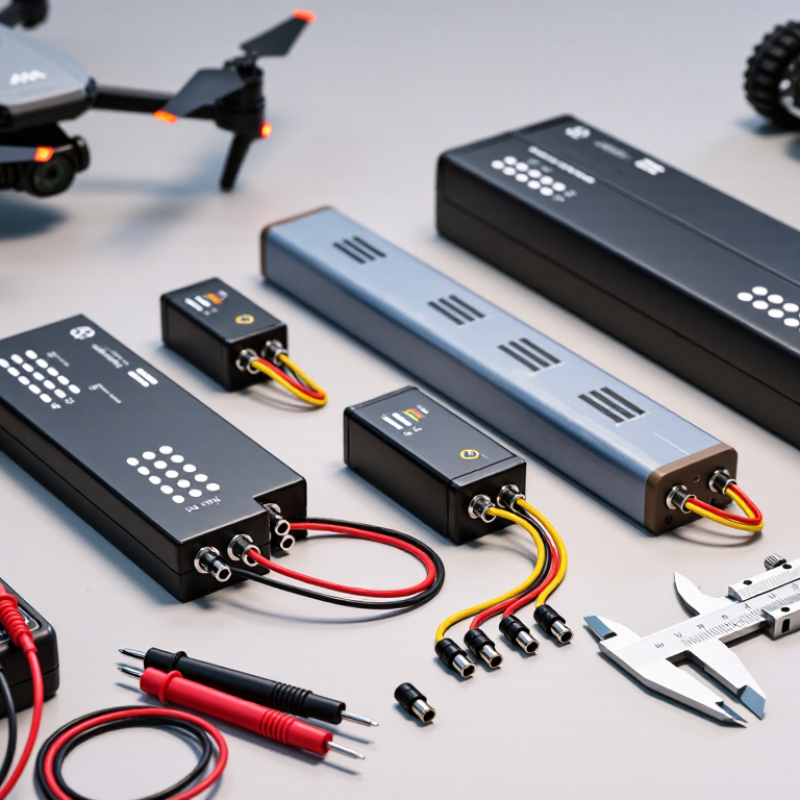
| 1 | Match the Cell Voltage | A standard lithium-polymer cell has a nominal voltage of 3.7 V and reaches 4.20 V when fully charged. Typical recommended discharge limits are around 3.0–3.2 V per cell, depending on the battery and application. | Confirm that the device, charger, and protection system support the battery's cell count and voltage range. Never connect a single-cell device to a multi-cell pack unless the electronics are specifically designed for it. | Incorrect voltage matching can cause malfunction, permanent damage, overheating, or a serious safety hazard. |
| 2 | Choose the Correct Series Count | Cells connected in series increase pack voltage. Common nominal values are: 1S = 3.7 V, 2S = 7.4 V, 3S = 11.1 V, and 4S = 14.8 V. Full-charge voltages are respectively 4.20 V, 8.40 V, 12.60 V, and 16.80 V. | Check the equipment's specified input voltage and verify whether it requires a 1S, 2S, 3S, or other series configuration. | The series count determines the total operating voltage and the charger required for safe charging. |
| 3 | Select Suitable Capacity | Capacity is measured in mAh or Ah. For example, a 2,000 mAh battery theoretically supplies 2 A for about one hour under ideal conditions; actual runtime varies with load, temperature, battery age, and discharge limits. | Estimate average current and desired runtime, then allow practical margin rather than selecting capacity solely from the device's peak rating. | Higher capacity generally increases runtime but may also increase the pack's size, weight, charging time, and cost. |
| 4 | Verify Continuous and Peak Current | The battery's continuous current capability is commonly estimated from capacity and the stated C-rating. For example, a 2,000 mAh pack rated at 10C has a theoretical continuous current of approximately 20 A (2 Ah × 10). Actual performance depends on temperature, wiring, connector resistance, and battery condition. | Compare the battery's continuous current rating with the device's continuous demand and check any separate short-duration peak rating. | An undersized battery may experience voltage sag, excessive heat, reduced cycle life, or cell damage. |
| 5 | Check the Charging Requirements | Standard LiPo cells use a constant-current/constant-voltage charging profile and are charged to 4.20 V per cell. Multi-cell packs require a charger designed for the exact series count and normally require cell balancing. | Use a compatible LiPo charger with the correct cell-count setting, charge current, connector, and balance function where applicable. A commonly used conservative charge rate is 1C, unless the battery manufacturer specifies otherwise. | Using the wrong charger or overcharging beyond 4.20 V per cell can cause swelling, fire, or permanent battery failure. |
| 6 | Confirm Physical and Electrical Compatibility | Important dimensions include length, width, thickness, connector type, wire gauge, polarity, and balance-lead configuration. A battery's dimensions and terminal arrangement are not standardized across all packs. | Measure the available battery compartment and verify connector polarity, cable length, mounting method, and whether the pack includes protection or balancing leads. | A physically incompatible pack can be difficult to install, restrict airflow, reverse polarity, or place stress on wires and terminals. |
| 7 | Review Temperature, Storage, and Safety Limits | LiPo batteries should be protected from puncture, crushing, moisture, and excessive heat. Charging below 0°C can cause lithium plating. For storage, many LiPo systems use approximately 3.80–3.85 V per cell, with the pack kept in a cool, dry, fire-resistant location. | Choose a pack with suitable operating-temperature guidance, inspect it for swelling or damage, and store it at the recommended storage voltage. Do not use or charge a swollen, leaking, or physically damaged pack. | Correct handling helps reduce the risk of thermal runaway and preserves capacity and cycle life. |