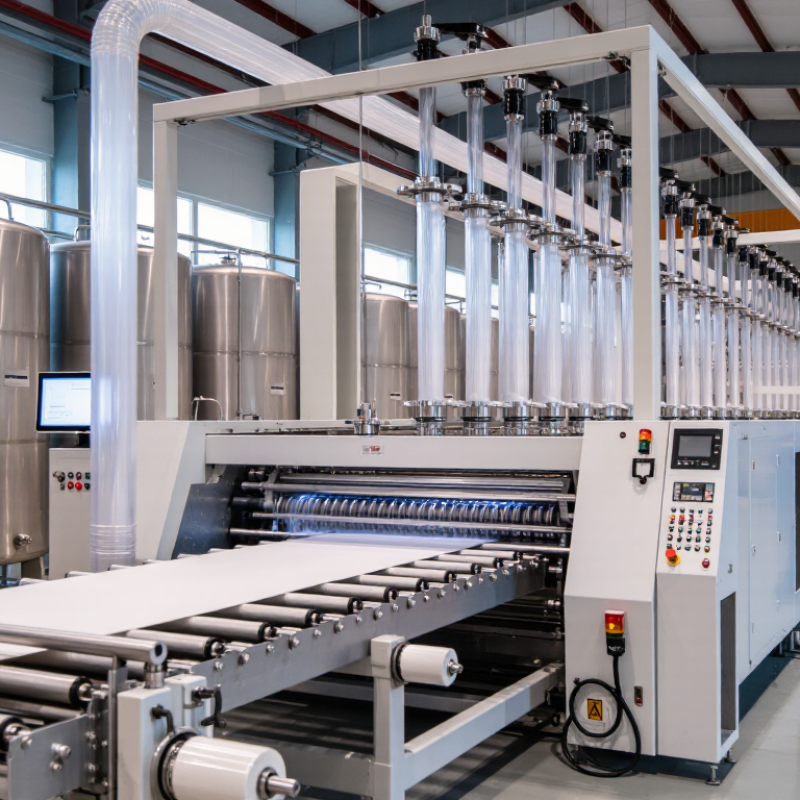
| 1. Match the machine to the target product | Fiber type, basis weight, web width, and end use | Typical spunlace products may cover approximately 30–120 g/m², depending on the fiber blend, web structure, and application. Common working widths range from about 1.6 m to 5.0 m. | An oversized line increases building, utility, and maintenance costs; an undersized line may require early replacement or parallel equipment. | Confirm guarding around carding, web-forming, entangling, and conveying zones. Require accessible emergency stops and documented risk assessment. | Can the line run a wider web, higher basis weight, recycled fibers, or biodegradable fibers without replacing the main forming section? |
| 2. Compare total cost of ownership | Capital cost, utilities, labor, consumables, maintenance, and downtime | A useful five-year model should include purchase, installation, commissioning, spare parts, water treatment, electricity, labor, waste, and planned shutdowns—not only the equipment quotation. | For water-jet entanglement, pumping and water-treatment demand can be significant. Request measured utility consumption at the intended production rate rather than nameplate estimates. | Check whether pressure vessels, pumps, electrical panels, and machine guarding comply with the regulations applicable in the installation country. | Is there enough space and utility capacity for additional drying, wastewater treatment, automation, or a second production module? |
| 3. Verify real production performance | Rated speed, saleable output, uptime, and quality consistency | Evaluate output using saleable kilograms per hour, not only line speed. A production trial should record speed, basis weight, moisture, defects, startup waste, and stoppage time. | A line operating at 85% of nominal speed with stable quality may deliver more usable output than a faster line with frequent breaks and high waste. | Confirm safe access for cleaning and threading. Interlocked doors should stop hazardous motion before operators can reach moving components. | Can the control system store recipes and monitor key variables such as line speed, pressure, moisture, basis weight, and fault history? |
| 4. Examine water and energy efficiency | High-pressure water circuit, filtration, recycling, drying, and electrical load | A closed-loop water system can reduce fresh-water demand, but it requires filtration, water-quality control, sludge handling, and scheduled cleaning. Drying is often a major energy consumer. | Compare kWh per kilogram, fresh-water use per kilogram, wastewater volume, and heat-recovery potential under the same product conditions. | Include leak detection, pressure relief, lockout/tagout procedures, thermal protection, and safe chemical-handling provisions for water treatment. | Can additional filtration, heat recovery, variable-frequency drives, or higher-efficiency pumps be added without redesigning the entire utility system? |
| 5. Prioritize safety and maintainability | Operator protection, access, ergonomics, cleaning, and preventive maintenance | The equipment should provide clearly marked emergency stops, guarded nip points, safe platforms, adequate lighting, lockable isolation points, and documented maintenance intervals. | Designs that reduce cleaning time and improve access can lower labor costs and shorten planned downtime, even if their initial price is higher. | Request conformity documentation for applicable machinery, electrical, pressure, noise, and workplace-safety requirements. Verify that safety devices are tested during commissioning. | Will future modules use the same safety circuits, access standards, spare parts, and operator training system? |
| 6. Assess automation and technical support | Controls, data collection, remote diagnostics, training, and spare-parts support | At minimum, the line should provide alarm history, recipe management, trend data, and clear operating parameters. Critical spare-parts lead times should be documented in writing. | Budget for operator training, software updates, calibration, recommended spare parts, and service travel. These items can materially affect availability over five years. | Use controlled access for remote service, maintain audit logs, and separate safety-related controls from non-safety communication networks where required. | Can the system connect to plant monitoring software and support additional sensors, automatic inspection, or predictive-maintenance functions later? |
| 7. Plan for expansion and lifecycle flexibility | Modularity, upgrade paths, building layout, and long-term product strategy | Reserve space for service access, raw-material handling, finished-roll storage, utilities, wastewater treatment, and possible capacity expansion. A layout review should be completed before final purchase. | Modular equipment may cost more initially but can reduce the cost and production disruption of adding a second card, extra entangling section, wider rewinder, or improved drying unit. | Ensure future modules will not create blocked emergency exits, restricted evacuation routes, excessive noise exposure, or unsafe maintenance access. | Which components can be upgraded independently, and which limitations—frame width, pump capacity, controls, dryer size, or foundation—would require major reconstruction? |