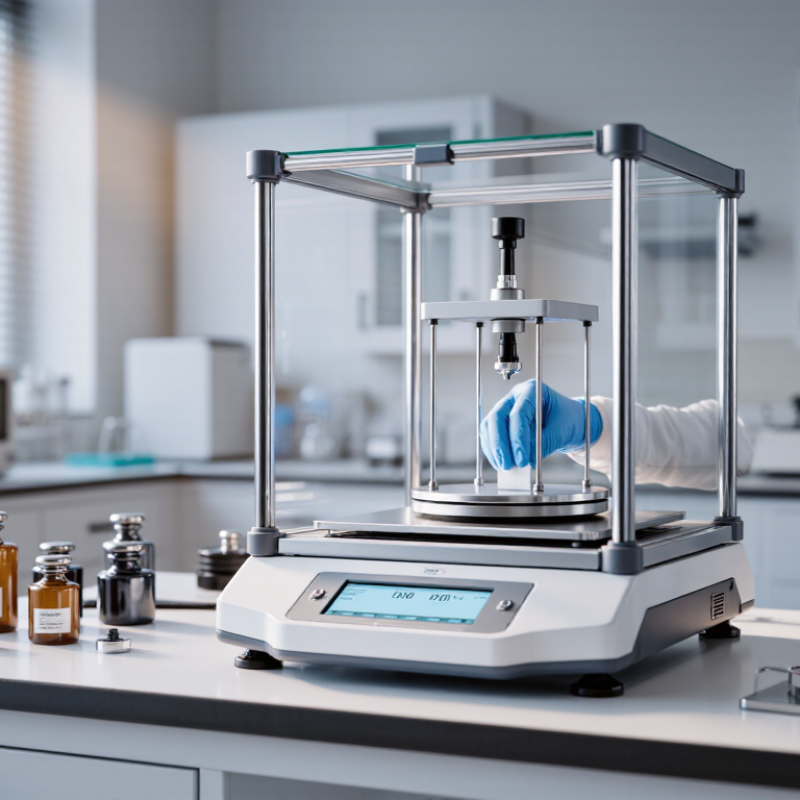
| Readability | Common analytical-balance readability: 0.1 mg (0.0001 g). Higher-resolution models may offer 0.01 mg readability. | Confirm readability on the quoted model and ensure it matches the required weighing procedure. | Readability is the smallest displayed increment; it does not, by itself, guarantee measurement accuracy. |
| Maximum capacity | Many analytical balances have capacities in the approximate 100–320 g range; available capacities vary by model. | Check that the usable capacity accommodates the sample, container, and any weighing accessories. | A suitable capacity helps prevent overloads while retaining the resolution needed for the task. |
| Repeatability | For a 0.1 mg readability model, a useful screening target is repeatability around 0.1–0.2 mg or better; verify the exact model specification. | Request the stated repeatability, test conditions, and the sample mass used for the specification. | Repeatability indicates how closely repeated measurements agree under specified conditions. |
| Linearity | Model-specific; values around ±0.2–0.3 mg are common screening benchmarks for some 0.1 mg readability balances, not universal requirements. | Compare the manufacturer’s stated linearity across the weighing range and ask how it is tested. | Linearity describes how closely readings track known loads across the balance’s capacity range. |
| Minimum weight and uncertainty | There is no single minimum weight that applies to every balance or application. It depends on required measurement uncertainty and operating conditions. | Ask for the minimum weight calculation or method, and relate it to the intended sample size and applicable quality procedures. | A small displayed increment does not ensure that very small samples can be weighed reliably. |
| Calibration | Models may provide external calibration, internal calibration, or both. | Confirm calibration method, available calibration records, and whether calibration weights or services are included. | Calibration supports measurement confidence and helps users check performance over time. |
| Stabilization time | Specified time varies by model and test conditions; request the manufacturer’s stated value rather than assuming a universal benchmark. | Check how stabilization time is defined and whether it reflects the balance’s intended installation environment. | Shorter stabilization can improve workflow, but readings also depend on drafts, vibration, temperature, and handling. |
| Environmental controls | Analytical balances commonly use a draft shield. Level indicators and adjustable feet are also useful setup features. | Check the draft-shield design, leveling aids, operating-temperature limits, and guidance on vibration and airflow. | Air movement, vibration, and temperature changes can affect weighing results, especially at fine resolutions. |
| Data connectivity | Depending on the model, interfaces may include USB, RS-232, or other digital connections. | Confirm interface type, supported data formats, software compatibility, and any data-integrity features required by the laboratory. | Suitable connectivity can reduce transcription errors and simplify recordkeeping. |
| Documentation and quality support | Documentation varies by supplier and model; request the applicable manuals, specifications, and calibration or inspection records. | Review document completeness, service response arrangements, warranty terms, and availability of spare parts. | Clear documentation and dependable support help with installation, routine checks, and ongoing maintenance. |