| Stainless Steel Grade | Material composition and corrosion resistance | 304 stainless steel, commonly specified as approximately 18% chromium and 8% nickel; 316 may be considered for higher chloride exposure | Review the material certificate and conduct an independent alloy-identification test, such as XRF testing, on production samples | 15% |
| Material Thickness | Nominal thickness of the sink bowl and supporting areas | Approximately 1.0–1.5 mm for many premium residential stainless-steel sinks; confirm whether the stated value is actual or gauge-equivalent thickness | Measure several points with a calibrated micrometer and compare the results with the approved technical drawing | 12% |
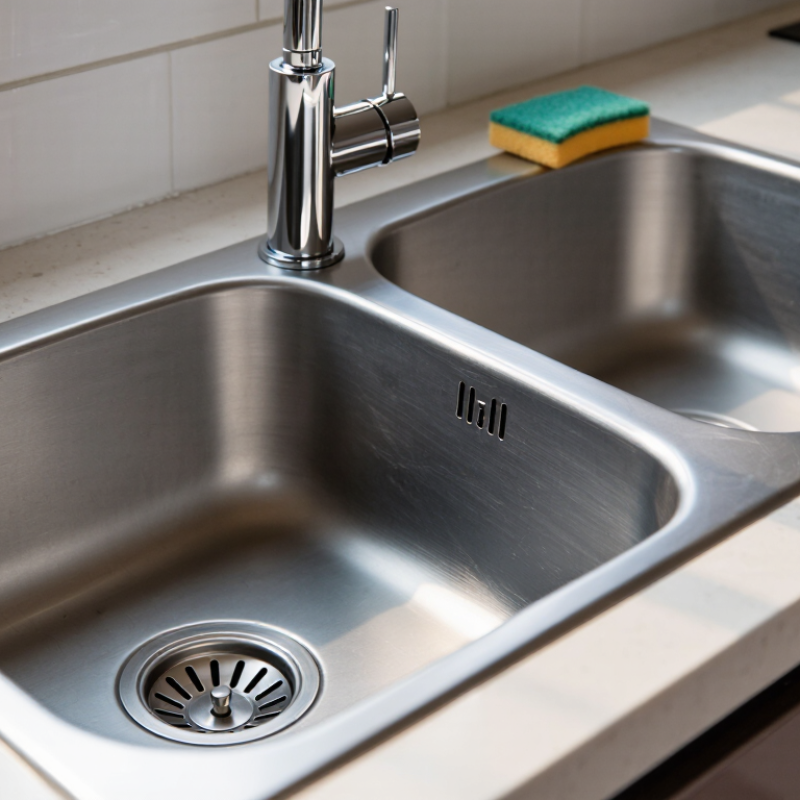
| Double-Bowl Configuration | Bowl proportions, depth, and usability | Two bowls with a practical size ratio, typically 50/50 or 60/40; bowl depth commonly falls within approximately 180–230 mm depending on the model | Check dimensional drawings, inspect a pre-production sample, and test clearance for cookware, faucets, drains, and waste-disposal fittings | 10% |
| Overall Sink Dimensions | Length, width, corner radius, and installation fit | Common double-bowl formats include approximately 760–860 mm in length and 440–520 mm in width, subject to cabinet and installation requirements | Use a calibrated steel rule or coordinate measuring equipment; verify cut-out dimensions against the approved installation template | 10% |
| Surface Finish | Consistency, appearance, and resistance to visible scratches | Uniform brushed, satin, or polished finish without visible dents, pits, weld discoloration, deep scratches, or uneven grain direction | Inspect under consistent lighting, compare with an approved master sample, and record finish defects using a defined acceptance standard | 10% |
| Welding and Forming Quality | Seams, corners, bowl geometry, and structural consistency | Continuous and clean welds, smooth internal corners, no pinholes or cracking, and no distortion that affects drainage or installation | Carry out visual inspection, water-fill testing, dimensional checks, and dye-penetrant inspection where higher assurance is required | 12% |
| Drainage Performance | Drain position, slope, and residual water after discharge | Each bowl should drain efficiently without persistent pooling under normal installation conditions; drain openings commonly use standard plumbing-compatible sizes | Perform a controlled water-drainage test on both bowls and verify compatibility with the specified waste kits and plumbing connections | 8% |
| Noise and Condensation Control | Sound-deadening pads and anti-condensation coating | Coverage should be consistent on the underside, with secure sound pads and an intact anti-condensation coating where specified | Inspect underside coverage, check adhesion manually, and conduct a controlled noise comparison using the same water flow and test environment | 7% |
| Load and Durability Testing | Resistance to impact, heat, staining, and repeated use | No leakage, cracking, coating failure, or permanent deformation after the buyer’s defined impact, thermal, and repeated-use test protocol | Request laboratory or in-house test reports and repeat critical tests on randomly selected production samples | 8% |
| Quality Management | Production controls and inspection records | Documented incoming-material inspection, in-process checks, final inspection, calibration control, and traceable batch records | Review quality manuals, inspection checklists, calibration certificates, nonconformance records, and recent corrective-action reports | 6% |
| Compliance Documentation | Safety, environmental, and market-entry documentation | Documentation should match the destination market and product configuration, including applicable food-contact, chemical, packaging, and plumbing requirements | Verify test reports directly with the issuing laboratory and confirm that reports identify the correct material, model, and production site | 5% |
| Packaging and Delivery Protection | Protection against scratches, dents, moisture, and transit movement | Individual protective packaging, reinforced cartons, secure accessories, moisture protection, and packaging dimensions suitable for efficient shipment | Conduct a packaging inspection, review carton specifications, and perform a trial drop or transport simulation based on the agreed protocol | 4% |
| Commercial Capability | Lead time, minimum order quantity, customization, and after-sales response | Written production lead time, clearly defined minimum order quantity, approved sample process, spare-parts policy, and documented claims procedure | Compare quotations, sample timelines, capacity statements, production schedules, service-level commitments, and reference purchase orders | 3% |