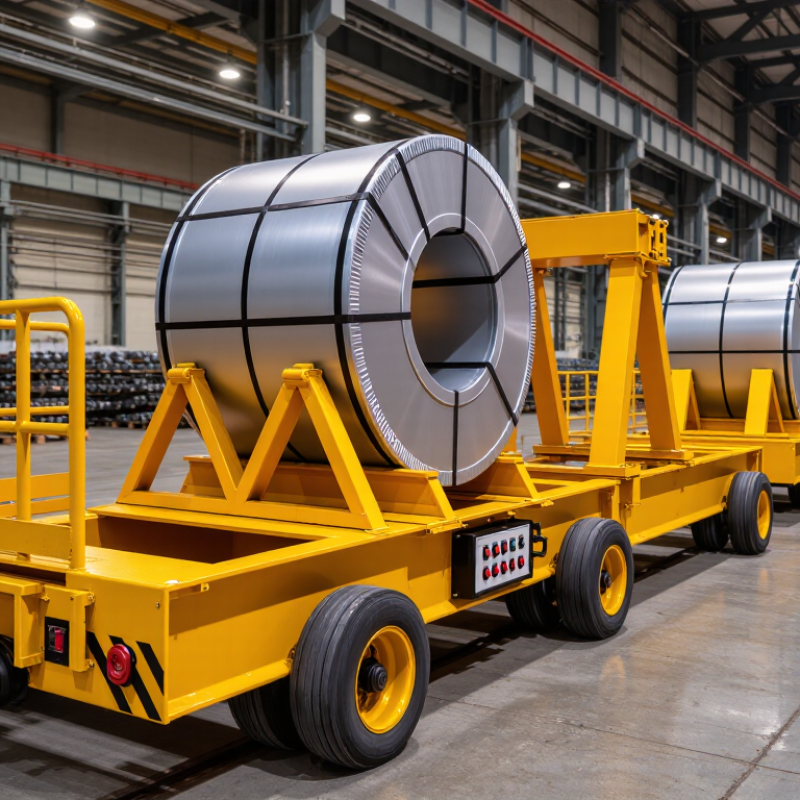
| Powered floor-running cart | 5–20 t | Frequent transfers between nearby production areas on a sound, level industrial floor. | V-shaped saddle or engineered cradle; verify coil stability during starting, stopping, and turning. | Assess collision, crushing, unintended movement, floor condition, visibility, and pedestrian interaction. | Determine the required performance level (PLr) for each safety-related function through risk assessment; evaluate the complete control-system architecture and components against that requirement. |
| Rail-guided transfer cart | 10–50 t | Repeated movement along a fixed route between machines or storage positions. | Fixed cradle or saddles positioned to suit the coil’s dimensions and center of gravity. | Assess access to the rail path, trapping points, end-of-track hazards, and safe maintenance access. | Review safety-related stopping, travel limits, and interlocks where used; confirm the achieved PL for each function is appropriate to its PLr. |
| Battery-powered operator-controlled cart | 3–20 t | Flexible indoor routes where a cable-free cart is useful and an operator can control travel. | Cradle, chocks, or other engineered restraint selected for the coil and route conditions. | Assess braking distance, operator sightlines, speed, route crossings, battery hazards, and emergency access. | Check the design and validation of safety-related travel, braking, and emergency-stop functions against their assessed PLr. |
| Automatic guided transfer cart | 5–30 t | Repeatable, programmed transfers on defined routes in an automated material-flow system. | Dedicated coil nest with load-position detection where needed to confirm a safe transfer condition. | Assess route changes, people entering the operating area, foreseeable misuse, recovery, and unexpected restart. | Assess safety-related detection, stopping, and restart-prevention functions individually; verify the required PLr and validate the implemented functions. |
| Low-profile cart for under-machine loading | 2–15 t | Moving coils into or out of presses, slitters, or other equipment with limited floor clearance. | Low-height saddles or a purpose-designed cradle; confirm clearance and load support throughout the travel path. | Assess crush and shear points, restricted visibility, clearance, load transfer, and safe access during setup. | Review safety-related motion control and any guarding or interlocking functions; set PLr from the risk assessment rather than assuming a single value. |
| Hydraulic lift transfer cart | 5–30 t | Transferring a coil while raising or lowering it to align with a machine or storage position. | Cradle supported by a designed lifting structure; include measures to prevent coil movement during height changes. | Assess lifting and lowering hazards, hydraulic failure, crushing zones, stability, and safe maintenance support. | Evaluate safety-related lift, hold, and stop functions where applicable; verify that their achieved performance meets the risk-assessed PLr. |
| Tilting or controlled-unloading cart | 5–25 t | Applications requiring a designed change in coil orientation or controlled unloading. | Purpose-designed supports and restraints that retain the coil through the full tilt or unloading sequence. | Assess rolling or sliding, changing center of gravity, crushing zones, and unintended movement during unloading. | Check safety-related sequencing, position monitoring, and stopping functions against their PLr; validate the completed control system. |
| Turntable transfer cart | 5–30 t | Changing the direction of a coil transfer where the layout requires a controlled rotation. | Cradle remains matched to the coil; verify load retention and clearance during rotation. | Assess rotating pinch points, load stability, access to the turning area, and collision risks at transfer interfaces. | Review any safety-related rotation limits, interlocks, and stopping functions; determine PLr through the risk-assessment process. |
| Heavy-duty multi-wheel cart | 20–60 t | Moving very heavy coils over a suitable floor or engineered route with a high-capacity chassis. | Wide, engineered support structure matched to coil width, mass, and center of gravity. | Assess floor loading, wheel and axle failure consequences, braking, steering, route gradients, and stability. | Check safety-related steering, braking, and travel functions where fitted; confirm their design and validation meet the assigned PLr. |
| Guided cart with cable-reel power supply | 10–40 t | Longer or repeated routes where continuous power is needed and the cable path can be managed. | Cradle or saddles engineered for the coil; keep the power cable clear of the load path and personnel routes. | Assess cable entanglement, trip and crush hazards, route crossings, stopping distance, and emergency response. | Review safety-related stopping and travel-control functions, including relevant cable-related fault conditions; verify each function against its PLr. |