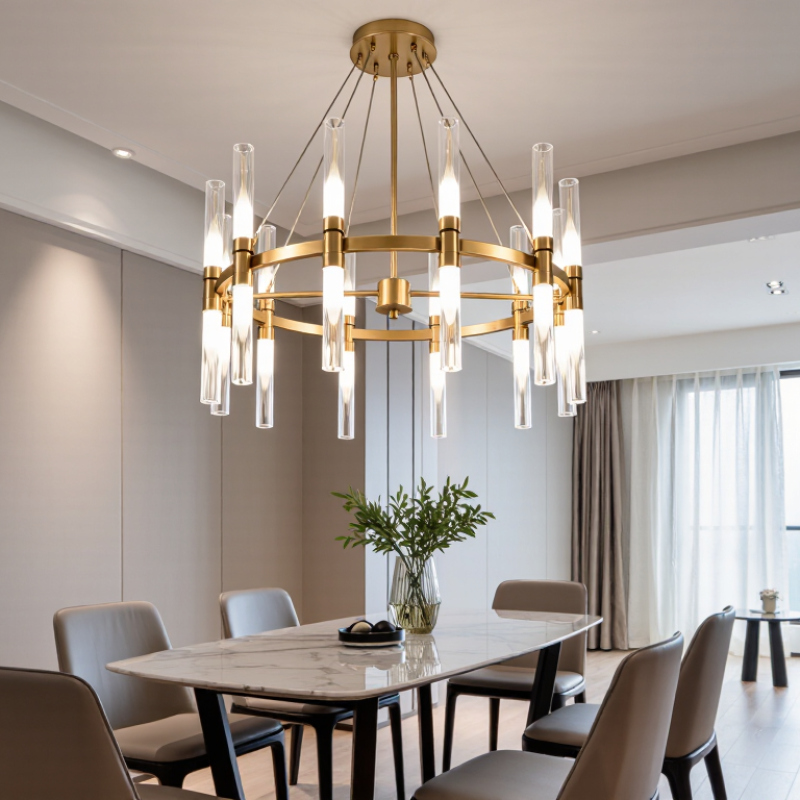
| What an LED chandelier is | A chandelier that uses light-emitting diodes (LEDs), either built into the fixture or fitted as replaceable LED bulbs. | Check whether the light source is replaceable. Integrated LEDs may require servicing or replacement of the fixture if the light engine fails. |
| How the light is produced | Electric current passes through a semiconductor in each LED, producing light through electroluminescence. A driver regulates power supplied to the LEDs. | Look for a clearly specified driver and suitable safety certification for the country where the chandelier will be installed. |
| Brightness | Lumens measure the total visible light output. Watts measure electrical power use, so wattage alone does not indicate brightness. | Choose the total lumen output for the room and intended use; check whether the stated figure applies to the complete fixture or only to its bulbs. |
| Light efficacy | Efficacy is measured in lumens per watt (lm/W) and describes how much light a source produces for the electricity it uses. | Compare lm/W figures only when they are measured on a comparable basis. Fixture optics and shades can affect delivered light. |
| Color temperature | Correlated color temperature (CCT) is measured in kelvins (K). Lower values look warmer; higher values look cooler. | Common choices include 2700 K for warm, cozy light; 3000 K for warm-white light; and 4000 K for a cooler, more neutral appearance. |
| Color rendering | The Color Rendering Index (CRI) indicates how accurately a light source reveals colors compared with a reference source. | CRI 80 or higher is common for general residential lighting. Consider CRI 90 or higher where faithful color appearance is especially important. |
| Dimming | Dimming depends on the LED driver, the control method, and the dimmer. Not every LED fixture works with every dimmer. | Confirm that the fixture and dimmer are explicitly compatible. Check the minimum dimming level and whether flicker is reported at low settings. |
| Power and installation | The driver converts incoming AC power to regulated power for the LEDs. Mains voltage differs by region. | Match the fixture’s voltage and frequency rating to the installation location. Have ceiling support and electrical connections checked by a qualified installer. |
| Heat and lifespan | LEDs generally use less electricity than incandescent lamps for comparable light output, but they still produce heat. Heat management affects component life. | Check the manufacturer’s stated rated life and the conditions behind it. A rated life is an estimate, not a guarantee that every component will last that long. |
| Fixture size and light distribution | Frame shape, shades, crystal elements, and the position of LEDs influence how light spreads and whether glare occurs. | Match the chandelier’s dimensions to the room and table. Review installation height, light direction, and whether the design provides ambient, task, or mostly decorative light. |
| Best choice for 2026 | There is no single best chandelier for every room; the right choice depends on brightness, color quality, dimming, size, installation, and maintenance needs. | Prioritize clearly stated lumens, CCT, CRI, dimmer compatibility, replaceability, regional electrical rating, warranty, and appropriate fixture dimensions. |