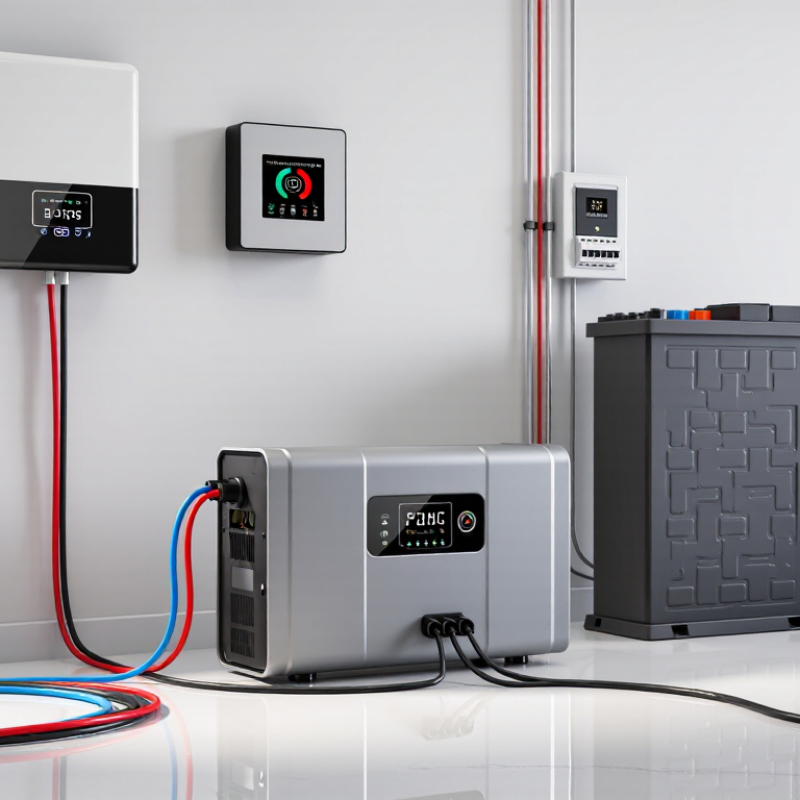
| Inverter type | Hybrid inverters manage solar, battery, and grid power. Off-grid inverters are designed for systems without utility-grid dependence. Grid-tied inverters generally need a compatible battery inverter or hybrid design for storage. | Choose a hybrid unit if you want solar, battery storage, and grid connection in one system. Choose an off-grid design when reliable standalone operation is required. | Confirm whether the inverter can operate without the grid and whether backup output is available during an outage. |
| Rated AC power | Residential units commonly cover a broad range, including approximately 3–6 kW for smaller systems and 8–12 kW for larger household systems. Available sizes vary by product and market. | Size the inverter for the loads that may run at the same time, not just the home’s average consumption. | Check continuous output power, overload duration, surge capacity, and whether the rating applies at the expected temperature. |
| Battery voltage | Low-voltage lithium systems commonly use a nominal 48 V battery; many lithium iron phosphate (LFP) packs are specified at 51.2 V nominal. High-voltage battery systems use product-specific voltage ranges. | Match the inverter to the battery’s nominal voltage and operating range. Do not mix low-voltage and high-voltage equipment. | Confirm the battery voltage range, maximum charge and discharge current, and approved communication method. |
| Battery chemistry and BMS | LFP is a common lithium chemistry for stationary storage. Battery management systems (BMS) may communicate with inverters over CAN or RS485. | Choose a battery and inverter that have been tested to work together, especially when closed-loop charge control is required. | Check the exact communication protocol, cable pinout, firmware requirements, and compatibility documentation for the specific battery model. |
| Solar input and MPPT | Maximum PV voltage, MPPT operating range, input current, and number of MPPT trackers are model-specific. An MPPT tracker lets the inverter optimize a separate solar-string input. | Use the PV module datasheet and local minimum-temperature conditions to design strings within the inverter’s limits. Separate roof orientations may benefit from separate trackers. | Verify maximum PV voltage, MPPT voltage range, maximum input current per tracker, short-circuit current limit, and permitted string configuration. |
| Conversion efficiency | Many modern inverter datasheets report peak conversion efficiency in the mid-to-high 90% range; the exact figure depends on the model and operating conditions. | Compare efficiency at realistic operating loads rather than selecting only by the peak figure. | Distinguish peak efficiency from weighted efficiency and account for standby consumption and conversion losses across the whole system. |
| Backup and transfer behavior | Backup capability and grid-to-backup transfer time vary by inverter design. Some products specify transfer times in milliseconds; this is not a universal guarantee for every load. | If backup is important, select a unit with a dedicated backup output and size it for the essential circuits. | Check the stated transfer time, backup power limit, neutral switching arrangement, and whether sensitive equipment needs a separate UPS. |
| Single-phase or three-phase output | Residential systems may use single-phase output, commonly around 220–230 V, or three-phase output, commonly around 380–400 V, depending on the local grid. | Match the inverter output to the building supply and the local utility connection requirements. | Confirm nominal voltage, frequency, phase configuration, grid-code settings, and whether export limits apply. |
| Battery capacity sizing | A practical starting estimate is: required battery energy ≈ essential-load power × backup hours ÷ usable depth of discharge ÷ system efficiency. | Estimate the energy needed for essential loads during the intended backup period, then include appropriate design margin. | Use the battery’s usable energy rating, not only its nominal capacity. Check maximum continuous discharge power as well as energy capacity. |
| Operating environment and protection | Temperature limits, enclosure rating, cooling method, and protection features differ between models and installation locations. | Choose equipment suitable for the intended indoor or outdoor location and expected ambient temperatures. | Review the specified operating temperature, enclosure protection rating, ventilation clearance, noise level, and required surge protection. |
| Standards, grid approval, and support | Grid connection requirements and approved equipment lists vary by country, utility, and installation type. | Select an inverter certified and approved for the installation location, with accessible technical support and replacement service. | Confirm applicable safety and grid certifications, utility approval, warranty terms, firmware support, and local service arrangements. |