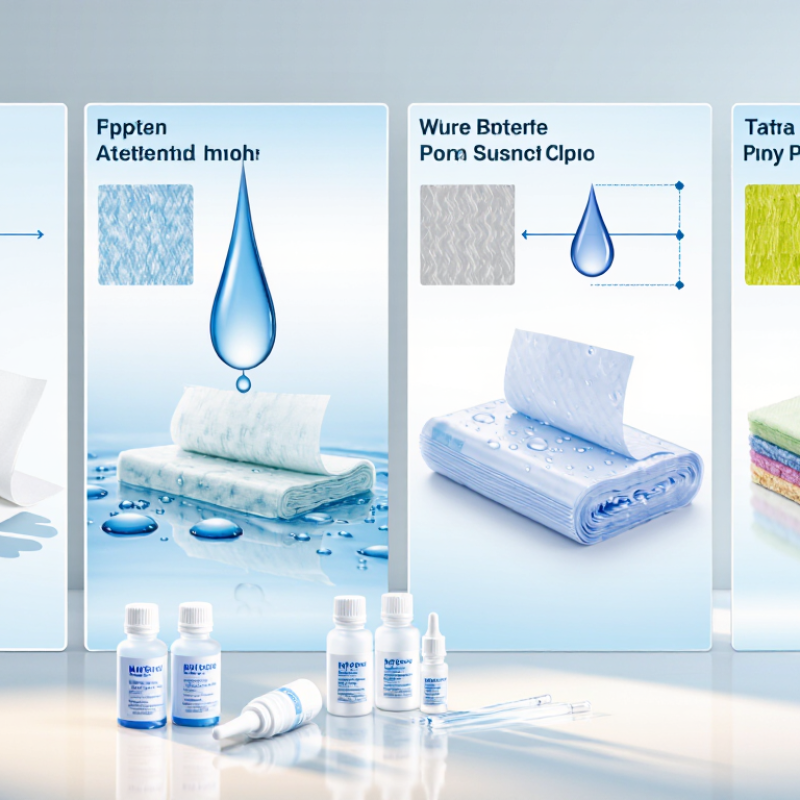
| How the web is made | Carded or cross-laid fibers are entangled by high-pressure water jets, usually without a conventional adhesive binder. | Fluff pulp and, in some grades, synthetic fibers are dispersed in air and formed into a bulky web; binders or other bonding methods may be used. | Fibers are formed into a web and held together by heat and pressure (thermal bonding) or by a binder (chemical bonding). The term covers several constructions. |
| Typical fiber composition | Polyester and viscose/rayon are common; cotton, lyocell, or other fibers may be used in specialty grades. | Cellulose fluff pulp is common, sometimes blended with polyester or other fibers for added strength or performance. | Often polypropylene or polyester; cellulose-containing blends are also used in some bonded nonwovens. |
| Typical basis-weight range | About 30–100 g/m² for many wipe applications; heavier grades are available. | About 40–100 g/m² for many wipe applications, with thicker and higher-basis-weight grades available. | About 20–80 g/m² for many lightweight wipe applications; the range varies by bonding process and end use. |
| Surface feel and texture | Generally soft and cloth-like. Embossing or patterned hydroentanglement can create a textured surface. | Typically bulky, soft, and paper-like, with a loftier feel than many lightweight bonded webs. | Often more uniform and sheet-like. Thermal bonding may feel firmer; chemical bonding can produce a softer or stiffer hand depending on binder and finish. |
| Liquid handling | Can provide good liquid uptake and distribution; performance depends on fiber blend, web structure, and lotion formulation. | Cellulose-rich structures commonly offer good absorbency and liquid capacity, although wet strength depends on construction. | Absorbency varies widely. Hydrophilic finishes or absorbent fiber blends may be needed for effective wet-wipe performance. |
| Strength and linting considerations | Often offers a useful balance of softness and strength. Wet and dry performance vary with fiber blend and basis weight; lint levels depend on the grade. | Can be bulky and absorbent, but some pulp-rich grades may be less resistant to tearing when wet than synthetic-rich alternatives. | Strength and linting depend on fiber type and bonding. Some grades can be durable, while binder selection and web structure affect softness and residue. |
| Common wipe applications | Personal care, baby, facial, and household wipes where a soft, cloth-like feel is desired. | Absorbent household, food-service, and personal-care wipes where bulk and liquid capacity are priorities. | Light-duty personal-care, household, and general-purpose wipes where a consistent, economical sheet is suitable. |
| Buyer considerations | Check fiber blend, basis weight, wet tensile strength, surface pattern, lotion compatibility, and disposal claims. | Check pulp proportion, wet integrity, linting, absorbency, binder or bonding system, and required sheet thickness. | Confirm whether the web is thermally or chemically bonded; review softness, wet strength, absorbency, binder details, and intended use. |