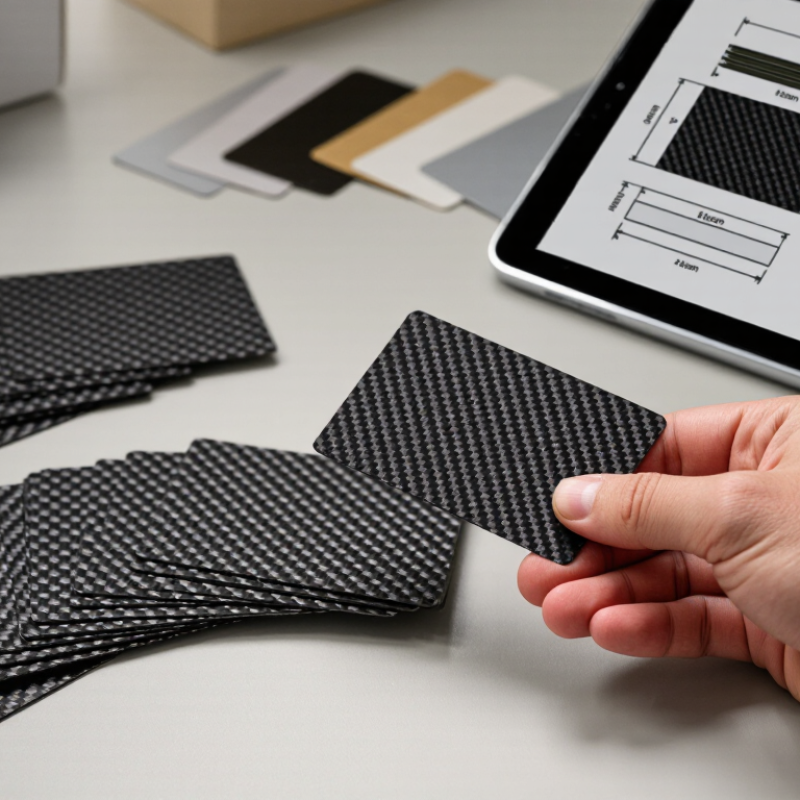
| 1. Confirm the card’s construction | Ask whether the card is made from carbon-fiber composite, a carbon-fiber surface layer bonded to a core, or a printed carbon-fiber pattern. | These constructions can differ in appearance, rigidity, edge finish, and cost. Request a physical sample and a written material description before approving a large order. | Premium business cards, presentation cards, and branded membership cards. |
| 2. Match dimensions to the intended format | Specify finished length, width, thickness, corner radius, and dimensional tolerances. | ISO/IEC 7810 ID-1 format measures 85.60 × 53.98 mm, with a nominal thickness of 0.76 mm. This is a common payment and identification-card format, but custom cards may use other dimensions. | Wallet cards, access badges, and cards intended for standard ID-1 card holders. |
| 3. Check contactless and chip compatibility | If the card needs NFC, RFID, or a payment chip, confirm antenna placement, material openings or non-conductive windows, and testing on the finished card. | Carbon-fiber composites are electrically conductive and can affect radio-frequency performance. Compatibility depends on the full card construction, so a material claim alone does not confirm reliable contactless operation. | Contactless access, transit, membership, or payment cards. Payment cards also require the relevant issuer and payment-system approvals. |
| 4. Choose a suitable print and finish | Review how the design will be applied and check contrast, legibility, surface texture, and scratch resistance on a finished sample. | The woven appearance and dark tones of carbon-fiber surfaces can affect color reproduction and fine-detail visibility. Approve artwork against a production-representative proof. | Business cards, event credentials, gift cards, and premium loyalty cards. |
| 5. Evaluate durability for the actual environment | Ask about edge bonding, surface protection, flexing, abrasion, and exposure to moisture, heat, or chemicals relevant to the intended use. | Performance depends on the resin, core, laminate, and manufacturing quality—not just the presence of carbon fiber. Request documented test methods and results where durability is critical. | Frequently handled access cards, staff badges, and long-term membership cards. |
| 6. Confirm personalization and data-security needs | Specify whether each card needs a unique serial number, barcode, QR code, magnetic stripe, chip, or variable printed details. | Test codes and encoded features on final samples. For cards carrying personal or access data, define how artwork, card data, proofs, and production files will be handled and protected. | Employee ID, visitor access, loyalty programs, and controlled-entry credentials. |
| 7. Plan international shipping and compliance | Confirm packed dimensions and weight, lead time, sample approval, customs documentation, packaging, and any destination-market requirements. | Import duties, taxes, product rules, and delivery timelines vary by destination and shipment terms. Agree on the specifications, inspection criteria, and delivery responsibilities before production. | Bulk orders for international events, offices, clubs, and card programs. |