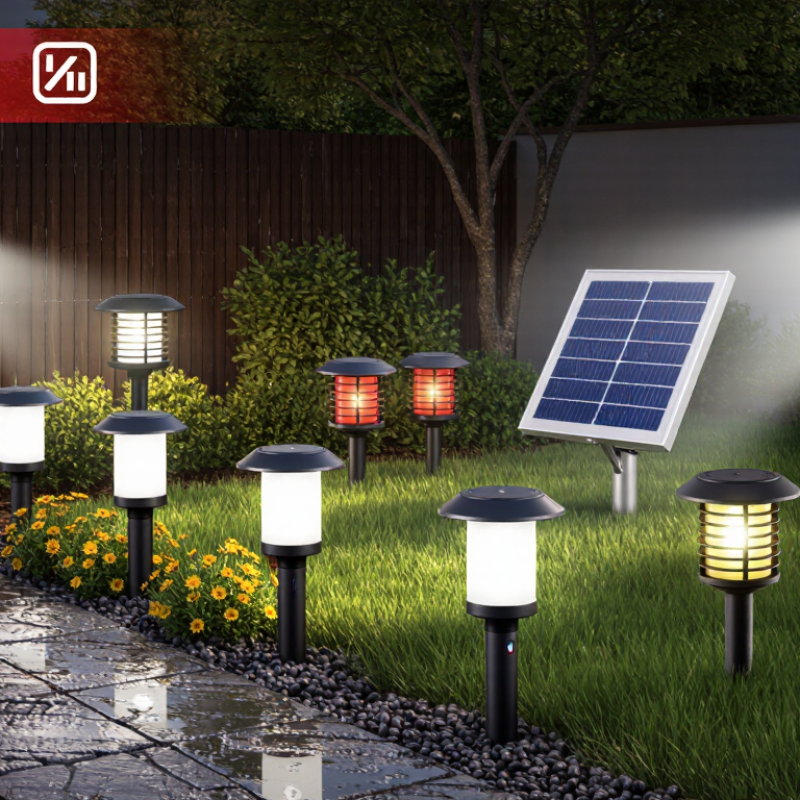
| Solar Panel | Panel type, rated power, conversion efficiency, and resistance to outdoor exposure. | Small integrated panels commonly range from approximately 0.3 W to 2 W per light. | Monocrystalline panels generally provide good efficiency in a compact area and should have a clear, well-sealed surface. | Compare the rated wattage, panel dimensions, charging performance, and output after several cloudy days. |
| Battery Capacity | Battery chemistry, nominal voltage, capacity, cycle life, and replaceability. | Common outdoor products use rechargeable batteries from approximately 600 mAh to 2,200 mAh. | A protected lithium-ion or LiFePO4 battery with a replaceable design can improve service life and maintenance convenience. | Check the battery label, protection circuit, charging time, and lighting duration after a full charge. |
| Nightly Runtime | Operating time after a full day of direct sunlight and the effect of brightness settings. | Many products are rated for approximately 6 to 12 hours, depending on sunlight, season, battery condition, and mode. | Runtime specifications should clearly state the test conditions rather than presenting only an unsupported maximum figure. | Test multiple units over several nights and record sunset-to-shutoff time under similar weather conditions. |
| Brightness | Measured lumens, beam angle, light distribution, and whether the light is decorative or functional. | Decorative garden lights often provide approximately 5 to 100 lumens; pathway and security-oriented models may provide more. | Useful products publish lumen output and provide an even beam without excessive glare or dark spots. | Compare measured illumination at the intended installation distance, not only the LED wattage. |
| LED Light Quality | Color temperature, color consistency, color rendering, and LED thermal management. | Warm white is commonly around 2,700–3,000 K, while neutral or cool white is generally around 4,000–6,500 K. | Stable color, low flicker, and a diffuser or optical lens suited to the intended garden area. | Check the stated color temperature, observe visible flicker using a camera, and inspect light uniformity. |
| Weather Resistance | Ingress protection, gasket quality, drainage design, and resistance to rain, dust, and condensation. | Outdoor products commonly claim IP44, IP54, IP65, or higher protection levels. | IP65 or higher is generally preferable for exposed locations, provided the rating applies to the complete assembled product. | Verify the test report or certification scope and inspect seals, cable entry points, screws, and drainage openings. |
| Material and Durability | Housing material, lens material, corrosion resistance, UV resistance, and mechanical stability. | Common materials include ABS plastic, polycarbonate, aluminum alloy, stainless steel, and tempered glass. | UV-resistant housing, impact-resistant lenses, corrosion-resistant hardware, and a stable ground stake or mounting base. | Inspect material specifications and perform a physical check for loose parts, sharp edges, weak joints, and surface defects. |
| Automatic Controls | Light sensor, on/off operation, brightness modes, motion detection, and memory function. | Basic models normally provide automatic dusk-to-dawn operation; advanced models may include multiple modes or sensors. | The light sensor should prevent daytime operation, while controls should be easy to access and clearly documented. | Place the product in bright and dark conditions and verify activation, shutoff, mode switching, and sensor response. |
| Installation | Ground stake strength, mounting options, cable length, tools required, and installation instructions. | Many pathway products support ground insertion; wall-mounted and cable-separated designs offer more placement flexibility. | Reinforced stakes, secure joints, clear instructions, and interchangeable mounting components are preferable. | Assemble and install one sample before purchase to check fit, stability, and adjustment range. |
| Safety and Compliance | Electrical safety, battery protection, charger specifications, material safety, and applicable market requirements. | Requirements vary by destination market and product type; low-voltage solar products still require suitable protection. | Complete technical documentation, traceable test reports, protected battery circuits, and clearly marked ratings. | Request documentation applicable to the destination country and confirm that reports match the exact product model. |
| Quality Consistency | Variation in brightness, charging, battery capacity, assembly quality, and appearance between units. | Consistency depends on component control, production inspection, and batch management. | Products with documented incoming inspection, functional testing, and pre-shipment sampling are generally more reliable. | Sample several units from the same production batch and compare output, runtime, dimensions, and charging behavior. |
| Warranty and Spare Parts | Warranty length, battery replacement, availability of lenses, stakes, housings, and control components. | Warranty terms differ by seller and market; batteries and solar panels are commonly the first service items. | Clear written warranty conditions and replaceable components can reduce long-term ownership costs. | Confirm coverage exclusions, replacement procedures, spare-part pricing, and expected response time before ordering. |
| Total Cost of Ownership | Purchase price, shipping, replacement batteries, maintenance, failure rate, and expected service life. | The lowest purchase price does not necessarily provide the lowest cost over several seasons. | A balanced combination of adequate brightness, dependable charging, replaceable batteries, and durable construction. | Compare estimated cost per year using purchase cost, replacement frequency, energy independence, and maintenance needs. |
| Best Use Case | Whether the product is intended for decoration, pathway marking, accent lighting, or security illumination. | Decorative lights prioritize appearance; pathway lights prioritize visibility; security lights require higher output and broader coverage. | The selected product matches the required brightness, runtime, mounting position, and weather exposure. | Define the lighting purpose and coverage area first, then compare products using the same performance criteria. |