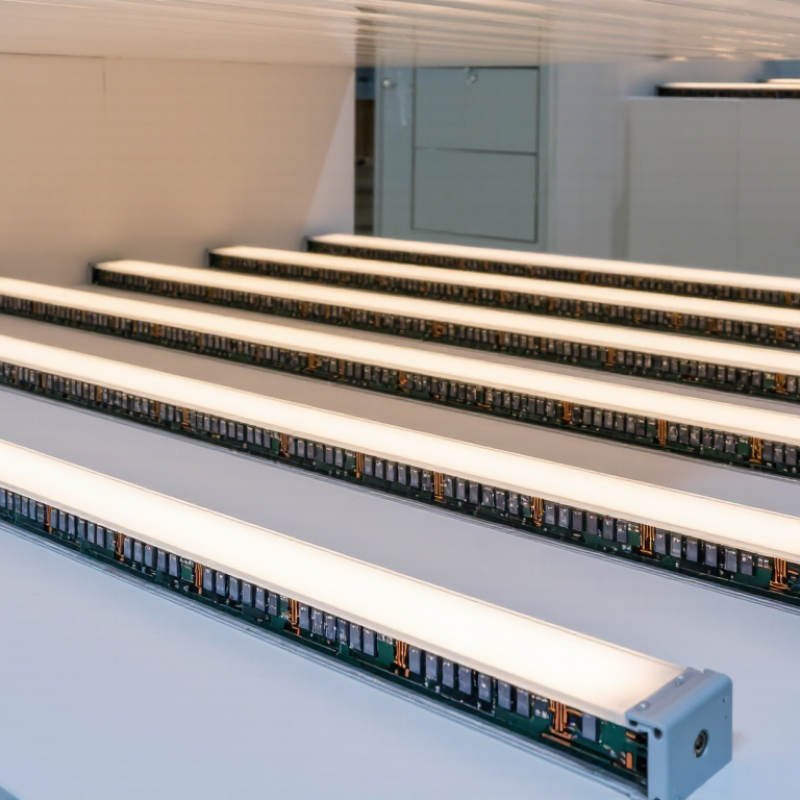
| COB construction | COB strips place closely spaced LED chips on a substrate beneath a continuous phosphor layer. This construction is designed to create a more continuous line of light than widely spaced, individually visible LED packages. | Request a lit sample and check for visible dark spots, color variation, and consistency along the strip. |
| Operating voltage | 12 V and 24 V DC are common options in low-voltage strip lighting. The appropriate supply depends on the strip model, installation length, and power requirement. | Confirm the rated voltage, watts per metre, maximum recommended run, and compatible power supply for each SKU. |
| LED density and cut interval | Chip density and cutting points are design-specific. The cut interval is determined by the electrical layout of the PCB; there is no single interval that applies to all COB strips. | Check the datasheet for chips per metre, cut marks, minimum segment length, and the effect of cutting on warranty. |
| Color temperature and color options | Single-color white strips are offered in different correlated color temperatures. Some product ranges also include tunable-white or colored-light variants, depending on the design. | Confirm the available CCT or color range, binning information, and whether the requested variant is available at the required voltage and density. |
| Color rendering | Color rendering is model-dependent; COB strip product ranges may include different CRI options. A high CRI value should not be assumed from the COB construction alone. | Ask for the tested CRI value and, where color accuracy is important, supporting test data for the exact model. |
| PCB dimensions and flexibility | Strip width, copper design, substrate, and bend characteristics vary by product. These features affect fit, heat management, and installation in channels or narrow spaces. | Request a dimensioned drawing and confirm strip width, thickness, bending direction, and installation surface requirements. |
| Environmental protection | Products may be supplied with different levels of protection, from uncoated indoor versions to coated or enclosed versions. Protection depends on the complete assembly and is not determined by COB technology alone. | Verify the stated IP rating and test documentation for the finished strip, connectors, and any supplied accessories. |
| Dimming and control | Dimming compatibility depends on the strip’s electrical configuration and the selected controller or power supply. Some products support single-channel dimming; multi-channel color variants require compatible control equipment. | Test the strip with the intended controller and power supply, including dimming range, flicker performance, and wiring requirements. |
| Thermal and electrical testing | Operating temperature, voltage drop, power consumption, and thermal behavior are product-specific performance characteristics that can be assessed through product testing. | Request the model-specific datasheet and test reports, and evaluate performance under the intended installation conditions. |
| Compliance documentation | Applicable compliance requirements depend on the destination market and the product configuration. Documents for one model or component do not automatically establish compliance for every finished product. | Check that certificates and test reports identify the exact model, components, and destination-market requirements. |
| OEM and customization | Potential customization areas include strip length, connector arrangement, packaging, labeling, and selected electrical or optical specifications. Availability and minimum order quantities vary by supplier and model. | Obtain written confirmation of customization scope, sample approval, tooling or setup costs, minimum order quantity, and production lead time. |
| Supplier profile assessment | A useful manufacturer comparison considers product range, documented quality controls, sample consistency, customization process, and export documentation rather than relying on a product listing alone. | Compare the same specification across suppliers and verify factory, quality, and delivery claims during due diligence. |