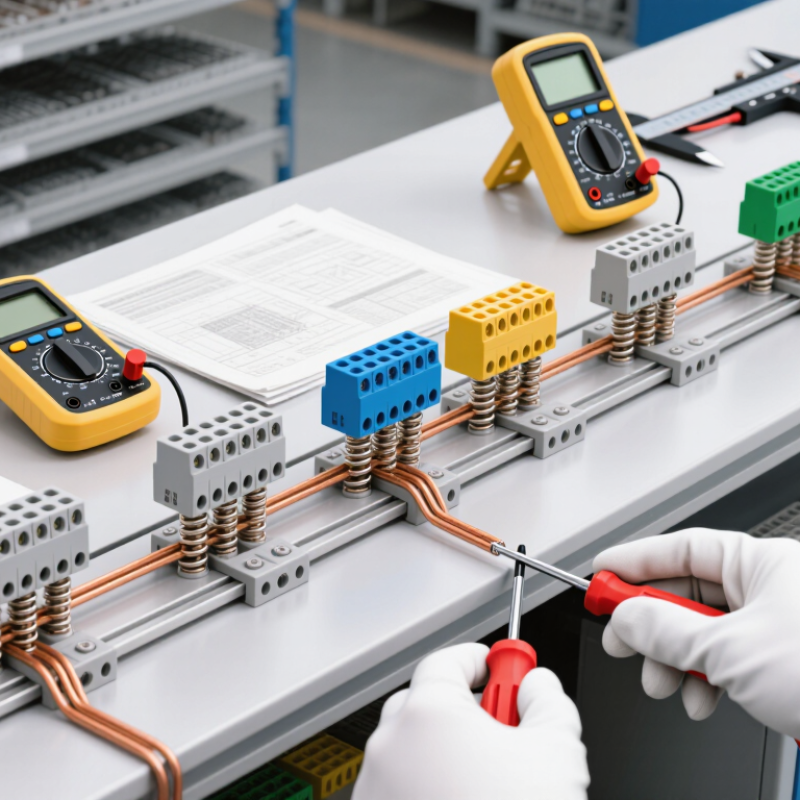
| What a DIN rail connector block is | An insulated electrical terminal mounted on a DIN rail. It connects, distributes, or separates conductors inside an electrical enclosure. | Used in control panels, machinery cabinets, building systems, and industrial equipment. |
| DIN rail mounting | Many terminal blocks are designed for 35 mm top-hat rails conforming to EN 60715. Other rail profiles and compact sizes are also available. | Check the rail profile and dimensions in the product documentation before ordering. |
| Feed-through blocks | Provide a direct connection between conductors entering and leaving the block. Available in different widths and conductor cross-section ranges. | Commonly used for point-to-point wiring and orderly distribution of control or power circuits. |
| Protective earth blocks | Connect protective conductors to the panel’s grounding system, typically through a conductive connection to the DIN rail. | Used for protective bonding; select and install according to applicable electrical standards and panel requirements. |
| Disconnect and fuse blocks | Disconnect blocks allow a circuit to be opened for testing or isolation. Fuse blocks incorporate a specified fuse to provide circuit protection. | Useful in measurement circuits, control systems, and applications requiring accessible overcurrent protection or isolation. |
| Connection methods | Common methods include screw clamps, spring clamps, and push-in connections. Each method has specific conductor types, preparation requirements, and tightening or insertion instructions. | Choose a method suited to installation speed, vibration conditions, maintenance practices, and the conductor specified by the manufacturer. |
| Electrical ratings | Rated voltage, current, conductor range, and permitted wire type depend on the specific terminal block design and applicable approvals. | Verify ratings against the circuit requirements and the product’s technical datasheet; do not infer ratings from appearance or block size alone. |
| Accessories | Common accessories include end plates, end stops, cross-connectors, separators, and marking systems. | Accessories help secure assemblies, separate circuits, create common potentials, and identify wiring. |
| Standards and documentation | IEC 60947-7-1 covers terminal blocks for copper conductors, and IEC 60947-7-2 covers protective conductor terminal blocks. Applicable requirements depend on product type and market. | When assessing a supplier, request current datasheets, test reports, and evidence of relevant approvals for the intended application. |
| Choosing a manufacturer | Compare technical documentation, product range, material and temperature specifications, quality controls, customization capability, and production traceability. | Confirm samples and specifications before placing an order. Ratings, certifications, lead times, and customization options vary by manufacturer and product. |