| Base Material | Titanium alloy Ti-6Al-4V ELI, also known as Grade 23, is commonly selected for implantable bone screws. | Provides a high strength-to-weight ratio, corrosion resistance, and established biological history for orthopedic implants. | ASTM F136; ISO 5832-3; material certificate and heat or lot traceability. |
| Chemical Composition | Typical Grade 23 limits include aluminum 5.5–6.5%, vanadium 3.5–4.5%, iron maximum 0.25%, oxygen maximum 0.13%, carbon maximum 0.08%, nitrogen maximum 0.05%, and hydrogen maximum 0.012%, with titanium as the balance. | Controlled chemistry supports consistent mechanical properties and reduces the risk of unsuitable material entering production. | Certified mill test report, positive material identification, and lot-based chemical analysis where required. |
| Material Condition | Use implant-grade bar or wire with documented diameter, surface condition, heat treatment, and material lot identification. | Stable incoming material reduces dimensional variation and supports complete traceability from raw stock to finished screw. | Incoming inspection records, supplier certificates, and batch or heat-number reconciliation. |
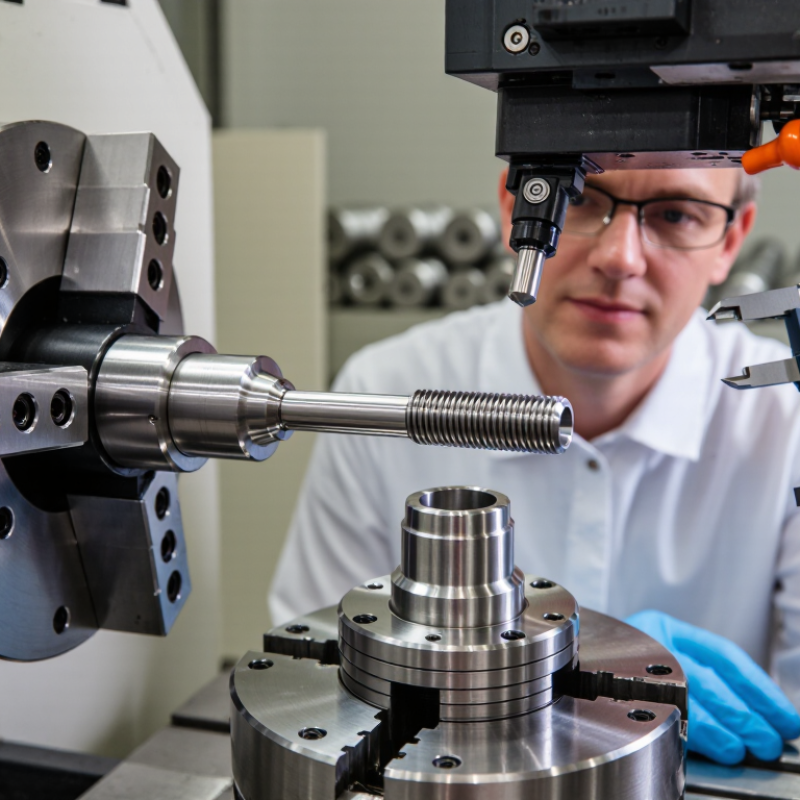
| Swiss Turning Capability | Guide-bushing or sliding-headstock turning is suitable for long, slender screws and repeat production of small-diameter features. | Improves support near the cutting zone and helps control runout, thread location, and concentricity. | Machine capability study, first-article inspection, in-process gauging, and statistical process control. |
| Dimensional Tolerances | Tolerances must be defined on the approved drawing. Non-critical turned dimensions may commonly use approximately ±0.02 to ±0.05 mm, while functional features require drawing-specific limits. | Thread fit, head geometry, driving recess, and bone-contact dimensions directly affect insertion and clinical performance. | Engineering drawing, calibrated micrometers, optical measurement, thread gauges, and CMM inspection where applicable. |
| Thread Form and Accuracy | Thread profile, pitch, major diameter, minor diameter, crest condition, and fit class must follow the approved implant design and applicable screw specification. | Accurate threads support predictable insertion torque, fixation, and compatibility with the mating instrument or implant system. | GO/NO-GO gauges, profile measurement, optical inspection, and functional mating tests. |
| Cutting and Chip Control | Use tooling and cutting conditions appropriate for titanium, with controlled heat generation, stable chip evacuation, and coolant management. | Titanium has low thermal conductivity and can generate localized heat, tool wear, burrs, and surface damage if poorly machined. | Tool-life records, visual inspection, burr checks, process validation, and documented coolant controls. |
| Surface Finish | Specify roughness by functional surface. A commonly requested machined target for selected non-contact surfaces may be Ra ≤ 0.8 µm; the approved drawing controls the actual requirement. | Controlled surface texture helps reduce tissue irritation, contamination retention, and stress concentrations. | Profilometer measurement, surface comparison standards, and documented inspection results. |
| Burr and Edge Control | Remove machining burrs without rounding functional thread crests, damaging the driving recess, or altering the specified head and tip geometry. | Loose burrs and sharp unintended edges can affect insertion, cleanliness, handling, and tissue contact. | Magnified visual inspection, tactile checks where appropriate, and documented deburring validation. |
| Heat Treatment | Apply only the heat-treatment condition specified by the material and product requirements; prevent distortion, contamination, and uncontrolled alpha-case formation. | Mechanical strength, ductility, fatigue behavior, and surface integrity can be affected by thermal processing. | Approved process records, furnace calibration, hardness or tensile testing, and material certification. |
| Cleaning and Passivation | Use a validated cleaning process to remove machining oils, particles, metal debris, and processing residues. Titanium naturally forms a protective oxide layer; additional chemical treatment must be specifically justified and validated. | Clean surfaces reduce contamination risk and support biocompatibility and sterilization performance. | Cleaning validation, residue testing, particulate inspection, and process-batch records. |
| Biocompatibility Assessment | Evaluate the finished device, including material, manufacturing residues, surface treatment, and packaging, using a risk-based biological evaluation. | Biological safety depends on the final finished product, not only the raw titanium alloy. | ISO 10993 series and documented biological evaluation plan or report. |
| Quality Management System | Manufacturing controls should operate under a medical-device quality system with documented procedures, training, change control, nonconformance handling, and corrective action. | A controlled quality system provides repeatability and evidence that production requirements are consistently met. | ISO 13485 certification or equivalent documented quality-system controls. |
| Risk Management | Identify and control risks related to fracture, thread damage, dimensional mismatch, contamination, corrosion, packaging failure, and incorrect labeling. | Risk-based controls connect design characteristics with inspection and process-validation activities. | ISO 14971 risk-management file and linked verification records. |
| Inspection and Testing | Perform first-article, in-process, final dimensional, visual, cleanliness, and functional inspections according to the approved control plan. | Multiple inspection stages detect process drift before nonconforming screws are released. | Inspection plan, calibrated equipment, sampling rationale, test reports, and device history records. |
| Mechanical Performance | Evaluate insertion torque, driving strength, axial pullout, torsional strength, fatigue, or other properties when required by the screw design and intended use. | Testing confirms that the screw withstands expected surgical insertion and in-use loads without stripping or fracture. | Product-specific validation protocol, applicable ASTM methods, and approved acceptance criteria. |
| Packaging and Sterilization | Use validated packaging appropriate to the supplied condition. If provided sterile, sterilization and packaging must be validated for the specified sterile-barrier and shelf-life claims. | Packaging protects the implant from particles, moisture, handling damage, and loss of sterility where applicable. | ISO 11607 for sterile-barrier packaging; applicable sterilization validation standards and shelf-life testing. |
| Traceability and Documentation | Maintain links among raw-material heat, machine route, operator or equipment records, inspection results, cleaning batch, packaging lot, and release authorization. | Traceability supports investigation, field action, regulatory compliance, and consistent quality over the product lifecycle. | Device history record, certificate of conformity, inspection report, and retention policy. |