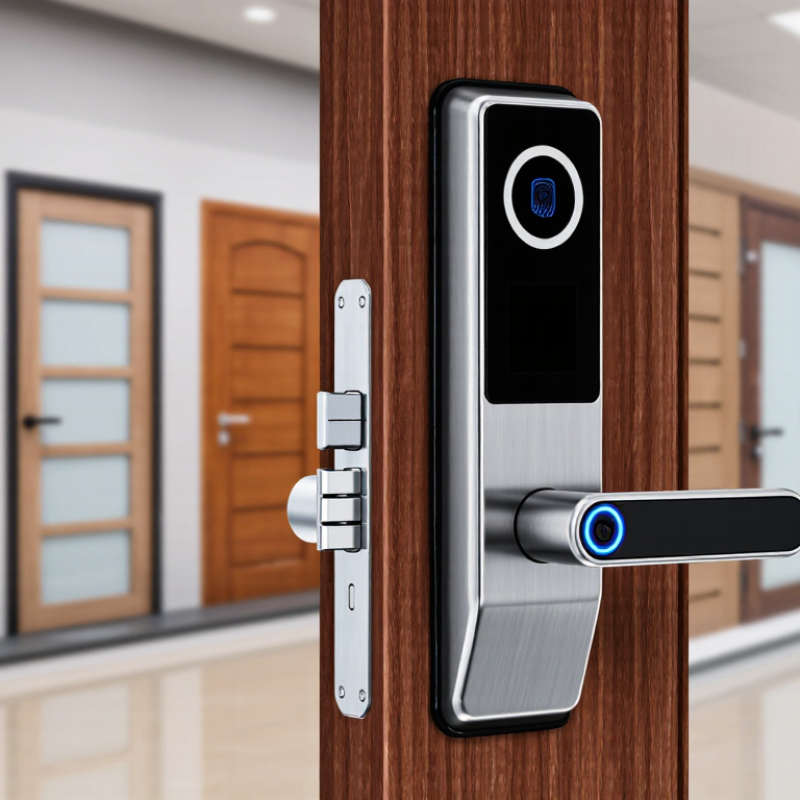
| 1 | Residential smart-lock production | Apartments, private homes, and multi-unit residential buildings | Compatibility with common door types, dependable latching, and clear low-battery alerts | More locks combine fingerprint access with PIN codes, mechanical keys, and app-based control |
| 2 | Fingerprint sensor integration | Front doors and interior access points requiring convenient user identification | Capacitive sensors are widely used in compact fingerprint readers; sensor placement and surface durability affect everyday usability | Improved recognition under varied finger placement and after repeated use |
| 3 | Multi-method access systems | Homes shared by family members, guests, or service providers | Alternative entry methods help provide access when a fingerprint cannot be read or the lock has no power | Access methods are increasingly managed together through a single lock interface or connected application |
| 4 | Connected-lock electronics | Homes where users want remote status checks or access management | Wireless functions can affect battery life; connectivity and remote features depend on the model and network setup | Greater integration with home automation platforms and connected-home devices |
| 5 | Rental and short-stay access solutions | Rental properties, serviced apartments, and other managed accommodation | Temporary PINs and user-access controls can reduce the need to distribute physical keys | More emphasis on time-limited credentials and remote user administration |
| 6 | Commercial and shared-space locks | Small offices, staff-only rooms, and shared facilities | Buyers may need multiple-user enrollment, access logs, and a suitable emergency-entry method | Fingerprint access is being paired with PIN or card credentials to support different user needs |
| 7 | Lock-body and door-hardware integration | New installations and replacements on compatible doors | Door thickness, backset, lock-body dimensions, handing, and installation conditions must be checked before purchase | Product ranges increasingly address different door formats and installation requirements |
| 8 | Power and emergency-access design | Residential and light-commercial doors where uninterrupted entry is important | Battery-powered locks should provide low-power warnings; some models offer an external emergency power connection and a mechanical key override | Clearer power-status alerts and more practical backup-entry provisions |
| 9 | Security and privacy engineering | Any setting where access credentials and entry records need protection | Security depends on the complete design, including credential management, device access, software support, and physical construction | More attention to secure configuration, software maintenance, and transparent handling of biometric data |
| 10 | Quality assurance and product compliance | Domestic sales, export supply, and project-based installations | Confirm applicable local requirements, product documentation, testing scope, warranty terms, and after-sales support for each model | Greater buyer focus on verifiable testing, traceable specifications, and long-term product support |