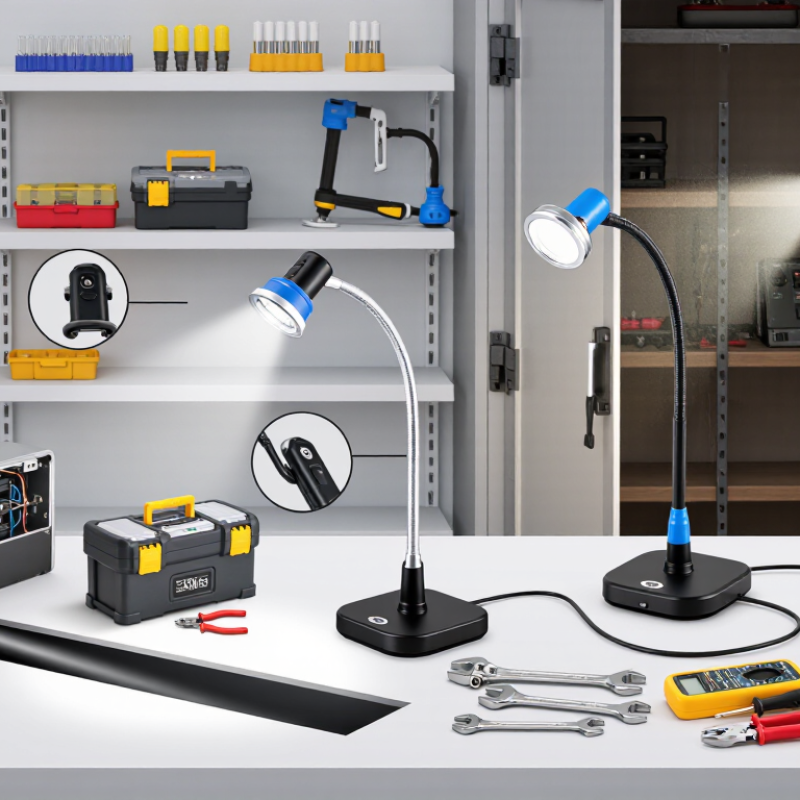
| Close-up repair or inspection | Adjustable beam, stable base or clamp, high color-rendering index (CRI) | Consider a focused beam for small work areas and a CRI of 80 or higher when distinguishing wire colors, finishes, or surface defects. | Accurate color perception and controllable light help reduce shadows and make detail work easier. |
| Large workshop or garage | Broad, diffuse output; multiple brightness settings; flexible positioning | Choose a wider beam or a light that can be aimed at different parts of the workspace. Compare lumen output with the area and task rather than choosing by wattage alone. | A broad beam can illuminate more of the work area, while adjustable output helps limit glare and wasted light. |
| Automotive work under a hood or chassis | Compact form, adjustable head, hook or magnetic mounting, impact-resistant housing | Look for a light that can fit into confined spaces and be secured without occupying both hands. Check that any magnet is suitable for the surfaces where it will be used. | Hands-free mounting and a movable head make it easier to direct light into awkward, shadowed areas. |
| Outdoor work in wet or dusty conditions | Sealed housing, protected switches and connectors, sturdy construction | Check the product’s IP rating for protection against dust and water ingress. For example, IP54 indicates limited dust ingress protection and resistance to water splashes; it does not mean the light is waterproof. | Environmental protection helps match the light to exposure, but the rating should be verified against the actual site conditions. |
| Moving between job sites | Rechargeable battery, compact body, low weight, carry handle or folding design | Compare stated runtime at the brightness setting you expect to use, charging time, battery replacement options, and whether the light can also operate while plugged in. | Battery runtime varies with output level, battery condition, and temperature, so a single maximum-runtime figure may not reflect everyday use. |
| Continuous or extended shifts | Reliable thermal management, replaceable or serviceable battery, stable mounting | Review operating-time information and any duty-cycle limits. A mains-powered model may be more suitable when charging access is available and uninterrupted operation is important. | Long operating periods can increase heat and battery demands; suitability depends on the light’s design and the work schedule. |
| Glare-sensitive or reflective work | Diffuser, adjustable brightness, indirect aiming options | Choose a model that can be aimed away from polished metal, glass, or the worker’s direct line of sight. Use a lower output setting when it provides sufficient visibility. | Reducing direct reflections and excessive brightness can improve visual comfort and help maintain clear visibility. |
| Uneven or crowded work areas | Stable non-slip base, secure clamp or hook, flexible neck or pivoting head | Match the mounting method to the available surfaces and check that the light remains secure when repositioned. | A stable mount keeps the beam where it is needed and reduces the chance of the light falling or being repeatedly adjusted. |
| Shared or changing tasks | Several output levels, adjustable color temperature if needed, simple controls | Prioritize easy-to-use controls and a range of settings. Neutral white light around 4000–5000 K is a common general-purpose choice, while preferences may vary by task and user. | Different tasks and users may benefit from different brightness and light color; adjustable settings provide more flexibility. |
| Selection note: Treat lumen output, runtime, beam angle, IP rating, CRI, battery capacity, and impact-resistance claims as product-specific specifications. Confirm them in the manufacturer’s documentation and select a light that suits the actual work environment and applicable safety requirements. |