How to Choose Large Lithium Batteries for Global Buyers
Choosing large lithium batteries for global buyers requires more than comparing capacity and price. The right decision starts with the application: electric buses, warehouse equipment, marine systems, backup power, or industrial machinery. Each use demands different voltage, energy density, cycle life, thermal performance, and installation conditions. A 48V battery may suit a warehouse vehicle, while a high-voltage pack could serve a commercial energy system. Small differences matter.
Experienced buyers examine the battery chemistry, battery management system, enclosure design, charging profile, and warranty terms. They also request verified test reports, traceable cells, production records, and clear safety documentation. Reliable suppliers should explain how their large lithium batteries perform at low temperatures, under repeated discharge, and during long storage. Ask for practical evidence, not polished promises. A sample pack, inspection report, and factory video can reveal more than a brochure.
Global purchasing adds transport, customs, local certification, service support, and spare-part concerns. These details can affect the real cost. A battery that looks affordable may become expensive after special packaging, delayed testing, or difficult maintenance. No selection method is perfect. Even experienced teams can overlook a connector, cooling requirement, or software limitation. That is why a careful comparison should include technical fit, supplier reliability, compliance readiness, and total ownership cost. The safest choice is rarely the cheapest one. It is the battery solution that performs consistently in the buyer’s actual environment.
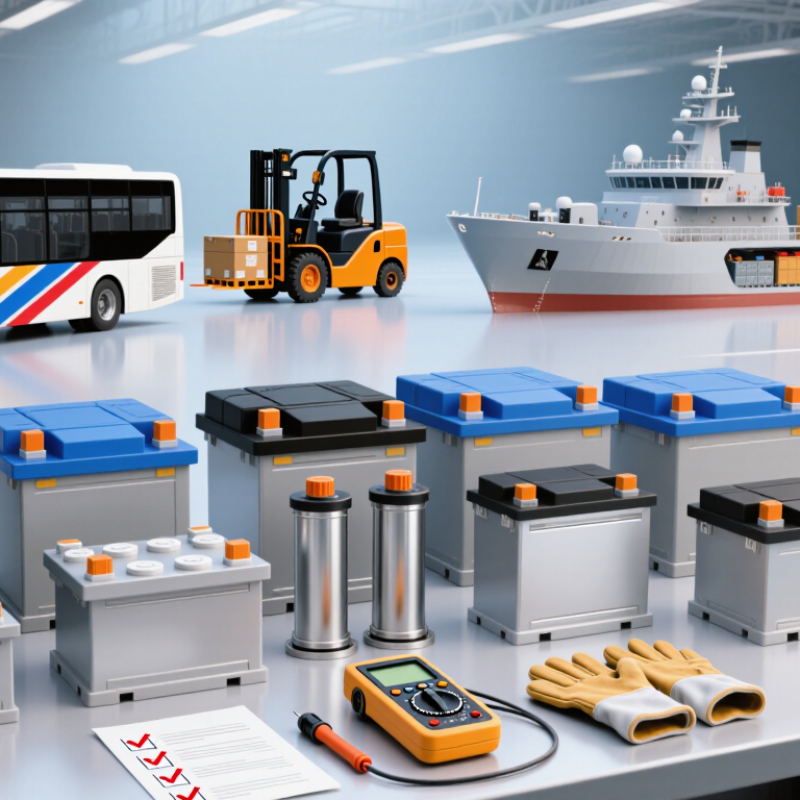
Define Large Lithium Battery Requirements for the Intended Application
Choosing a large lithium battery begins with the application, not the advertised capacity. A warehouse vehicle, backup system, and marine instrument have very different operating demands. Write down the equipment’s continuous voltage and peak current. Then measure the expected running time under real conditions.
A useful requirement sheet should include energy, cycle frequency, charging windows, and installation space. For example, a 48-volt system drawing 40 amps continuously needs about 1.92 kilowatts during operation. If it runs for five hours, the basic energy demand is 9.6 kilowatt-hours. Add a practical reserve for cold weather, aging, conversion losses, and unexpected load changes. Do not size only from laboratory figures.
Temperature deserves attention. Outdoor equipment may face freezing mornings, hot enclosures, dust, vibration, or moisture. Ask whether the battery management system can monitor cell temperature, voltage balance, overcurrent, and state of charge. Confirm connector types, cable length, mounting direction, and service access before ordering. Small installation details can create expensive redesigns.
I have seen projects fail because buyers trusted the motor’s label instead of measuring startup demand. That assumption was convenient, but wrong. Test the complete system with a temporary data logger when possible. Record peak current during acceleration, charging behavior, and performance near the lowest expected temperature. Requirements should also reflect local transport, storage, and electrical safety rules. Specifications look precise, yet field conditions remain imperfect.
How to Choose Large Lithium Batteries for Global Buyers - Define Large Lithium Battery Requirements for the Intended Application
| Intended Application |
Typical System Energy |
Common Nominal Voltage |
Recommended Usable Depth of Discharge |
Continuous Power Requirement |
Short-Term Peak Power |
Typical Daily Cycling |
Important Design Priorities |
| Residential Energy Storage |
5–30 kWh |
48–51.2 V DC or 200–500 V DC |
80–90% |
3–15 kW |
1.2–2.0 times continuous power for 1–10 seconds |
0.5–1 cycle per day |
Backup duration, inverter compatibility, low-noise operation, indoor installation, and automatic transfer capability. |
| Commercial and Industrial Energy Storage |
50 kWh–5 MWh |
400–1,500 V DC |
80–90% |
50 kW–2 MW |
Up to 1.5 times continuous power, depending on the power-conversion system |
1–2 cycles per day |
Demand-charge reduction, peak shaving, thermal management, fire protection, modular expansion, and remote monitoring. |
| Solar and Renewable-Energy Storage |
100 kWh–10 MWh |
600–1,500 V DC |
80–95% |
100 kW–5 MW |
Usually 1.1–1.5 times continuous power |
1 cycle per day, with seasonal variation |
Renewable-energy forecast accuracy, state-of-charge control, grid connection requirements, and high-temperature performance. |
| Electric Bus and Commercial Vehicle |
100–600 kWh |
400–800 V DC |
80–90% |
100–500 kW |
1.5–2.5 times continuous power during acceleration |
1–3 equivalent full cycles per day |
Weight, vibration resistance, fast charging, regenerative-braking power acceptance, liquid cooling, and electrical isolation. |
| Electric Truck and Heavy-Duty Vehicle |
300–1,000 kWh |
600–1,000 V DC |
80–90% |
200–800 kW |
Up to 2 times continuous power for short acceleration events |
0.5–2 equivalent full cycles per day |
High usable energy, rapid charging, robust mechanical construction, thermal uniformity, and cold-weather range retention. |
| Marine and Electric Vessel |
100 kWh–10 MWh |
400–1,000 V DC |
70–90% |
100 kW–5 MW |
1.2–2.0 times continuous power for maneuvering |
0.5–2 cycles per day |
Salt-mist protection, water ingress resistance, marine classification, shock and vibration tolerance, and emergency isolation. |
| Material-Handling Equipment |
10–100 kWh |
24–96 V DC |
80–90% |
5–100 kW |
1.5–2.5 times continuous power during lifting |
1–3 cycles per working day |
High charge acceptance, opportunity charging, frequent regenerative braking, compact packaging, and operator safety. |
| Telecommunication and Critical Backup |
10–500 kWh |
48 V DC or 192–800 V DC |
70–85% |
5–250 kW |
Up to 1.5 times continuous power |
Standby use with occasional discharge |
Long standby life, low self-discharge, rapid automatic switchover, remote alarms, and redundant battery monitoring. |
| Off-Grid and Remote Power System |
10–500 kWh |
48–800 V DC |
80–90% |
5–250 kW |
1.5–2.0 times continuous power for motor starting |
0.5–1 cycle per day |
Wide operating temperature range, serviceability, solar-charge compatibility, low maintenance, and reliable protection against over-discharge. |
Compare Lithium Battery Chemistries, Capacity, and Power Ratings
How to Choose Large Lithium Batteries for Global Buyers
Choosing a large lithium battery starts with chemistry, not price. Lithium iron phosphate offers strong thermal stability and long cycle life. It usually weighs more for the same energy. Nickel manganese cobalt batteries provide higher energy density and smaller enclosures. They need stricter thermal control and careful protection settings. Lithium titanate supports rapid charging and impressive cycle performance. However, its lower energy density and higher cost may limit practical use.
Capacity should be measured in usable watt-hours, not only advertised amp-hours. Multiply nominal voltage by amp-hours, then consider the permitted depth of discharge. A 48-volt, 200-amp-hour battery stores about 9.6 kilowatt-hours nominally. The available energy may be lower in cold weather or near the battery’s minimum voltage. That detail matters.
Power ratings deserve equal attention. Continuous power supports normal loads, while peak power handles short surges from pumps, compressors, or motor starts. Check the battery management system’s continuous current limit and the inverter’s surge demand. A battery can show high capacity but still fail under a sudden 8-kilowatt load. Field measurements often reveal this mismatch. A clean spreadsheet is not enough.
Compare charging temperature limits, enclosure protection, communication options, and service documentation. Ask for test reports, cycle-life conditions, and warranty exclusions. Specifications can look precise while hiding different testing methods. I would also leave capacity margin instead of designing around perfect weather and perfect efficiency. That choice costs more upfront, but real systems rarely operate perfectly.
Check Safety Standards, Certifications, and Transport Regulations
When choosing large lithium batteries, safety documents should be checked before price or capacity. The IEA’s Global EV Outlook 2024 reported that battery demand exceeded 750 GWh in 2023, increasing about 40% from 2022. This rapid growth makes verification more important, not less.
Ask suppliers for UN 38.3 test evidence, including the test summary and cell or battery identification. This standard covers transport-related risks such as vibration, shock, overcharge, and external short circuit. For stationary systems, IEC 62619 or equivalent national standards may apply. Some projects also require certification under local electrical or fire codes. A certificate alone is not enough. Check its scope, expiration date, model number, and testing laboratory.
Transport planning needs equal attention. Air shipments generally follow IATA Dangerous Goods Regulations, while sea freight uses the IMDG Code. Road requirements may involve ADR or local rules. Confirm the battery’s watt-hour rating, state of charge limits, packaging instructions, labels, and emergency contact details. Terminals should be protected, and damaged units must never enter normal cargo. Request a safety data sheet and written confirmation of lithium battery classification. The IATA 2024 guidance restricts many lithium-ion batteries shipped by air to 30% state of charge, unless specific conditions are met.
Regulations change. Product pages can become outdated. A careful buyer should recheck requirements with the carrier and destination authority before dispatch. Mistakes often happen in paperwork, not chemistry.
Evaluate Suppliers, Manufacturing Quality, and Warranty Support
Global buyers should treat supplier evaluation as a technical investigation, not a catalog comparison. In 2023, the International Energy Agency reported that electric vehicle battery demand exceeded 750 GWh. BloombergNEF recorded an average lithium-ion pack price of 115 dollars per kWh in 2024, down 20 percent. Lower prices increase opportunity, but they can also hide weaker cells, rushed assembly, or limited after-sales support.
Request cell-level traceability, incoming inspection records, and production test results. Examine weld consistency, insulation, thermal management, and battery management system logs. Ask whether samples undergo capacity, vibration, overcharge, and temperature testing. Compliance with IEC 62619 and UN 38.3 supports safer industrial use and transportation. A factory video is useful, but an independent audit is stronger. No audit predicts every field failure.
Warranty language deserves equal attention. Confirm the retained-capacity threshold, cycle limit, operating temperature, installation duties, and excluded misuse. Require a written response time for faults, replacement procedures, and access to spare modules. A supplier that shares failure-rate data and corrective-action reports usually shows greater accountability. However, reported figures may be selective. I would compare them with shipment records and third-party test results. A low warranty claim rate means little without a clear denominator. Condition monitoring, periodic capacity checks, and documented service training can reveal problems before a large battery bank becomes an expensive interruption.
How to Choose Large Lithium Batteries for Global Buyers
A practical supplier assessment should prioritize manufacturing quality and safety,
while still verifying supplier capability and long-term warranty support.
Suggested purchasing framework: manufacturing quality includes traceability, process control,
safety testing, and compliance evidence such as UN 38.3 and IEC 62619. Supplier capability
covers production capacity, export experience, and quality-system documentation. Warranty
support covers written warranty terms, capacity-retention commitments, spare parts, and RMA procedures.