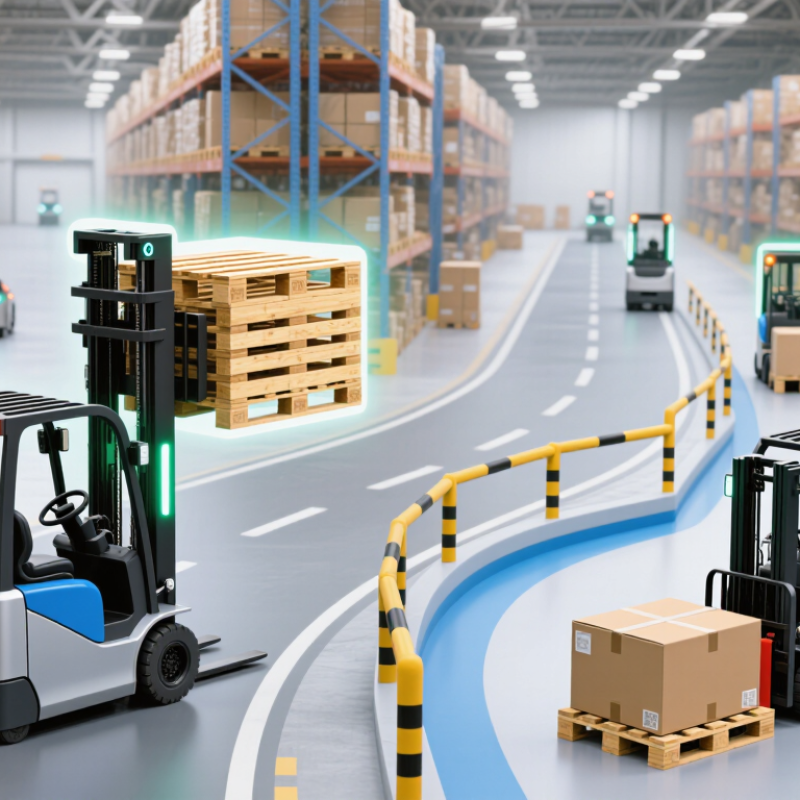
| Automated Pallet Truck | Moves pallets at floor level using onboard sensors, mapping software and warehouse-management-system instructions. | Approximately 1,000–2,500 kg | Floor-level transport; limited or no high-level lifting | Approximately 1.5–2.5 m/s, depending on load and site conditions | Horizontal pallet movement, staging areas, dock-to-storage transfers and production-line replenishment | Best where repetitive transport routes are predictable and pallet presentation is consistent. |
| Automated Counterbalance Forklift | Uses cameras, laser scanners, inertial sensors or combinations of these technologies to navigate without a fixed guide path. | Approximately 1,500–3,500 kg | Approximately 3–6 m | Approximately 1.5–2.5 m/s | General pallet handling, truck loading and unloading, manufacturing warehouses and mixed-use distribution areas | Requires adequate turning space, floor quality, pedestrian controls and accurate pallet detection. |
| Automated Reach Truck | Combines autonomous navigation with a reach mechanism for depositing and retrieving pallets in narrow storage aisles. | Approximately 1,000–2,000 kg | Approximately 6–11 m | Approximately 1.0–2.0 m/s | High-density pallet storage, narrow aisles and distribution centers with tall racking | Suitable rack geometry, aisle width, rack condition and load-center requirements are critical. |
| Automated Very-Narrow-Aisle Truck | Operates in narrow aisles with precise localization, aisle guidance and automated pallet placement. | Approximately 1,000–2,000 kg | Approximately 8–16 m | Approximately 0.8–1.5 m/s in narrow aisles | High-bay warehouses where storage density is more important than flexible aisle access | Needs carefully planned rack spacing, consistent pallet dimensions and reliable floor flatness. |
| Automated Stacker Crane Forklift | Travels along dedicated storage aisles and uses a mast or load-handling device to place pallets into fixed rack locations. | Approximately 500–2,000 kg per load | Approximately 10–25 m, depending on system design | System-specific; generally optimized for controlled, dedicated aisles | Automated storage and retrieval systems, cold stores, high-bay warehouses and controlled inventory environments | Offers high storage density but requires significant infrastructure and a stable warehouse layout. |
| Towing Automated Forklift | Pulls one or more carts or trailers along programmed routes using autonomous navigation and obstacle detection. | Trailer-dependent; often several tonnes of total train load | Not applicable; transports floor-level carts | Approximately 1.0–2.0 m/s | Line-side delivery, kitting, waste collection and repeated movement of materials between work areas | Route width, trailer coupling, stopping distance and traffic rules must be designed for the full train length. |
| Hybrid Automated Forklift | Supports autonomous operation while allowing supervised manual control for exceptions, unusual loads or maintenance tasks. | Approximately 1,000–3,500 kg | Approximately 3–8 m | Approximately 1.0–2.5 m/s | Warehouses with variable workflows, changing layouts or a gradual transition from manual to automated handling | Useful when flexibility is important, but operator training and clear operating modes are essential. |
| Navigation Technology | Common methods include laser-based mapping, camera-based perception, inertial measurement, wheel odometry, magnetic guidance and QR or reflective markers. | Not applicable | Not applicable | Determined by vehicle type, traffic density and safety limits | Navigation choice depends on whether the site needs flexible routing, fixed paths or high positional accuracy. | Consider lighting, dust, reflective surfaces, changing obstacles, map maintenance and localization reliability. |
| Safety and Control Functions | Typical functions include obstacle detection, protective fields, emergency stopping, speed reduction, audible or visual alerts and controlled interaction with pedestrians. | Not applicable | Not applicable | Reduced automatically in high-risk zones or near people | All facilities where automated vehicles share space with employees, visitors or manually operated equipment | Safety design should be validated through a site risk assessment and applicable machinery-safety requirements. |
| Battery and Charging | Electric drive systems commonly use lead-acid or lithium-ion batteries with scheduled, opportunity or automated charging. | Not applicable | Not applicable | Performance may vary with battery state and payload | Multi-shift warehouses, manufacturing sites and operations requiring predictable vehicle availability | Compare shift length, charging windows, battery replacement needs, temperature range and charging-room requirements. |
| Integration Requirements | Fleet software can exchange job requests, inventory status and traffic information with warehouse-management or manufacturing-execution systems. | Not applicable | Not applicable | Depends on task queues, traffic management and system response time | Facilities seeking coordinated transport, traceability and fewer manual dispatch decisions | Evaluate interface compatibility, cybersecurity, data ownership, exception handling and system scalability. |
| Best Overall Selection Criteria for 2026 | Choose the vehicle type that matches the material flow rather than selecting solely by rated capacity or advertised speed. | Must exceed the heaviest routine load with an appropriate safety margin | Must match rack height, pallet dimensions and required clearance | Should support required throughput without compromising safe stopping distances | Sites with repetitive, measurable workflows and stable material-handling rules generally provide the strongest automation case. | Assess total cost of ownership, safety validation, uptime, serviceability, integration effort, facility changes and future scalability. |