| Roll-Bond Evaporator | Two aluminum sheets are formed, welded, and expanded to create internal refrigerant channels. The finished panel is usually curved around a cold-water tank. | Direct-cooling bottle dispensers, countertop water coolers, and compact cold-water units. | Approximately 60–250 W for compact water-cooling systems. | Commonly designed for R600a, R290, R134a, or other refrigerants specified by the refrigeration system design. | Indirect contact with the water tank through the evaporator wall or mounting surface. | Lightweight; compact; low material usage; easy to shape around cylindrical tanks; suitable for mass production. | Limited internal channel flexibility; repair is difficult if the panel develops a leak; heat transfer depends strongly on surface contact and mounting quality. | Choose when the water cooler requires a compact, low-cost, curved evaporator with moderate cooling capacity. |
| Copper Tube-in-Tank Evaporator | Refrigerant flows through a copper tube attached to, wrapped around, or inserted into a cold-water tank, often with thermal insulation around the assembly. | Traditional compressor water coolers and units where a separate tank and evaporator assembly are preferred. | Approximately 80–350 W, depending on tube length, compressor size, and operating conditions. | R134a, R600a, R290, and other refrigerants when the tube, lubricant, compressor, and expansion device are properly matched. | Indirect contact through the tank wall or a thermally bonded surface. | Flexible layout; relatively easy to manufacture in different sizes; serviceable components; good compatibility with customized tank designs. | May require more assembly labor; thermal contact can be less uniform than an integrated panel; copper material cost can be higher. | Choose when design flexibility, serviceability, or a custom tank shape is more important than the smallest possible package. |
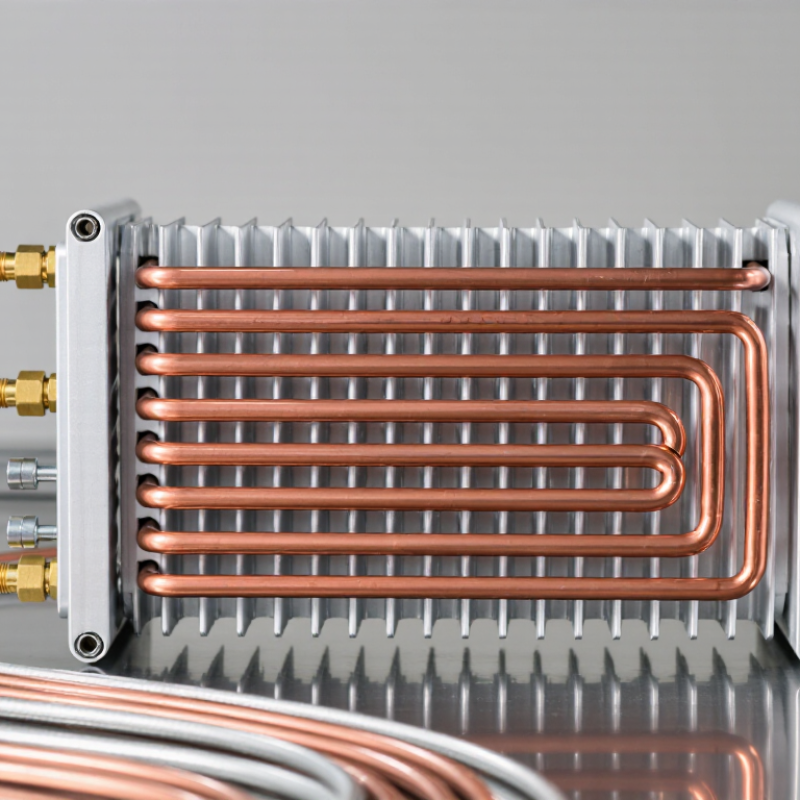
| Copper Tube with Aluminum-Fin Evaporator | Copper refrigerant tubes pass through or are bonded to aluminum fins. A fan moves air across the fin surface. | Air-cooled refrigeration modules, fan-assisted water coolers, and systems that cool a water tank through a secondary air circuit. | Approximately 100–500 W in small appliance applications, subject to airflow and ambient temperature. | R134a, R600a, R290, and other refrigerants selected according to compressor and system design. | Refrigerant cools air first; the cooled air then removes heat from the water tank or internal compartment. | Large heat-transfer area; widely understood manufacturing process; suitable for forced-air cooling and modular refrigeration assemblies. | Requires a fan and air path; produces fan noise; can accumulate dust; usually less direct and less compact than a tank-mounted evaporator. | Choose when higher air-side heat transfer, modular installation, or separation between the refrigeration circuit and water tank is required. |
| Stainless-Steel Coil Evaporator | A stainless-steel tube coil is installed inside or around a water tank, with the refrigeration circuit isolated from the potable water. | Specialized direct-cooling units, larger cold-water tanks, and designs requiring enhanced corrosion resistance. | Approximately 100–400 W for small and medium water-cooling equipment. | Depends on the refrigeration circuit; R600a, R290, R134a, and similar refrigerants may be used with suitable components. | Indirect contact between the refrigerant coil and the water through the coil wall. | Good corrosion resistance; strong mechanical durability; suitable for humid environments and larger tank assemblies. | Higher material and fabrication cost; stainless steel generally has lower thermal conductivity than copper; coil forming may require specialized tooling. | Choose when corrosion resistance, mechanical strength, and long service life are priorities. |
| Shell-and-Tube Evaporator | A refrigerant circuit and a water circuit are separated by a heat-transfer wall inside a compact shell-and-tube heat exchanger. | Larger water-cooling systems, commercial dispensers, and systems using a circulating water loop. | Approximately 300 W to several kilowatts, depending on size, flow rate, and temperature difference. | Selected according to the compressor, expansion device, pressure rating, and heat-exchanger design. | Refrigerant cools circulating water through a separating tube wall. | Scalable capacity; controlled water flow; good separation between refrigerant and potable water; suitable for continuous-duty systems. | More expensive and complex; requires a pump or reliable water circulation; may be oversized for household bottle coolers. | Choose when the water cooler has a circulating loop, high demand, or commercial-grade cooling requirements. |
| Plate Heat-Exchanger Evaporator | Multiple corrugated metal plates create separate refrigerant and water channels with a large heat-transfer area in a compact package. | Compact commercial systems, high-efficiency water chillers, and water coolers with controlled circulation. | Approximately 500 W to several kilowatts, depending on plate area, flow rate, and system design. | Refrigerant selection depends on pressure rating, plate material, brazing method, compressor, and expansion control. | Refrigerant and water exchange heat across thin metal plates without mixing. | High heat-transfer efficiency; compact size; low water-side hold-up volume; suitable for higher-capacity systems. | Requires clean water flow; sensitive to incorrect flow conditions; replacement and cleaning can be more specialized than for simple tank evaporators. | Choose when compactness and high heat-transfer performance are more important than the lowest initial cost. |