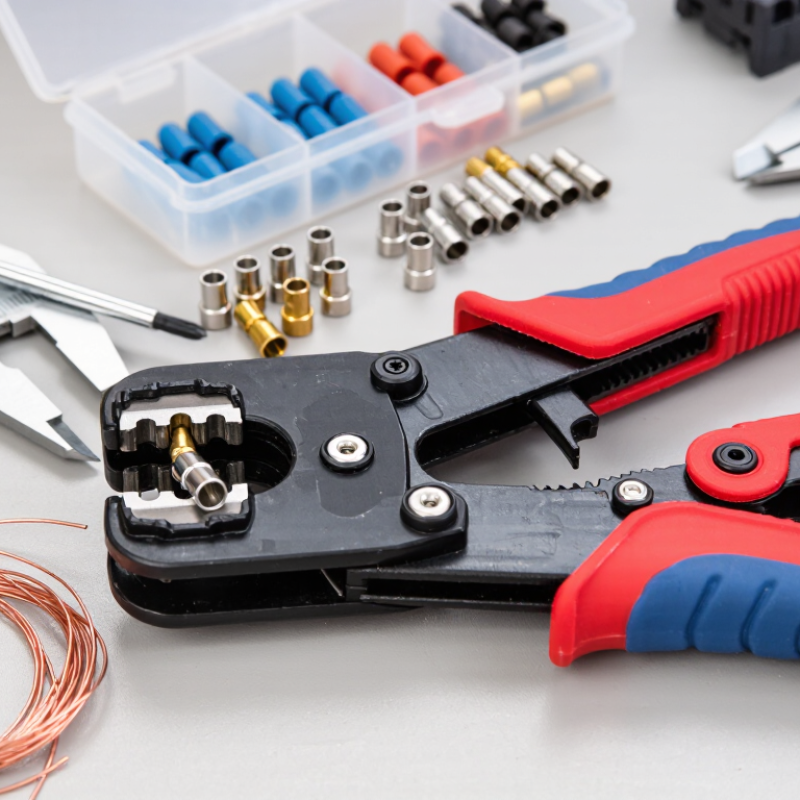
| Comparison of Common Manual Hand Crimper Designs |
| Ratcheting Insulated Terminal Crimper For red, blue, and yellow insulated terminals | Electrical repairs, control panels, automotive wiring, and general cable termination. | 0.5–6.0 mm²
Approximately 20–10 AWG
Common terminal sizes: red, blue, and yellow | Full-cycle ratchet helps complete each crimp.
Color-coded die cavities match common terminal insulation colors.
Factory-set dies are normally sufficient for standard terminals. | Hardened carbon-steel jaws.
Replaceable or serviceable pivot hardware on higher-quality designs.
Typical service life: about 10,000–20,000 crimps when correctly used. | Ratchet release lever for emergency opening.
Non-slip molded handles.
Insulated handles improve grip but do not make the tool electrically live-safe. | Brush away terminal fragments after use.
Apply a small amount of light tool oil to the pivot every few months.
Store closed in a dry location. | ★★★★★ | General electrical work requiring repeatable crimps without frequent adjustment. |
| Ratcheting Non-Insulated Terminal Crimper For bare copper and non-insulated terminals | Battery cables, grounding connections, industrial wiring, and ring or fork terminals. | 0.5–6.0 mm²
Approximately 20–10 AWG
Some larger versions cover up to 16 mm² | Closed-cycle ratchet improves consistency.
Contoured die cavities support the terminal barrel.
Some models include an adjustable pressure wheel for terminal variation. | Drop-forged or hardened steel frame is preferred.
Wide jaws reduce uneven loading.
High-load designs commonly use riveted or bolted pivots. | Ratchet release prevents a partially compressed terminal from being trapped.
Textured handles reduce hand slippage.
Eye protection is recommended because bare terminals can produce sharp edges. | Remove copper particles from the dies.
Inspect die edges for mushrooming or cracks.
Lubricate the pivot lightly and avoid oil on the crimping surfaces. | ★★★★★ | Reliable compression of bare terminals where mechanical strength is important. |
| Open-Barrel F-Crimp Tool For automotive and electronic open-barrel contacts | Automotive connectors, compact harnesses, sensor wiring, and electronic assemblies. | Approximately 0.1–2.5 mm²
Approximately 26–13 AWG
Depends strongly on terminal design and conductor size | Separate conductor and insulation crimp sections.
Formed F-crimp supports the conductor without flattening it.
Narrow dies help prevent contact distortion. | Hardened precision-ground dies are preferred.
Rigid frame limits jaw misalignment.
Replaceable dies are useful for frequent harness production. | Ratchet mechanism helps prevent incomplete crimps.
Handle guards reduce finger pinch risk.
Verify terminal retention with a light pull test before installation. | Clean the narrow dies with a soft brush.
Do not file or widen the die cavities.
Check alignment regularly because small jaw errors affect contact fit. | ★★★★★ | Small-gauge wiring where terminal shape, contact fit, and conductor support are critical. |
| Coaxial Compression Crimper For coaxial cable compression connectors | Television, satellite, security camera, broadband, and antenna cable installations. | Commonly RG-6 and RG-59
Some designs also support RG-58 or other specified cable sizes
Connector compatibility must be checked | Fixed or adjustable compression stop.
Interchangeable inserts may support different connector families.
Correct cable-strip length is essential for accurate results. | Die inserts should be hardened and corrosion-resistant.
Reinforced frame withstands repeated compression cycles.
Replaceable inserts extend tool life. | Non-slip handles improve control at awkward installation angles.
A controlled stop reduces over-compression.
Keep the connector and cable free of loose braid strands. | Wipe the compression chamber after use.
Keep inserts free of dirt and metal debris.
Confirm the stop setting when changing connector types. | ★★★★★ | Fast, repeatable termination of coaxial connectors in field installations. |
| Manual Hydraulic Cable Lug Crimper For large copper or aluminum cable lugs | Battery systems, distribution wiring, solar installations, grounding, and heavy cable work. | Commonly 10–300 mm²
Approximately 8 AWG to 600 kcmil, depending on die set
Copper and aluminum compatibility must be confirmed | Interchangeable hex or indent dies.
Hydraulic pressure provides high compression with lower hand effort.
Correct die size and crimp sequence are essential. | Steel body with hardened die holders.
Sealed hydraulic system is preferred for dusty work areas.
Typical rated force ranges from approximately 6 to 12 tons. | Pressure-release valve allows controlled opening.
Handles should have secure non-slip grips.
Never exceed the tool’s rated cable and terminal range. | Inspect for hydraulic leaks before every use.
Keep dies clean and lightly protected against corrosion.
Replace seals or hydraulic fluid according to the service instructions. | ★★★★★ | Large conductors requiring high compression force without powered equipment. |
| Compound-Leverage Manual Crimper For medium-size terminals and cable lugs | Workshop assembly, maintenance teams, marine wiring, and medium-duty electrical repairs. | Approximately 1.5–16 mm²
Approximately 16–5 AWG
Some versions use interchangeable die sets | Compound linkage increases mechanical advantage.
Die stops help position the terminal consistently.
Adjustable pressure improves compatibility with different terminal barrels. | Forged-steel or heat-treated alloy frame.
Replaceable dies reduce long-term tool cost.
Reinforced pivot minimizes deflection under load. | Locking handle keeps the tool closed during storage.
Anti-pinch handle design is preferable.
Use insulated gloves where the work procedure requires them. | Inspect the linkage for looseness.
Lubricate pins and pivots lightly.
Replace worn dies rather than reshaping them manually. | ★★★★★ | Users who need more force than a standard hand crimper but do not need a hydraulic tool. |
| Selection Checklist for 2026 |
| Precision | Choose a tool with a correctly matched die profile, a controlled ratchet or pressure stop, minimal jaw movement, and a clearly defined terminal range. A crimp should hold the conductor firmly without cutting or excessively flattening the terminal barrel. |
| Durability | Look for hardened or forged steel construction, corrosion-resistant die surfaces, secure pivot hardware, replaceable dies where practical, and a handle material that remains comfortable after repeated use. |
| Safety | Prefer a controlled ratchet, emergency release, non-slip handles, protected pivot points, and a positive storage lock. Always disconnect power before crimping and use the correct personal protective equipment for the installation. |
| Maintenance | Remove debris after use, keep crimping cavities dry and clean, lubricate only pivots or linkage points, inspect for cracks and looseness, and recalibrate or replace the tool if completed crimps become inconsistent. |
| Verification | After crimping, perform a visual inspection and an appropriate pull test. For critical installations, verify the crimp against the terminal manufacturer’s specified height, force, or electrical-resistance requirements. |