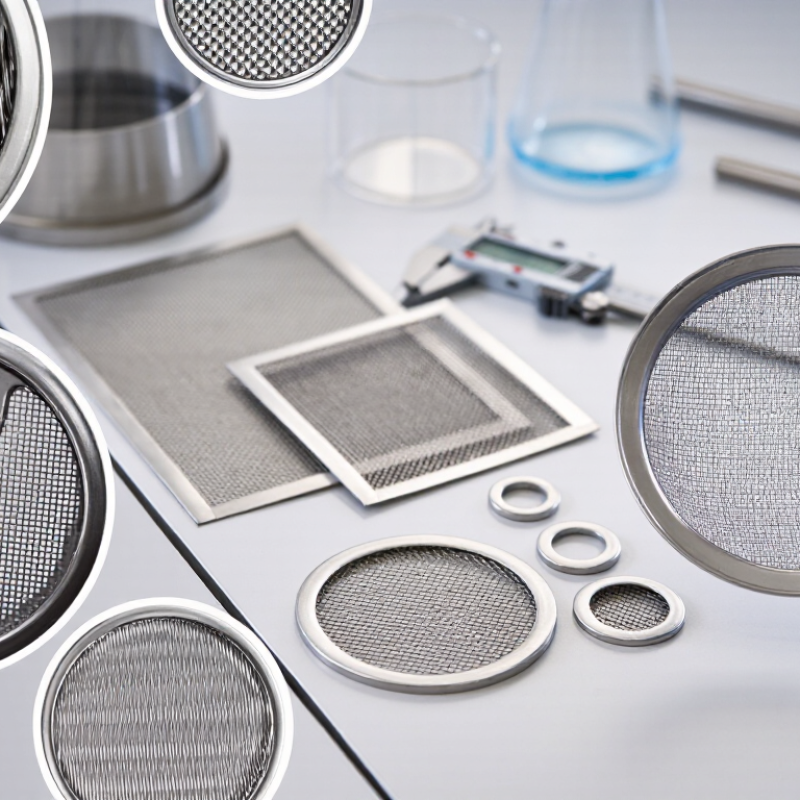
| Mesh grade | Match the alloy to the process fluid, contaminants, and cleaning chemicals. | Type 304 stainless steel is commonly used in general service. Type 316L contains molybdenum and is often selected for improved resistance to chloride-containing environments; it is not immune to chloride corrosion. | Specify the grade for the mesh, support layers, housing, and wetted fittings. Check the chemical composition and corrosion suitability for the actual fluid and concentration. |
| Filtration opening | Define the target particle size and whether the requirement is nominal or absolute. | Woven mesh opening depends on both mesh count and wire diameter. Mesh count alone does not define the clear opening or guarantee a specific particle-removal efficiency. | Request the nominal aperture in micrometres, opening tolerance, test method, and particle-retention performance under the intended flow conditions. |
| Operating pressure | Check both system pressure and pressure differential across the filter element. | There is no universal pressure rating for wire mesh. Capacity depends on the element geometry, wire diameter, support structure, end connections, housing, and temperature. | Confirm maximum operating and design pressure, expected clean and dirty differential pressure, allowable differential pressure, and the point for cleaning or replacement. |
| Temperature | Evaluate the complete assembly at normal operation, start-up, shutdown, and upset conditions. | The usable temperature limit is set by the full assembly—not just the stainless-steel grade. Seals, joints, supports, corrosion conditions, and thermal cycling can impose lower limits. | Document the minimum and maximum process temperatures, exposure duration, temperature cycling, and the limits of every wetted component. |
| Flow and loading | Estimate flow rate, fluid viscosity, contaminant concentration, and solids characteristics. | Higher viscosity, higher flow, or increased solids loading can raise pressure drop and shorten the interval between cleaning cycles. | Validate flow at the expected operating range, clean-element pressure drop, dirt-holding behavior, and the effect of peak or intermittent solids loading. |
| Cleaning method | Check chemical compatibility and mechanical limits for the planned cleaning process. | Backwashing, rinsing, ultrasonic cleaning, and chemical cleaning may be suitable in different applications. Strong oxidizers, acids, alkalis, chlorides, and aggressive brushing can damage the mesh or its assembly depending on conditions. | Confirm cleaning chemicals and concentrations, temperature, contact time, rinse requirements, permitted mechanical action, and the number of validated cleaning cycles. |
| Construction and support | Review the mesh weave, layer arrangement, seams, edge treatment, and support design. | Fine mesh can deform or tear if unsupported under differential pressure. A support layer can improve strength but may affect flow and cleaning access. | Check dimensions, joining method, support arrangement, bypass risk, and inspection criteria for damage after operation and cleaning. |
| Validation criteria | Define measurable acceptance limits before testing. | Validation should represent the actual fluid, operating temperature, flow range, pressure differential, and cleaning procedure. | Set acceptance criteria for particle retention, clean pressure drop, maximum differential pressure, leakage or bypass, corrosion, and post-cleaning performance. |