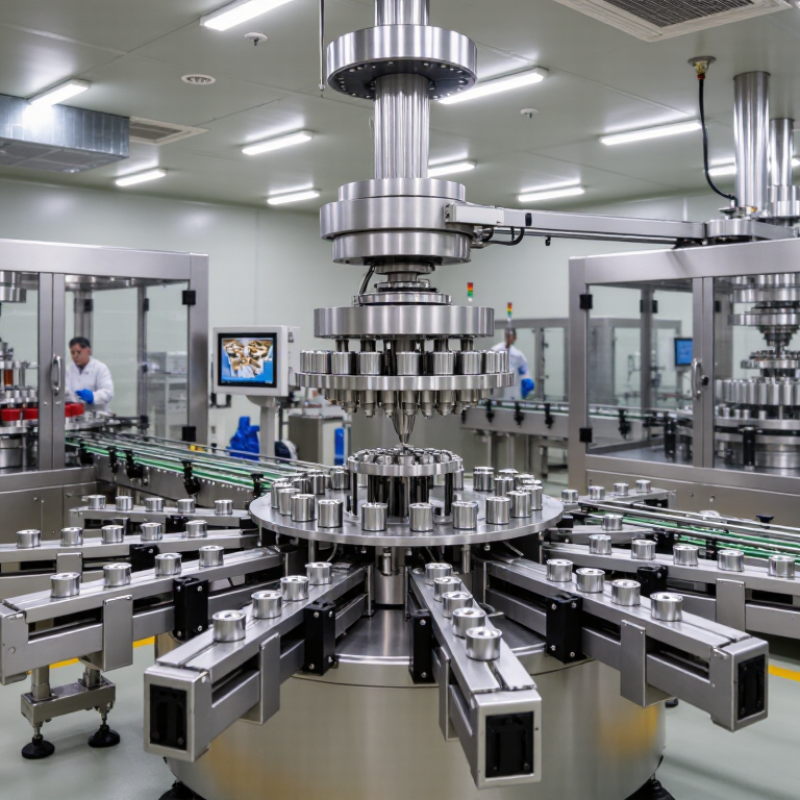
| Cell Preparation | Feeds, orients, and transfers cylindrical cells or cell components into the assembly line. | Automatic feeding system, indexing conveyor, barcode or code reader, and positioning fixture. | Positioning accuracy: Consistent cell orientation and controlled transfer without dents or deformation. | Battery-cell production lines, module assembly lines, and automated inspection stations. |
| Insulation and Protection | Applies insulating materials and protective components to reduce the risk of short circuits and mechanical damage. | Insulation-sleeve insertion, insulating washer placement, adhesive application, or protective-film wrapping. | Coverage and adhesion: Uniform insulation coverage with no wrinkles, exposed conductive areas, or loose edges. | High-volume rechargeable battery packs, power tools, portable equipment, and electric mobility products. |
| Cell Sorting and Matching | Groups cells according to measured electrical and physical characteristics before module assembly. | Voltage measurement, internal-resistance testing, capacity data integration, and automated binning. | Matching consistency: Cells in the same group should have closely aligned electrical characteristics. | Battery modules requiring balanced performance, including traction and stationary energy-storage systems. |
| Cell Arrangement | Places cylindrical cells into a specified row, column, or staggered configuration. | Robotic pick-and-place unit, multi-axis positioning system, cell tray, and module fixture. | Array accuracy: Correct spacing, polarity orientation, and cell count within each module. | Two-wheeled vehicles, electric vehicles, backup power systems, and industrial battery packs. |
| Busbar or Connector Installation | Positions conductive connectors that electrically link individual cells or parallel groups. | Busbar feeding, connector placement, clamping, laser welding, resistance welding, or ultrasonic welding. | Electrical and mechanical integrity: Low-resistance joints, controlled weld energy, and adequate pull strength. | Battery modules for transportation, industrial machinery, energy storage, and automated equipment. |
| Welding and Joining | Creates permanent electrical and mechanical connections between cells, terminals, busbars, and protection components. | Resistance-welding head, laser-welding system, weld monitoring, pressure control, and cooling system. | Weld quality: Stable current, voltage, duration, electrode force, penetration, and absence of excessive heat damage. | High-throughput battery-module manufacturing where repeatable connections are required. |
| Electrical Testing | Checks the assembled module for continuity, polarity, insulation, and electrical performance. | Open-circuit-voltage test, resistance test, insulation-resistance test, dielectric withstand test, and continuity test. | Electrical safety: Correct polarity, acceptable resistance, insulation integrity, and no unintended short circuit. | Consumer electronics packs, power tools, light electric vehicles, and industrial battery systems. |
| Battery Management System Integration | Installs and connects the battery-management-system components used to monitor and protect the battery pack. | Board placement, connector insertion, wire routing, terminal fastening, and communication-interface testing. | Signal reliability: Secure connections, correct wiring sequence, temperature-sensor placement, and communication functionality. | Rechargeable battery packs requiring monitoring of voltage, current, temperature, and state of charge. |
| Mechanical Compression and Housing | Secures the cell array and installs structural components that help maintain alignment and protect the module. | Compression fixture, end-plate installation, frame assembly, screw fastening, adhesive dispensing, and enclosure closing. | Structural stability: Controlled compression, fastening torque, dimensional accuracy, and protection from vibration. | Vehicle battery modules, stationary storage cabinets, robotics, and industrial power systems. |
| Final Inspection and Traceability | Confirms that the completed module meets process and safety requirements and records production data. | Vision inspection, dimensional inspection, code marking, database upload, leak testing where applicable, and end-of-line testing. | Traceability: Recorded measurements for cell identification, weld results, test results, and assembly history. | Regulated battery manufacturing, automotive supply chains, energy storage, and quality-controlled industrial production. |
| Where the Machines Are Used | Automates repeatable cylindrical-cell handling and module or pack assembly operations. | Used as standalone stations, semi-automatic lines, or fully integrated production lines. | Production objective: Higher consistency, improved throughput, reduced manual handling, and safer process control. | Electric vehicles, hybrid vehicles, electric bicycles, power tools, consumer electronics, medical equipment, robotics, aerospace systems, and stationary energy storage. |