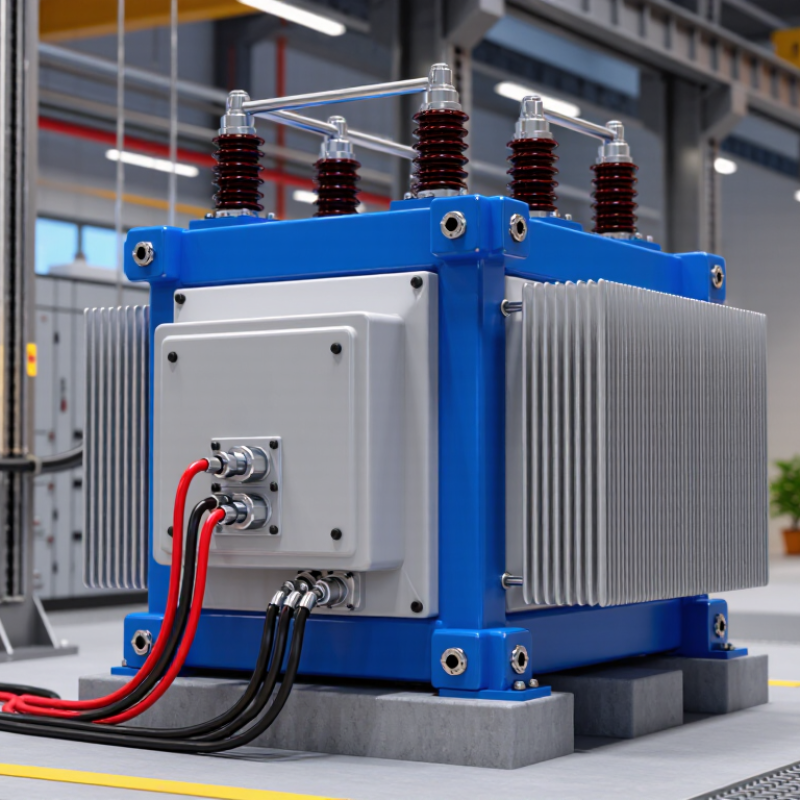
| Zig-Zag Grounding Transformer | Interconnected-star winding with an accessible neutral point | Commonly considered for 6 kV, 10 kV, and 35 kV distribution systems where a neutral point is not available | Creates an artificial neutral and provides a low-impedance path for zero-sequence current | Compact design; efficient zero-sequence performance; normally does not require a separate secondary load supply | Its continuous grounding capacity must be checked carefully; it is not intended to supply ordinary three-phase loads unless specifically designed for that purpose | Artificial neutral required |
| Star-Delta Grounding Transformer | Grounded wye primary with delta secondary, often with an accessible neutral | Medium-voltage networks requiring a neutral point and, in some designs, a small auxiliary power source | Provides a neutral point while the delta winding helps circulate zero-sequence components internally | Can offer an auxiliary secondary winding; suitable when grounding and limited station-service power are required together | Usually larger and more costly than a grounding-only zig-zag unit; the secondary rating must be coordinated with the actual auxiliary load | Grounding plus auxiliary supply |
| Grounding Transformer with Neutral Grounding Resistor | Grounding transformer neutral connected to a resistor before the earth connection | 6–35 kV systems where earth-fault current must be limited to a defined engineering value | Establishes a neutral and limits single-line-to-ground fault current through resistance | Reduces thermal and mechanical fault stress; supports selective earth-fault protection and controlled fault-current levels | Requires resistor thermal-duty verification, insulation coordination, protection settings, and adequate outdoor ventilation where applicable | Controlled fault current |
| Grounding Transformer with Neutral Grounding Reactor | Grounding transformer neutral connected to a reactor before the earth connection | Networks where inductive grounding is selected after system capacitance and resonance conditions are studied | Introduces inductive impedance to limit or control zero-sequence current | Can reduce earth-fault current while avoiding the continuous power losses associated with a resistor | System capacitance, resonance, transient overvoltage, and protection coordination require detailed study | Inductive grounding design |
| Grounding Transformer with Petersen Coil | Neutral connected to a tuned arc-suppression coil | Selected for certain medium-voltage overhead or mixed networks with significant capacitive earth-fault current | Compensates a substantial portion of the network's capacitive earth-fault current | Can reduce arcing current and help maintain service during some transient single-line-to-ground faults, subject to local operating rules | Requires accurate network-capacitance assessment, tuning, automation, and suitable earth-fault protection | Capacitive-current compensation |
| Grounding Transformer with Solidly Grounded Neutral | Neutral connected directly to the grounding grid or earth system | Systems designed to permit high earth-fault current for rapid protective-device operation | Provides a low-impedance zero-sequence path and establishes a firm reference to earth | Simple configuration; fast and decisive fault detection when protection is correctly coordinated | Earth-fault current can be high, increasing equipment stress and requiring a robust grounding grid and appropriately rated switchgear | Fast fault clearing |
| Dry-Type Grounding Transformer | Usually zig-zag or star-delta winding construction without liquid insulation | Indoor substations, renewable-energy collection systems, industrial facilities, and locations with fire-safety restrictions | Provides the same artificial-neutral or auxiliary-supply function as the selected winding arrangement | No liquid leakage risk; suitable for indoor installation; simplified fire-safety management | Heat dissipation, enclosure ventilation, audible noise, and altitude derating must be considered | Indoor or fire-sensitive sites |
| Oil-Immersed Grounding Transformer | Usually zig-zag or star-delta winding construction in an insulating-liquid tank | Outdoor substations and applications requiring high insulation strength or rugged environmental performance | Provides an artificial neutral and can be combined with a resistor, reactor, or other neutral-grounding equipment | Effective heat transfer; commonly suitable for outdoor service and higher-duty applications | Requires liquid maintenance, leak prevention, fire-risk assessment, and suitable installation clearances | Outdoor and higher-duty service |