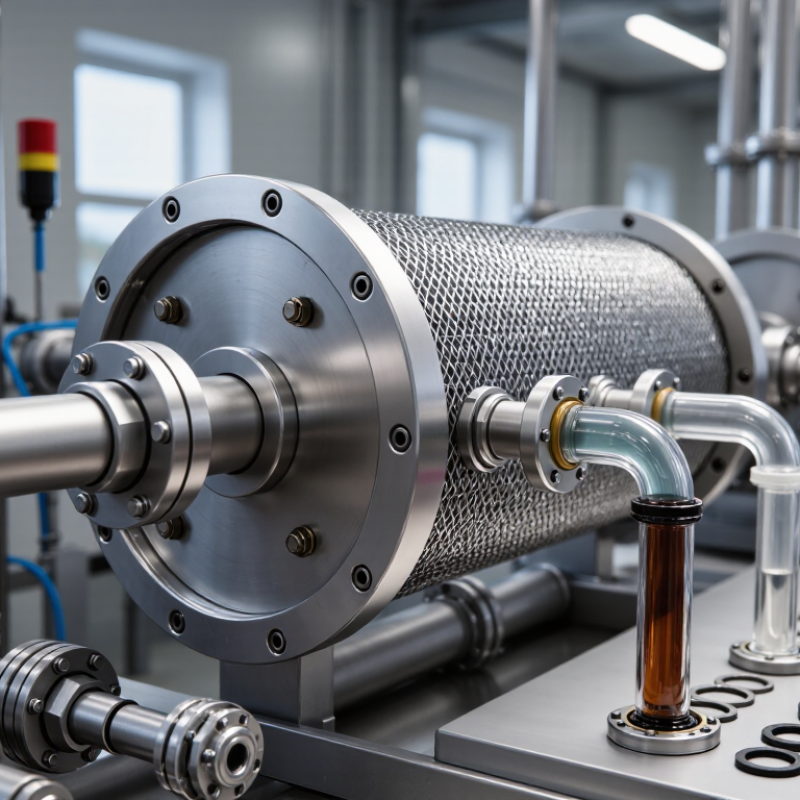
| Rotary Drum Screen | A rotating cylindrical screen retains solids on the drum surface while liquid passes through the perforations or mesh. A scraper or spray system removes the screened material. | Approximately 0.2–3 mm, depending on the screen opening and media design. | Large or fibrous solids, moderate suspended-solids loads, and relatively free-flowing liquids. | Continuous, usually driven by gravity flow or a feed pump. | Simple construction, continuous solids removal, low shear, and relatively low energy demand. | Not intended for dissolved contaminants or very fine particles; mesh blinding can occur with greasy or sticky solids. | Pre-treatment of industrial wastewater, municipal wastewater screening, food-processing effluent, and process-water protection. |
| Rotary Disc Filter | Several cloth-covered discs rotate through a tank. Water flows through the filter cloth, while suspended solids accumulate on the cloth and are removed by backwashing. | Typically about 10–60 micrometres, depending on cloth rating, hydraulic loading, and solids characteristics. | Low-to-moderate suspended solids after upstream treatment; best where fine polishing is required. | Continuous or semi-continuous, commonly controlled by water-level difference or head loss. | Compact footprint, efficient tertiary polishing, low hydraulic head requirement, and automatic backwashing. | Cloth fouling may increase when oil, grease, algae, or sticky solids are present; upstream clarification may be necessary. | Tertiary wastewater treatment, reuse-water polishing, cooling-water filtration, and removal of fine suspended solids. |
| Rotary Vacuum Drum Filter | A partially submerged drum rotates under vacuum. Filtrate passes through the filter cloth, forming a cake on the outer surface; the cake is dewatered, washed, and discharged. | Commonly about 5–100 micrometres, primarily determined by the filter cloth and the solids’ particle-size distribution. | Slurries with a sufficient concentration of filterable solids that can form a permeable cake. | Continuous vacuum-assisted operation. | Continuous cake formation, optional cake washing, good throughput for many mineral and chemical slurries, and established mechanical design. | Vacuum performance declines with highly compressible cakes; cloth selection and cake release can be critical. | Mineral processing, chemical slurries, pigment recovery, biomass separation, and industrial solids dewatering. |
| Rotary Pressure Filter | A rotating drum or disc contains filter compartments. Feed pressure forces liquid through the filter medium while solids form a cake that is discharged continuously. | Often about 1–100 micrometres, depending on the filter medium, pressure, and cake properties. | Concentrated slurries requiring higher driving force or improved cake dryness compared with gravity or vacuum systems. | Continuous pressure filtration; operating pressure is selected according to equipment and process design. | Higher driving force than vacuum filtration, continuous cake discharge, and potential for relatively dry filter cakes. | Higher capital and operating complexity; seals, pressure control, and cloth maintenance require careful attention. | Fine chemical processing, mineral concentrates, catalyst recovery, and high-solids industrial slurries. |
| Centrifugal Basket Filter | A perforated or mesh-lined basket spins at high speed. Centrifugal force drives liquid through the screen while solids remain inside the basket and are removed periodically or continuously. | Approximately 5–500 micrometres, based mainly on the basket screen or filter cloth opening. | Free-draining crystalline, granular, or relatively coarse solids; feed should not contain excessive sticky or deformable material. | Batch or continuous, depending on basket and discharge design. | High centrifugal driving force, effective liquid removal, and good performance with free-draining solid products. | Less suitable for compressible, gelatinous, or very fine solids; rotating equipment requires balancing and mechanical protection. | Crystal separation, salt recovery, pharmaceutical solids processing, chemical production, and washing of granular products. |
| Self-Cleaning Rotary Screen Filter | A rotating screen or wedge-wire element separates solids while brushes, sprays, or differential motion continuously remove retained material from the screening surface. | Usually about 0.3–2 mm for coarse-to-fine screening, depending on the screen opening. | Continuous liquid streams containing fibrous, coarse, or moderately sticky solids. | Continuous, with automatic cleaning during operation. | Reduced manual cleaning, stable flow, compact installation, and reliable protection of downstream pumps or membranes. | Screen wear and spray-water consumption may be significant; fine dissolved or colloidal contaminants pass through. | Industrial wastewater pre-treatment, intake-water protection, pulp and paper processes, food production, and irrigation-water screening. |