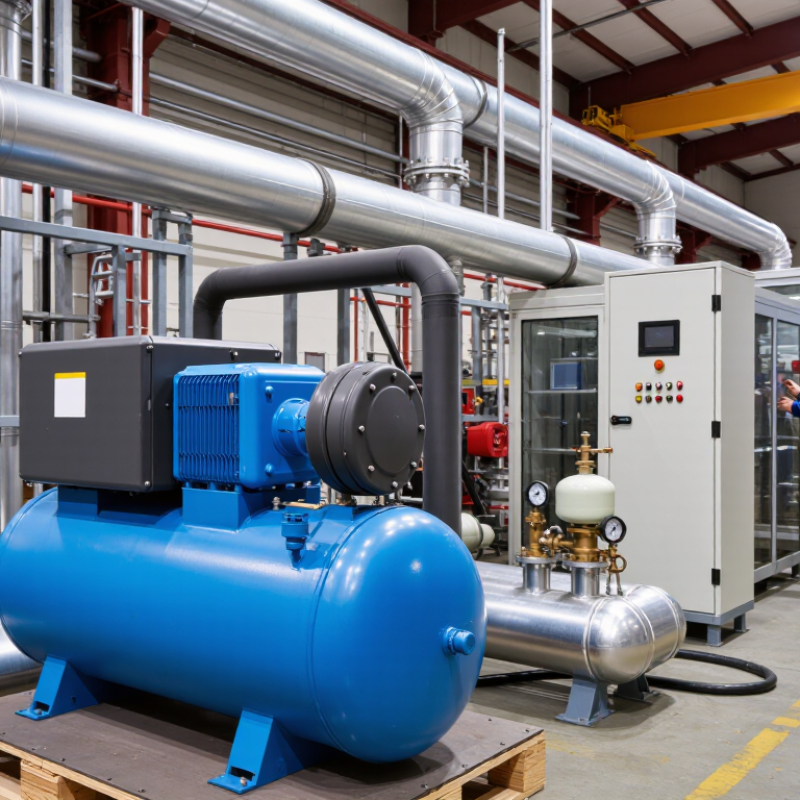
| Basic definition | An industrial air compressor is a machine that converts mechanical energy into compressed-air energy for factory equipment and processes. | The compressor draws in atmospheric air, reduces its volume, and raises its pressure before delivering it to a receiver or distribution system. |
| Common factory operating pressure | 7–10 bar(g), approximately 100–145 psi(g) | This range is widely used for pneumatic tools, automation equipment, assembly lines, packaging machinery, and general plant air systems. |
| Pressure terminology | Pressure is commonly specified as bar(g) or psi(g); atmospheric pressure is about 1.013 bar absolute at sea level. | Gauge pressure excludes atmospheric pressure, while absolute pressure includes it. Correct terminology prevents sizing and control errors. |
| Main compression stages | Intake, compression, cooling, moisture separation, storage, and distribution | Air passes through an intake filter, compression element, aftercooler, separator, receiver, dryer, and point-of-use filtration as required. |
| Common compressor technologies | Rotary screw, reciprocating piston, centrifugal, and rotary vane | Rotary screw machines suit continuous factory demand; piston compressors suit intermittent or smaller loads; centrifugal units suit large, steady flows. |
| Drive configuration | Fixed-speed or variable-speed electric motor drive | Fixed-speed units are effective near a steady load. Variable-speed drives adjust motor speed to better match changing air demand and may reduce unloaded running. |
| Typical flow measurement | m³/min, m³/h, or cubic feet per minute (cfm) | Required flow should be based on the combined demand of connected equipment, expected duty cycle, leakage, and a controlled design margin. |
| Compressed-air quality | Ranges from general-purpose plant air to dry, oil-controlled air for critical processes | Filters, dryers, drains, and suitable compressor construction are selected according to allowable particles, water, oil, and microbial contamination. |
| Air treatment equipment | Aftercooler, water separator, refrigerated or desiccant dryer, coalescing filter, and particulate filter | Treatment removes heat, condensed water, oil aerosols, and particles that could damage tools, products, valves, or control systems. |
| Air receiver function | A pressurized storage vessel installed downstream of the compressor | The receiver dampens pressure fluctuations, supports short demand peaks, helps remove condensate, and reduces frequent compressor cycling. |
| Factory applications | Pneumatic tools, actuator control, material handling, cleaning, packaging, instrumentation, and process air | Compressed air provides a controllable, distributed power source where electric or hydraulic systems may be unsuitable. |
| Energy consumption | Often the largest operating cost over the equipment life cycle | Pressure set points, leakage, intake restriction, poor maintenance, artificial demand, and unloaded operation can significantly increase energy use. |
| Heat generation | A large portion of the motor input energy becomes heat during compression | Cooling systems remove heat from the compressed air and compressor package. In some facilities, recovered heat can support water or space heating. |
| Routine maintenance | Inspect filters, oil level or separator, belts, drains, coolers, hoses, safety devices, and system leaks | Preventive maintenance preserves flow and pressure, protects the compression element, improves reliability, and helps maintain air quality. |
| System design principle | Size the system for actual peak and average demand rather than compressor capacity alone. | A complete design considers pressure drop, pipe diameter, storage, duty cycle, redundancy, air quality, expansion plans, and operating conditions. |