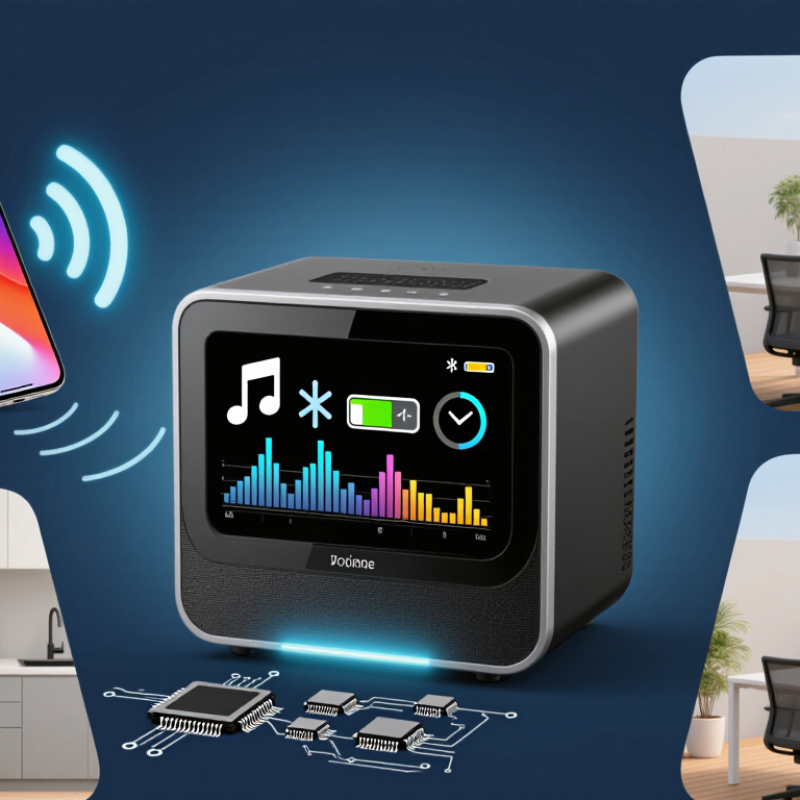
| Definition | A wireless speaker that receives digital audio through Bluetooth and uses a liquid-crystal display (LCD) to show information. | The speaker combines an audio playback system with a small visual interface for status, time, playback, or settings. |
| Primary Audio Source | Bluetooth-enabled phones, tablets, computers, and other compatible source devices. | The source device encodes and transmits audio wirelessly; the speaker receives, decodes, amplifies, and plays it. |
| Bluetooth Function | Wireless pairing, audio streaming, basic playback control, and sometimes hands-free calling. | Bluetooth removes the need for an audio cable between the source device and the speaker, although the exact features depend on the supported profiles. |
| LCD Display | A flat-panel display that may show clock information, volume, track status, input mode, battery level, or alarm settings. | The LCD uses electronically controlled liquid crystals and a backlight or reflective layer to make characters and symbols visible. |
| Audio Conversion | Digital audio is converted into an analog electrical signal before amplification. | A digital-to-analog converter and amplifier prepare the signal to drive the speaker driver. |
| Speaker Driver | Usually one or more compact dynamic drivers, sometimes supported by a passive radiator or bass-reflex enclosure. | The driver converts amplified electrical energy into air movement, producing audible sound. |
| Power Options | Rechargeable battery, USB power, or household AC power, depending on the design. | Battery-powered models provide portability, while AC-powered models are suited to fixed locations such as desks or bedrooms. |
| Typical Battery Range | Approximately 4–20 hours for many portable designs, depending on capacity, volume, display brightness, and features. | Higher volume and brighter or continuously active displays generally consume more energy. |
| Common Auxiliary Inputs | A 3.5 mm analog audio input, USB port, memory-card slot, or broadcast-radio tuner may be included. | These options allow playback from wired sources or local media when Bluetooth is unavailable or unnecessary. |
| Controls | Physical buttons, rotary controls, remote control, or app-based controls may be provided. | Controls can manage volume, pairing, playback, input selection, alarms, and display settings. |
| Hands-Free Calling | Some models include a built-in microphone and support call answering through the speaker. | The microphone captures the user’s voice while the speaker reproduces the incoming call audio. |
| Wireless Range | Often around 10 metres in open indoor conditions, but the actual range varies with Bluetooth class, walls, interference, and device placement. | Obstacles and competing wireless signals can reduce connection stability and operating distance. |
| LCD Visibility | Visibility depends on screen size, viewing angle, contrast, backlight brightness, and ambient light. | A brighter backlight improves readability but can increase power consumption. |
| Common Use Cases | Bedrooms, kitchens, offices, travel, outdoor gatherings, bedside alarms, and compact entertainment systems. | The combination of wireless audio and visible status information makes the device useful for both entertainment and everyday routines. |
| Key Advantages | Cable-free playback, compact design, visible operating information, simple controls, and flexible placement. | It provides more immediate feedback than a speaker without a display while remaining simpler than a full audio system. |