| Primary function | Conducts electric current and supplies carbon to the electrolytic cell | Electrolysis component | The anode is consumed during alumina reduction and directly influences electrical efficiency, carbon consumption, and cell stability. | Confirm compatibility with the buyer's cell technology, anode beam system, and operating amperage. |
| Main carbon raw material | Calcined petroleum coke; some formulations use selected calcined pitch coke | Solid carbon aggregate | Raw-material quality affects electrical resistivity, strength, thermal behavior, and reactivity. | Review particle-size distribution, moisture, sulfur, vanadium, nickel, iron, and ash content. |
| Binder material | Coal-tar pitch, commonly about 13–17% of green anode mass | Carbon binder | The binder provides cohesion during forming and becomes a carbon matrix during baking. | Evaluate pitch softening point, quinoline-insoluble content, coking value, and volatile content. |
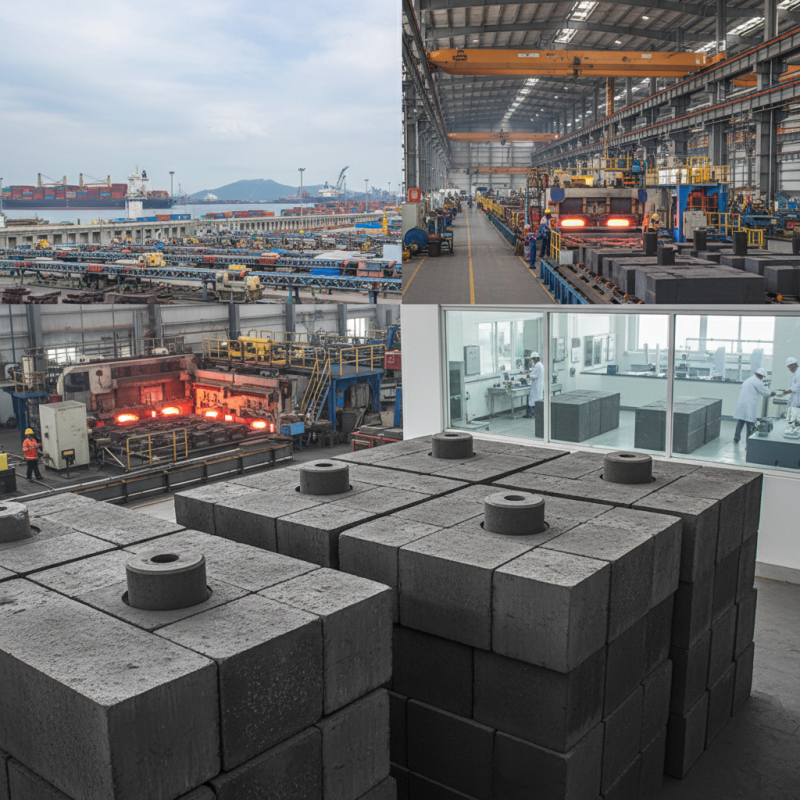
| Manufacturing route | Crushing → screening → batching → mixing → vibrocompaction or pressing → baking → optional rodding | Production process | Process control determines density uniformity, crack resistance, dimensional accuracy, and electrode performance. | Request process-control records, batch traceability, and inspection procedures for each shipment. |
| Final baking temperature | Approximately 1,100–1,250 | °C | Baking converts the pitch binder into solid carbon and establishes the anode's final structural and electrical properties. | Verify temperature uniformity, heating rate, soaking time, and furnace atmosphere control. |
| Apparent density | 1.50–1.65 | g/cm³ | Higher and more uniform density generally supports lower permeability, better mechanical strength, and improved resistance to air and CO₂ attack. | Measure using a documented immersion or equivalent laboratory method; define acceptance limits in the purchase specification. |
| Electrical resistivity | 45–65 | µΩ·m at controlled temperature | Lower resistivity reduces voltage loss and can contribute to lower energy consumption in the reduction cell. | Compare results only when specimen temperature, conditioning, geometry, and test method are consistent. |
| Compressive strength | 25–35 | MPa | Strength helps the anode withstand handling, rodding, thermal stress, and mechanical loading during cell operation. | Specify sample orientation, conditioning, loading rate, and minimum lot-average value. |
| Open porosity | 15–25 | % by volume | Excessive open porosity can increase air and CO₂ access, while very low porosity may indicate processing or impregnation issues. | Assess together with apparent density, permeability, reactivity, and internal crack inspection. |
| Air reactivity | Typically controlled within a plant-specific low-to-moderate range | Mass loss or reaction-rate index | Air attack can create dust, increase carbon loss, and affect anode geometry above the electrolyte. | Use one agreed laboratory procedure and compare results against the buyer's historical operating data. |
| CO₂ reactivity | Typically controlled within a plant-specific low-to-moderate range | Mass loss or reaction-rate index | CO₂ reacts with carbon in the anode and can increase net carbon consumption and dust generation. | Consider residual carbon, baked density, permeability, temperature, and test duration when comparing suppliers. |
| Ash content | Commonly below 0.5 | % by mass | Mineral impurities can increase electrical resistance, contaminate the bath, and influence anode consumption. | Set limits for total ash and relevant trace metals according to the smelter's process requirements. |
| Sulfur content | Often approximately 1–4, depending on petroleum-coke source | % by mass | Sulfur affects anode gas composition, emissions management, and the operating balance of the reduction process. | Review sulfur together with volatile matter, environmental permits, and the smelter's gas-treatment capacity. |
| Dimensional accuracy | Usually controlled to millimetre-level tolerances defined by the cell design | mm | Accurate dimensions support safe installation, correct current distribution, and stable anode-to-cathode distance. | Specify length, width, height, hole position, taper, flatness, and allowable corner or edge damage. |
| Typical anode mass | Approximately 400–1,200 | kg per block | Mass determines handling requirements, crane capacity, rodding configuration, and delivery planning. | Confirm the exact block geometry and mass tolerance for the target potline and anode handling system. |
| Packaging and transport | Bulk or protected palletized shipment with impact and moisture controls | Logistics requirement | Carbon blocks can be damaged by impact, contamination, and uncontrolled moisture during long-distance transport. | Define loading method, stacking limits, moisture protection, inspection at arrival, and claims procedures. |
| Recommended buyer documentation | Certificate of analysis, dimensional report, packing list, traceability record, and safety documentation | Quality assurance | Complete documentation supports customs clearance, incoming inspection, supplier qualification, and process troubleshooting. | Require lot numbers linking test results to production date, raw-material batches, and shipment quantity. |