| Core Technology | Polymer-dispersed liquid crystal film | Liquid-crystal droplets are dispersed in a polymer layer and respond to an applied electrical field. | Provides switchable visual privacy without installing conventional blinds or curtains. |
| Transparent State | Clear or translucent appearance when powered | The electrical field aligns the liquid-crystal molecules, allowing more light to pass through the film. | Maintains visibility, daylight, and an open appearance when privacy is not required. |
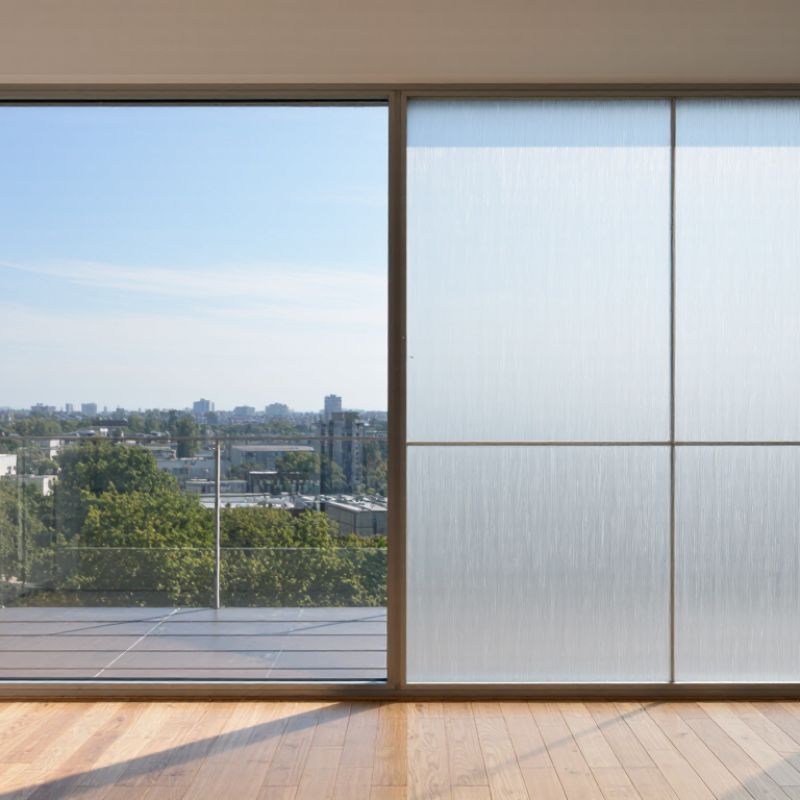
| Privacy State | Frosted or opaque appearance when unpowered | Without the electrical field, the liquid crystals scatter incoming light and reduce direct visibility. | Conceals people, equipment, documents, and activities behind the glass. |
| Switching Speed | Usually less than one second for switching; exact speed varies by construction and temperature | The film changes state when the control system applies or removes voltage. | Allows rapid privacy control for meeting rooms, clinics, bathrooms, display areas, and residential spaces. |
| Electrical Operation | Low-voltage AC operation; commonly supplied through a dedicated transformer or controller | The controller converts building power to the voltage required by the film. | Supports wall switches, remote controls, timers, sensors, and building-automation systems. |
| Energy Use | Power is primarily consumed while the film remains in the transparent state; product ratings commonly fall within a low single-digit to low-teens watts per square metre | In many installations, the privacy state is the default power-off condition. | Can reduce continuous electrical demand compared with technologies that require powered operation in both states. |
| Visible Light Transmission | Typically higher in the clear state and lower in the privacy state; exact values depend on the film and glass assembly | The aligned state transmits more light, while the scattered state diffuses light. | Balances daylight access with visual separation. |
| Ultraviolet Protection | Many PDLC laminated constructions block a substantial portion of ultraviolet radiation; performance depends on the complete glazing system | The film and interlayer materials absorb or reflect part of the UV spectrum. | Helps protect furnishings, artwork, flooring, and interior finishes from UV-related fading. |
| Solar and Heat Control | Limited as a standalone function; PDLC is primarily a privacy technology | Switching from clear to frosted changes scattering, but it does not replace dedicated solar-control glass, shades, or low-emissivity coatings. | Provides privacy while allowing designers to select separate solutions for glare and heat management. |
| Installation Format | Available as laminated glass or as retrofit adhesive film for suitable existing glazing | Factory-laminated products are integrated during glass manufacturing, while retrofit film is applied to a prepared glass surface. | Offers options for new construction, renovation, partitions, doors, windows, and display glazing. |
| Office Applications | Meeting rooms, executive offices, reception areas, and internal partitions | Privacy can be activated for meetings or confidential work and removed afterward. | Improves space flexibility while preserving daylight and a modern glass-partition design. |
| Healthcare Applications | Patient rooms, consultation rooms, treatment areas, and observation spaces | Glass can remain visually open when observation is useful and become private when required. | Supports patient dignity, staff visibility, and easier cleaning than fabric curtains in many settings. |
| Hospitality and Residential Applications | Bathroom glazing, bedroom partitions, shower enclosures, and interior doors | Users can change the glass from transparent to private with a switch or control system. | Combines privacy, natural light, and efficient use of limited interior space. |
| Retail and Display Applications | Storefronts, product displays, exhibition cases, and projection surfaces | The glass can function as a transparent display surface or as a diffused background for projected images. | Enables flexible visual merchandising, presentations, branding content, and display concealment. |
| Cleaning and Maintenance | Clean the exposed surface with a soft cloth and a non-abrasive, low-moisture method; keep electrical edges and connections dry | PDLC film contains electrical layers and should not be saturated, cut, or exposed to abrasive tools. | Routine maintenance is generally simple when installation and electrical sealing are completed correctly. |
| Key Limitation | Not fully transparent like ordinary clear glass, and privacy performance depends on lighting, viewing angle, installation quality, and product design | PDLC reduces direct visibility by scattering light rather than creating a solid wall. | Designers can set realistic expectations and combine PDLC with curtains, blinds, or opaque panels where complete blackout is necessary. |