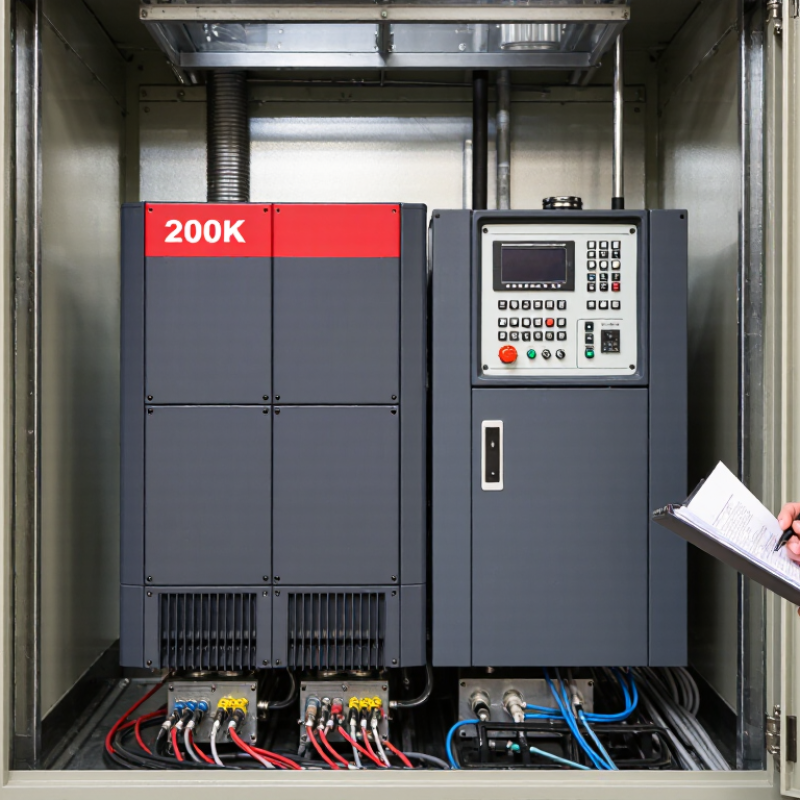
| 1 | Match the motor and supply | Rated voltage, phase, frequency, motor full-load current, and connection arrangement. | Use the motor nameplate and wiring diagram. As an illustration, a 200kW motor on a 400V three-phase supply may draw roughly 350–380A at rated load; confirm the actual nameplate current rather than sizing from kW alone. | Current varies with voltage, efficiency, power factor, and motor design. A mismatch can cause nuisance trips or inadequate starting performance. |
| 2 | Check the starting duty | Load inertia, required starting torque, starts per hour, start duration, and time between starts. | Record the driven equipment and its usual operating sequence—for example, a loaded conveyor may need different starting performance from an unloaded pump. Compare the duty with the starter’s published ratings. | Repeated or prolonged starts create heat in the starter and motor. A kW rating by itself does not establish suitability for every duty. |
| 3 | Assess the installation environment | Ambient temperature, altitude, dust, moisture, corrosive substances, ventilation, and enclosure rating. | Check the site’s maximum temperature and altitude against the manufacturer’s derating instructions. Confirm the enclosure rating fits the actual location; an enclosure rating does not replace suitable cooling or installation practices. | Temperature and altitude can reduce available capacity, while dust and moisture can affect service life and reliability. |
| 4 | Review protection and bypass | Motor overload protection, short-circuit coordination, phase-loss or imbalance protection, and bypass arrangement. | Confirm which protections are built in and which must be provided separately. Where a bypass contactor is used, verify its rating, control sequence, and suitability for the intended operating duty. | Correct coordination helps protect the motor, starter, and supply equipment. A bypass can reduce heat generated by the power electronics during normal running, but does not remove the need for correct protection. |
| 5 | Verify controls and integration | Control voltage, start/stop inputs, fault outputs, communications, interlocks, and restart behavior after a power interruption. | Compare the starter’s control terminals and communication options with the plant control system. Confirm how emergency stops, permissives, alarms, and local isolation will be handled. | Compatible controls simplify commissioning and help ensure the motor starts only when the equipment is in a safe operating state. |
| 6 | Compare support and serviceability | Technical assistance, commissioning guidance, documentation, warranty terms, repair options, and availability of replacement parts. | Ask for written support hours, response arrangements, warranty conditions, and the process for obtaining a repair or replacement unit. Check that manuals and wiring information are available for the selected model. | Clear support arrangements can reduce troubleshooting time and the impact of an unplanned outage. |
| 7 | Calculate total cost of ownership | Purchase price, installation, panel changes, commissioning, cooling, maintenance, spare parts, and expected downtime. | Compare equivalent configurations and include any required bypass contactor, protective devices, enclosure, wiring, and engineering work. Evaluate lifecycle cost using the site’s operating hours and service requirements. | The lowest purchase price may not be the lowest overall cost if installation, operating conditions, support, or downtime differ. |