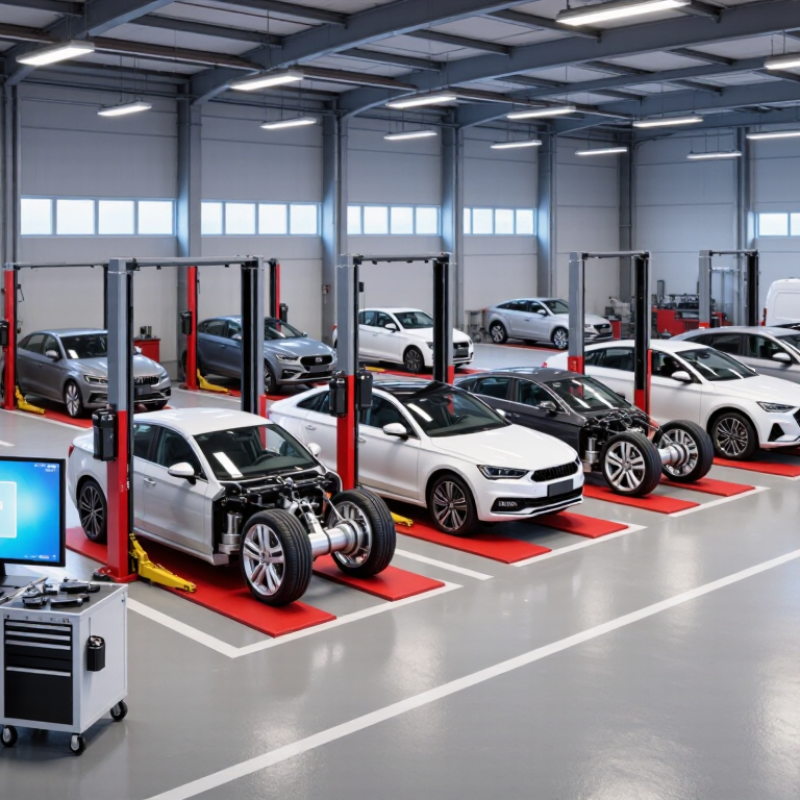
| 1 | Four-Wheel 3D Imaging Aligner | Cameras track targets mounted on the wheels to calculate alignment angles. | Vehicle positioned on an alignment lift; targets are attached to all four wheels. | Measures all four wheels together and can show rear thrust direction alongside front-wheel readings. | General repair shops that perform both front- and four-wheel alignment. |
| 2 | CCD Sensor-Based Aligner | Electronic sensor heads communicate angle measurements between wheel-mounted units. | Sensor heads are clamped to the wheels and connected by cables or wireless links, depending on configuration. | Provides live measurement updates while technicians adjust steering and suspension components. | Shops seeking an established electronic measurement workflow. |
| 3 | Front-Axle Two-Wheel Aligner | Measures front-wheel angles, commonly including toe and camber; caster measurement depends on the system and procedure. | Targets or sensors are fitted to the two front wheels, with the vehicle on turntables. | Concentrates on front-axle measurements rather than providing a complete four-wheel alignment assessment. | Applications where front-wheel alignment is specifically required and rear-axle geometry is not being assessed. |
| 4 | Wireless Sensor Aligner | Wheel-mounted electronic sensors transmit measurement data wirelessly to a console. | Sensor heads are attached to the wheels; the display is positioned near the vehicle. | Reduces cables around the lift area and allows the operator to view readings away from the console. | Busy workshops prioritizing an uncluttered work area. |
| 5 | Drive-Through Imaging Aligner | Fixed cameras read wheel targets as the vehicle passes through the measurement area. | Camera units are installed beside or around a designated drive-through bay. | Can capture a rapid initial alignment check without first mounting conventional sensor heads. | High-throughput inspection lanes and service operations that need quick screening. |
| 6 | Portable Alignment System | Compact electronic sensors or optical targets measure wheel angles and send results to a portable display. | Equipment is transported to a suitable, level work area and set up around the vehicle. | Can be moved between bays or locations instead of remaining permanently installed in one alignment lane. | Mobile service work, smaller facilities, or shops with changing bay layouts. |
| 7 | Runout-Compensation Aligner | Uses a wheel-rolling or wheel-turning procedure to account for wheel and mounting irregularities in measurements. | Wheel targets or sensor heads are mounted; the vehicle is rolled or the wheels are rotated as instructed. | Compensation helps reduce measurement error caused by imperfect wheel or clamp positioning. | Shops seeking repeatable readings, particularly when wheel mounting conditions vary. |
| 8 | Low-Profile Lift Alignment System | Uses camera-based or electronic wheel sensors to measure alignment angles on a compatible lift. | Installed with a lift and turntables suited to vehicles with limited ground clearance. | Pairs alignment measurement with a setup intended to accommodate low-clearance vehicles. | Performance, sports, and other low-profile passenger vehicles, subject to lift capacity and clearance. |
| 9 | Commercial-Vehicle Alignment System | Uses suitable sensors or optical equipment to measure steering and axle geometry on larger vehicles. | Requires a compatible heavy-vehicle bay, lifting equipment, and vehicle-specific measurement data. | Designed around the greater dimensions and axle configurations found on commercial vehicles. | Truck and fleet service facilities; equipment capacity must match the vehicle being serviced. |
| 10 | Alignment System with ADAS Workflow Support | Measures wheel alignment using cameras or electronic sensors; some workflows also interface with separate calibration equipment. | Requires alignment equipment and, when needed, compatible ADAS calibration tools and procedures. | Can help coordinate wheel alignment and driver-assistance sensor calibration workflows; alignment equipment alone does not calibrate every ADAS sensor. | Shops servicing vehicles with driver-assistance systems and following the vehicle maker’s calibration requirements. |