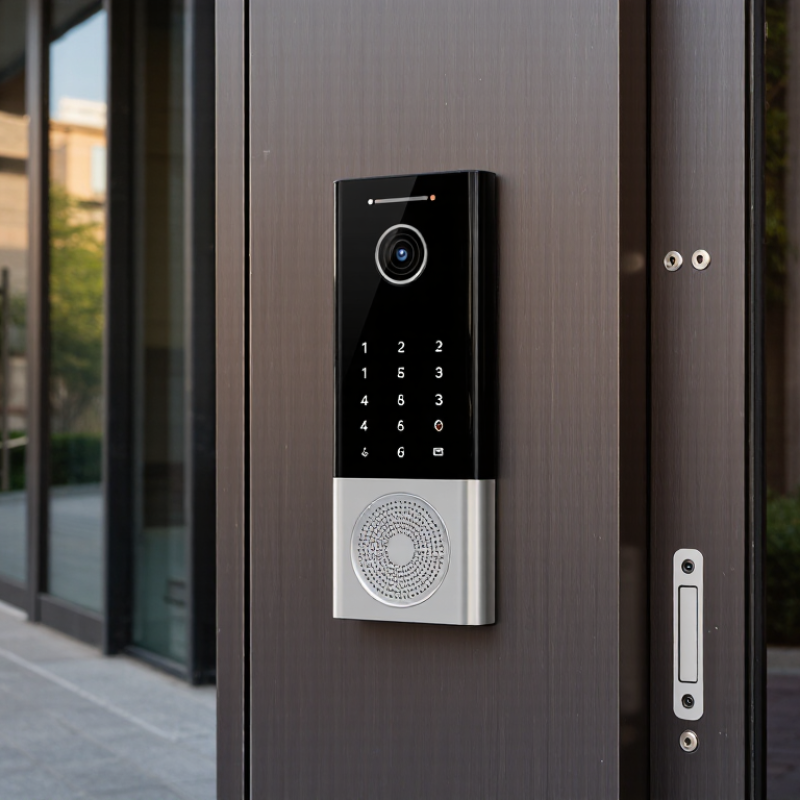
1. Visitor identification
Outdoor camera and call button | The visitor presses the call button. The camera captures video and the system sends a call to an indoor monitor or compatible mobile device. | HD and 1080p cameras are common options; lens viewing angles and low-light performance vary by model. Some stations include infrared illumination. | Check resolution, viewing angle, night visibility, camera placement, and whether the stated performance is supported in the intended lighting conditions. |
2. Keypad credential entry
PIN-based access | A resident or authorized visitor enters a programmed PIN. The controller checks the credential and, if permitted, signals the door-release relay. | Keypads may support individual or shared PINs, schedules, and administrator credentials. PIN length, user capacity, and management features are model-dependent. | Ask about user capacity, PIN reset procedures, temporary access codes, failed-attempt limits, and audit logs where required. |
3. Optional credentials
Cards, fobs, or mobile access | If supported, a reader checks a card, fob, or mobile credential in addition to or instead of a PIN. Reader and credential technologies must be compatible. | Available options may include proximity cards, smart cards, or app-based credentials. Supported frequency, protocol, and encryption differ between systems. | Confirm the exact reader protocol and credential type before ordering; similar-looking cards are not necessarily interchangeable. |
4. Call and two-way communication
Indoor monitor or app | The resident views the visitor and communicates through the system’s microphone and speaker. Depending on the setup, the call can be answered at a monitor or supported mobile app. | Indoor touchscreens commonly range from about 7 to 10 inches. App access, multiple monitors, and call forwarding are optional features on some systems. | Check the number of supported indoor stations, app and network requirements, audio quality, and what functions remain available during an internet outage. |
5. Credential decision
Controller and access rules | The controller compares the entered credential with stored permissions and applies configured rules, such as authorized users or time schedules. | Credential storage, schedules, user limits, and event logging depend on the controller and software. Some systems operate locally; others rely partly on network services. | Determine where credentials are stored, who can administer them, whether events can be exported, and how access continues if a network service is unavailable. |
6. Door release
Relay and electric lock | After an authorized PIN or resident command, a relay changes state to control a compatible electric strike, magnetic lock, or other door hardware. | Relay contact ratings and lock power requirements vary. The lock may require a separate power supply; fail-safe and fail-secure behavior depend on the lock and wiring. | Match relay ratings to the lock, verify the required power supply, and confirm the required egress and emergency-release arrangements with a qualified installer. |
7. Network and power
System connectivity | Wired Ethernet or another supported connection links system components. Power may be supplied by a local adapter or, on compatible devices, Power over Ethernet (PoE). | PoE availability and required standard depend on the equipment. SIP, mobile access, and integration with other systems are compatibility-dependent features. | Request a wiring diagram, supported network and PoE requirements, cable-distance limits, and confirmation of interoperability with existing equipment. |
8. Outdoor installation
Housing and environmental protection | The outdoor station is mounted near the entrance. Its enclosure and installation method help protect the device from the environment. | Some outdoor units are rated IP65 or higher, but ratings and operating-temperature ranges vary. An IP rating applies only under the stated test conditions. | Verify the documented IP rating, temperature range, mounting method, and suitability for the site’s exposure to rain, dust, and direct sunlight. |
9. Recording and event history
Optional evidence and audit trail | Depending on the system, calls, snapshots, or access events may be recorded locally or stored through a supported network service. | Storage may use internal memory, removable media, or a network service. Capacity, retention time, and recording triggers are model- and configuration-dependent. | Confirm storage capacity, retention settings, export options, privacy requirements, and whether any cloud service requires a subscription. |
10. Supplier evaluation
Procurement and support | Buyers compare technical fit, documentation, production consistency, and after-sales support before selecting a system or supplier. | Request a bill of materials, datasheets, wiring diagrams, sample-unit test results, warranty terms, and production lead time. Certifications are product- and market-specific. | Verify model-specific certifications with the issuing body, clarify spare-parts availability and firmware support, and test the complete system with the intended lock and network. |