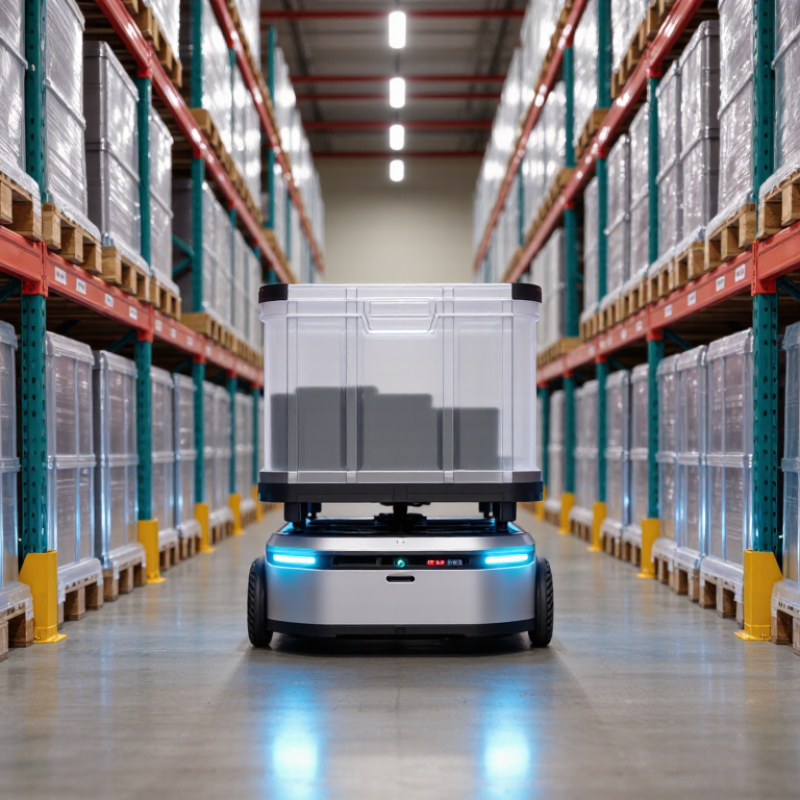
| System definition | Automated tote storage and retrieval system | A tote shuttle is a powered carriage that moves horizontally inside a storage rack to store and retrieve plastic totes, bins, trays, or cartons. |
| Primary movement | Horizontal travel within a rack level | The shuttle travels along rails or a guided track, positioning itself at a storage location and transferring the tote with a load-handling mechanism. |
| Vertical movement | Performed by lifts, elevators, or robotic transfer units | A lift moves totes between levels, while conveyors or transfer devices connect the rack to receiving, picking, packing, and dispatch areas. |
| Typical tote capacity | Commonly about 20–50 kg per tote, depending on system design | The permitted load depends on shuttle construction, tote dimensions, load distribution, rack design, and required acceleration. |
| Tote sizes | Often based on modular footprints such as 600 × 400 mm or 400 × 300 mm | Standardized tote footprints simplify rack design, conveyor integration, barcode identification, and automated handling. |
| Storage density | High-density storage with multiple rack levels and deep lanes | The system uses vertical space and can place totes in dense lanes, reducing unnecessary aisles compared with many conventional shelving layouts. |
| Typical horizontal speed | Approximately 2–4 m/s in many applications | Actual speed varies according to payload, travel distance, safety requirements, acceleration limits, and the selected equipment configuration. |
| Control system | Warehouse control software plus warehouse management system integration | Software assigns storage locations, sequences tote movements, manages inventory records, and coordinates shuttles, lifts, conveyors, and picking stations. |
| Identification methods | Barcode, two-dimensional code, RFID, or sensor-based identification | Identification technologies support tote tracking, inventory accuracy, location confirmation, and exception handling. |
| Basic operating cycle | Receive → identify → store → retrieve → deliver | The shuttle receives a tote, moves it to an assigned location, retrieves it when requested, and delivers it to a workstation or outbound conveyor. |
| Throughput measure | Totes or tote movements per hour | Throughput depends on the number of shuttles, rack levels, travel distances, lift capacity, tote presentation, sequencing, and the proportion of storage versus retrieval tasks. |
| Picking method | Goods-to-person picking | The system brings totes to an operator or robotic picking station, reducing walking and searching time inside the storage area. |
| Inventory rotation | FIFO, LIFO, or rule-based sequencing | Software can apply first-in, first-out rules for dated goods or alternative rules based on order priority, batch, product class, or storage constraints. |
| Main benefits | Space efficiency, reduced travel, consistent handling, and improved traceability | Automation can improve storage utilization and process consistency while reducing manual movement and exposure to repetitive travel tasks. |
| Labor impact | Less walking, lifting, and manual put-away activity | Workers generally focus on induction, picking, replenishment, quality checks, and exception handling rather than traveling through storage aisles. |
| Typical applications | E-commerce, retail distribution, spare parts, pharmaceuticals, and manufacturing | Tote shuttle systems are well suited to high-SKU environments with frequent small-item storage and retrieval requirements. |
| Key design considerations | Demand profile, SKU dimensions, tote standardization, peak throughput, expansion, and maintenance access | A successful design must match equipment capacity and control logic to order patterns, peak periods, product characteristics, safety requirements, and future volume growth. |