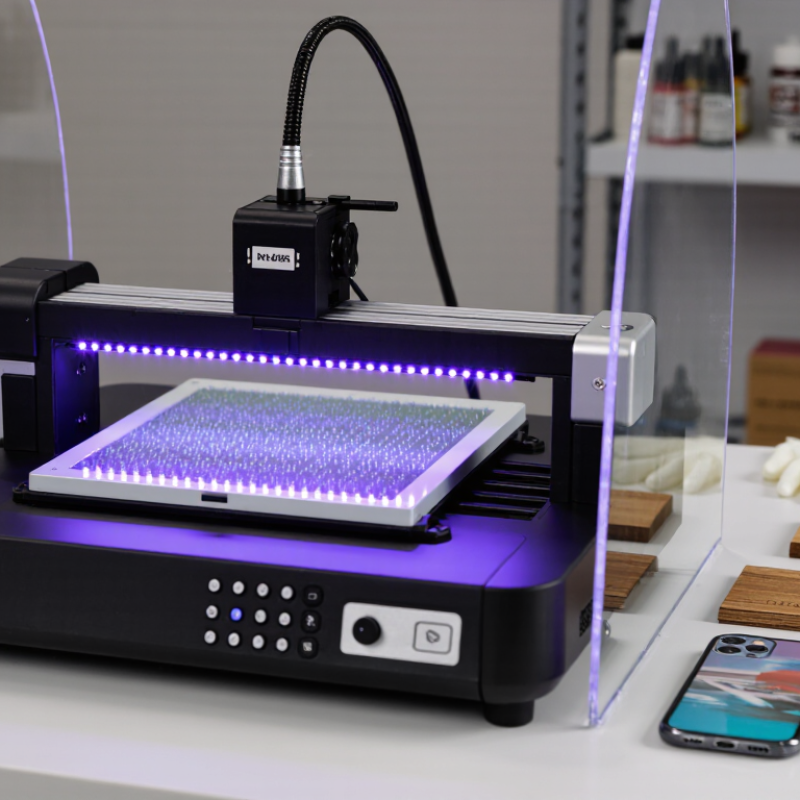
| Printhead technology | Piezoelectric drop-on-demand inkjet | Generates and places individual ink droplets without continuously spraying ink. | Supports accurate text, graphics, and variable droplet placement. |
| Ink droplet volume | Approximately 3–30 picoliters per droplet, depending on printhead and mode | Controls how much ink is deposited in each firing cycle. | Smaller droplets improve fine detail; larger droplets increase coverage and solid density. |
| Nozzle configuration | Multiple linear nozzle arrays; nozzle counts vary widely by printhead model | Places droplets across the print swath as the carriage or substrate moves. | More active nozzles can improve throughput and reduce the number of passes. |
| Print resolution | Common selectable settings: approximately 600–1,440 dpi | Defines the addressable placement density of ink droplets. | Higher settings can improve detail but usually increase processing time and ink usage. |
| UV LED wavelength | Typically about 365–405 nanometers; many systems operate near 395–405 nanometers | Emits ultraviolet energy that initiates curing of UV-reactive ink. | Determines compatibility with the photoinitiator system and affects curing performance. |
| UV curing method | LED exposure immediately after or during ink deposition | Converts liquid ink into a solid polymer film through photochemical curing. | Allows printing on many rigid or flexible materials with minimal drying time. |
| LED thermal output | Lower radiant heat than traditional mercury-vapor UV lamps, though heat management is still required | Provides curing energy while helping limit heat exposure to the substrate. | Can reduce deformation risk on some heat-sensitive materials. |
| CMYK channels | Cyan, Magenta, Yellow, and Black | Builds process colors using halftone dots and controlled ink densities. | Produces the main color gamut for photographic images, graphics, and text. |
| White ink channel | Optional or standard on many UV configurations; commonly used as a spot, underlay, or overprint layer | Creates opacity and a neutral base on dark, transparent, or colored substrates. | Improves color brightness and enables layered effects on non-white media. |
| Varnish channel | Clear UV-curable coating; availability depends on the ink and printer configuration | Adds a transparent gloss, satin, or raised-texture effect to selected areas. | Enhances tactile appearance, contrast, and decorative finishing options. |
| Ink layer order | Common modes include CMYK, White+CMYK, CMYK+White, and CMYK+White+Varnish | Determines how color, opacity, and clear effects are stacked. | Layer order influences color density, visual depth, and substrate appearance. |
| Substrate compatibility | Common examples include acrylic, glass, metal, wood, coated paper, plastics, leather, and selected textiles | Directly deposits and cures ink on the surface or on a suitable coating. | Expands applications beyond conventional absorbent paper printing. |
| Typical small-printer print area | Often from approximately A4 size to A2 size, depending on machine design | Defines the maximum printable width and length for a single job. | Suitable for customized products, signage, samples, packaging, and short-run work. |
| Curing status after printing | Usually touch-dry immediately after adequate UV exposure; full performance depends on formulation and dosage | Stabilizes the printed layer for handling and further processing. | Reduces waiting time compared with water-based ink drying. |