| Basic Function | Melting, injecting, packing, cooling, and ejecting | A machine heats plastic pellets, injects the melt into a mold cavity, allows the part to cool, and removes the finished product. | These coordinated stages convert thermoplastic raw material into repeatable molded parts. |
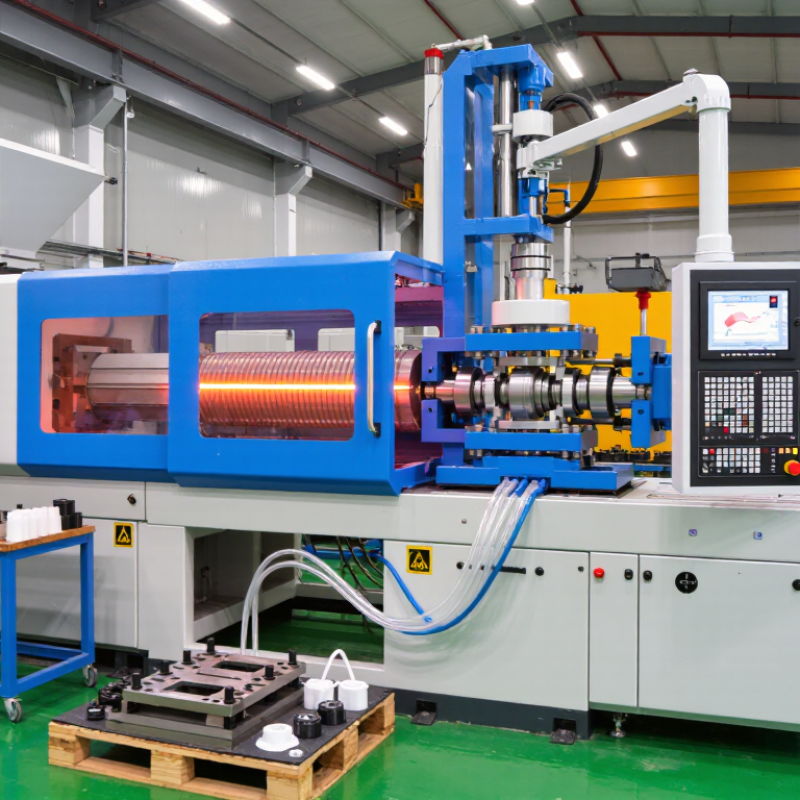
| Main Machine Sections | Injection unit, clamping unit, hydraulic or electric drive, control system, and material hopper | The primary mechanical and control assemblies used during molding. | Each section affects injection accuracy, mold safety, cycle time, and production consistency. |
| Clamping Force | Approximately 20–4,000 metric tons | The force used to keep the mold closed while molten plastic is injected. | Required clamping force depends mainly on projected part area, cavity pressure, and mold design. |
| Injection Pressure | Approximately 700–2,500 bar | The pressure used to push molten plastic through the nozzle, runner system, and mold cavity. | Thin walls, long flow paths, and difficult materials generally require higher injection pressure. |
| Shot Size | Approximately 1–100,000 g of polystyrene equivalent | The maximum amount of material that the injection unit can deliver in one molding cycle. | The selected shot size should normally provide sufficient capacity without operating the machine at its limit. |
| Mold Size Compatibility | Varies by machine; commonly about 150–2,000 mm between tie bars on medium and large machines | The mold must fit within the available tie-bar spacing, platen dimensions, and machine daylight. | Machine selection must consider mold width, height, weight, opening stroke, and ejection requirements. |
| Mold Opening Stroke | Approximately 150–2,000 mm | The distance the moving platen travels to open the mold. | The stroke must be long enough to remove the molded part and accommodate the mold construction. |
| Cycle Time | Approximately 5–120 seconds | The time required to complete injection, packing, cooling, mold opening, ejection, and mold closing. | Small thin-walled parts may have short cycles, while large or thick parts require longer cooling periods. |
| Common Machine Types | Hydraulic, all-electric, hybrid, and vertical injection molding machines | Machines are classified by drive system and physical configuration. | Hydraulic systems provide broad size availability; electric systems offer precise movement and efficient repeatability; vertical machines are useful for inserts and overmolding. |
| Typical Materials | PP, PE, ABS, PS, PC, PA, POM, PET, and thermoplastic elastomers | Common thermoplastics processed by injection molding. | Barrel temperature, screw design, drying requirements, and mold temperature must match the material. |
| Barrel Temperature | Approximately 160–400°C, depending on the polymer | The temperature range used to melt and process the selected thermoplastic. | Actual settings vary by resin grade, screw design, residence time, and required flow behavior. |
| Mold Temperature | Approximately 20–150°C, depending on the material and part requirements | The temperature maintained in the mold during filling and cooling. | Higher mold temperatures can improve surface finish and reduce stress for some engineering polymers. |
| Drive System | Hydraulic pumps, servo-hydraulic systems, electric motors, or a combination | The power system that controls screw rotation, injection, clamping, and platen movement. | The drive technology influences energy consumption, noise, motion accuracy, and maintenance requirements. |
| Automation Options | Part-removal robots, conveyors, dryers, temperature controllers, material loaders, and vision inspection | Auxiliary equipment integrated with the molding cell. | Automation can improve cycle consistency, reduce manual handling, and support continuous production. |
| Typical Applications | Automotive components, medical parts, electrical housings, packaging, appliances, and consumer products | Industries and products manufactured using injection molding. | The required machine size and configuration depend on part dimensions, material, tolerance, surface finish, and production volume. |
| Key Selection Factors | Clamping force, shot size, injection pressure, mold dimensions, cycle time, material, and automation needs | The main technical criteria used to select a suitable machine. | Correct sizing helps prevent flash, incomplete filling, excessive wear, unstable quality, and unnecessary operating costs. |