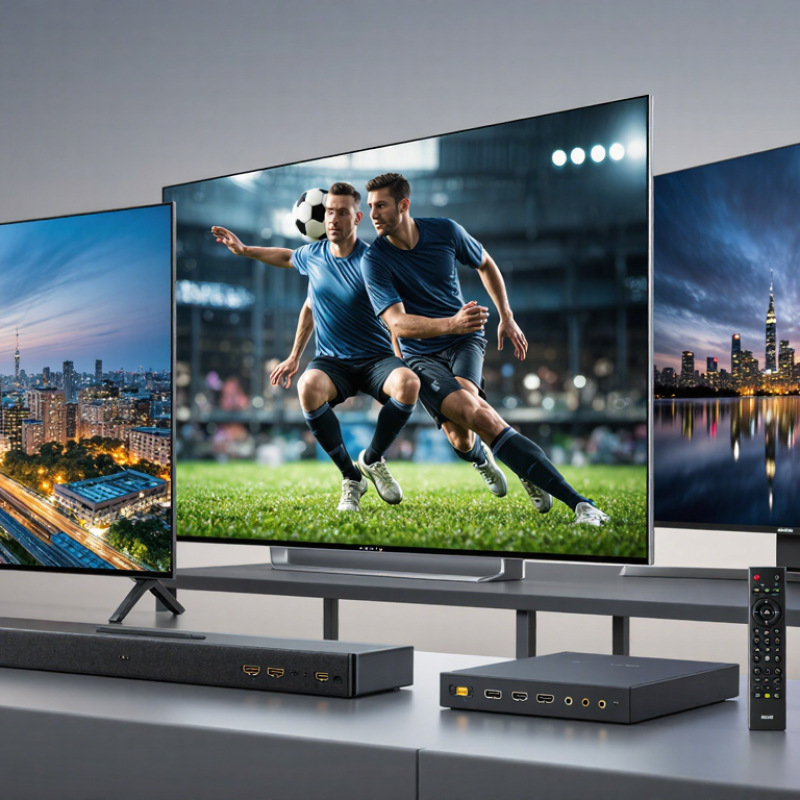
| Flat-screen TV (general) | A thin, flat panel contains a grid of picture elements, or pixels. The display changes the color and brightness of those pixels to form moving images. | Depends on the display technology: the panel may control light from a backlight or produce light at each pixel. | “Flat screen” describes the screen’s shape, not one specific image-making technology. | The display type determines how contrast, brightness, and viewing characteristics are produced. |
| LCD with LED backlighting | Liquid crystals change how much backlight passes through each pixel’s red, green, and blue color filters. | Light-emitting diodes behind or along the edges of the LCD panel provide the backlight. | A widely used flat-panel design; the liquid-crystal layer shapes the light rather than producing it. | Because a backlight is used, dark areas may not appear as completely black as on a self-emissive display. |
| Quantum-dot LCD | It uses an LCD layer to control light, with a quantum-dot layer helping produce more precisely defined colors. | A backlight, commonly blue LEDs, excites quantum dots that emit selected colors of light. | Can provide a wide color range while retaining the basic backlit-LCD image process. | Quantum dots improve color generation; they do not make the LCD pixels self-emissive. |
| Mini-LED LCD | An LCD layer controls the image, while many small LEDs are arranged in local dimming zones behind the panel. | The mini-LEDs provide a controllable backlight; groups of LEDs can be dimmed independently. | More numerous, smaller backlight sources can allow finer local dimming than a basic backlight design. | It remains an LCD technology, so light can still spread between bright and dark areas. |
| OLED | Each pixel contains organic light-emitting elements that produce light when an electric current passes through them. | Pixels are self-emissive, so a separate backlight is not required. | Individual pixels can be switched off, allowing very dark areas and high image contrast. | Static images displayed for long periods can pose a risk of uneven pixel wear over time. |
| Plasma (legacy) | Tiny cells containing gas create ultraviolet light when electrically energized; that light makes phosphors emit visible red, green, or blue light. | Each cell generates light through an electrical discharge and phosphor emission. | Unlike LCD, plasma pixels produce their own light. | Plasma is an older flat-panel technology and is no longer commonly used in new TVs. |