| Electrical conductivity | Approximately 97–102% IACS for high-conductivity copper grades | Allows efficient current transfer and helps reduce resistive power loss in conductive components. | Commercially pure aluminum is approximately 61% IACS; stainless steel is commonly below 5% IACS. | Excellent conductivity |
| Thermal conductivity | Approximately 380–400 W/m·K for high-conductivity copper | Transfers heat rapidly away from electrical contacts, terminals, heat spreaders, and busbars. | Aluminum is typically around 200–235 W/m·K, while many stainless steels are near 15 W/m·K. | Faster heat dissipation |
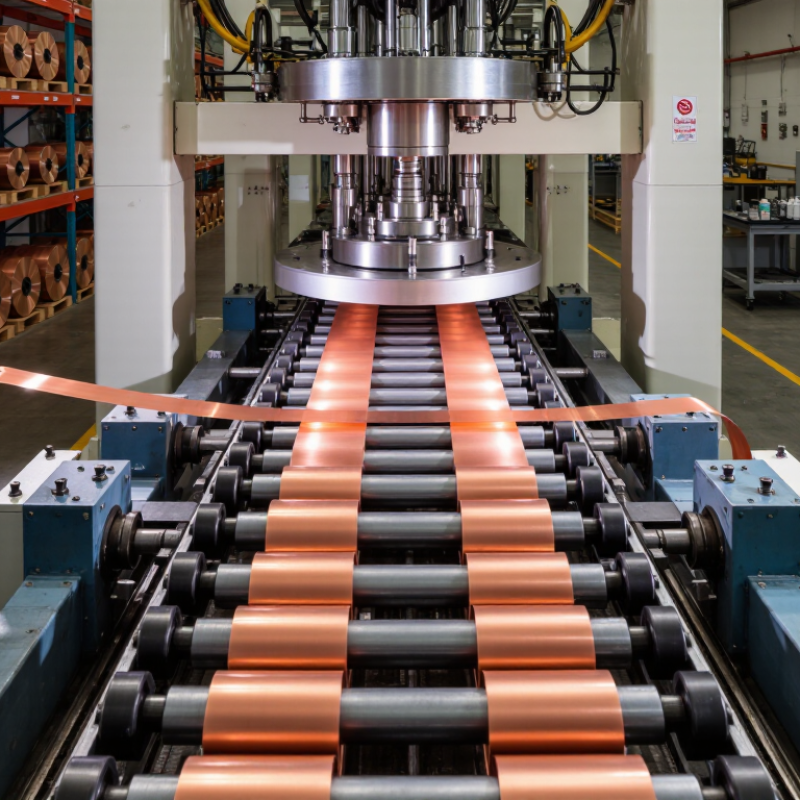
| Production speed | Typical mechanical press operation: approximately 60–600 strokes per minute, depending on the part and die | Progressive and high-speed stamping can produce large quantities with consistent cycle times. | Machining generally requires separate cutting paths and longer cycle times for thin, repeated parts. | High throughput |
| Material thickness range | Common strip and sheet applications: approximately 0.10–3.00 mm | Supports miniature electronic contacts as well as heavier terminals, brackets, shields, and busbar components. | Available thickness depends on alloy temper, press tonnage, die clearance, and required feature detail. | Flexible part design |
| Dimensional repeatability | Typical stamped features may achieve approximately ±0.05–±0.25 mm under controlled conditions | Repeatable dimensions help maintain reliable assembly fit and stable electrical contact performance. | Final tolerance depends on material temper, tooling accuracy, springback, burr control, and inspection method. | Consistent quality |
| Material utilization | Approximately 70–95% in many optimized strip-stamping layouts | Strip nesting and progressive tooling can reduce scrap compared with processes that remove large volumes of material. | Actual utilization varies with blank shape, pitch, carrier design, edge margin, and recycling practices. | Lower material waste |
| Part complexity | One progressive die can combine blanking, piercing, bending, coining, and forming operations | Multiple features can be produced in a single automated sequence, reducing manual handling and secondary operations. | Separate machining, bending, or assembly steps may be required for comparable multi-feature parts. | Integrated processing |
| Surface and edge quality | Clean shear zones are achievable with suitable clearance, sharp tooling, and controlled lubrication | Good tooling practice helps reduce burrs, deformation, and contact-surface defects. | Fineblanking or secondary deburring may be needed when exceptionally smooth edges are specified. | Reduced finishing |
| Suitable applications | Electrical terminals, busbars, connectors, shielding parts, clips, heat spreaders, and precision brackets | These applications benefit from copper’s conductivity, ductility, formability, and heat-transfer capability. | Material selection should also consider strength, corrosion exposure, operating temperature, and contact requirements. | Broad application range |
| Automation potential | High; coil feeding, in-die sensing, automatic inspection, and part collection can be integrated | Automation improves production continuity, traceability, labor efficiency, and process consistency. | Automation level depends on tooling design, part geometry, quality requirements, and production volume. | Scalable production |
| Economic suitability | Most advantageous for medium- to high-volume production after tooling costs are amortized | Per-part cost can decrease substantially as production volume increases and setup time is spread across more parts. | Laser cutting, machining, or manual forming may be more economical for prototypes and very small batches. | Lower unit cost at scale |